About Galba truncatula (O.F.Müller, 1774)
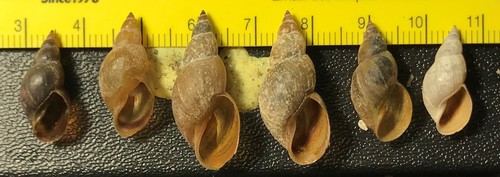
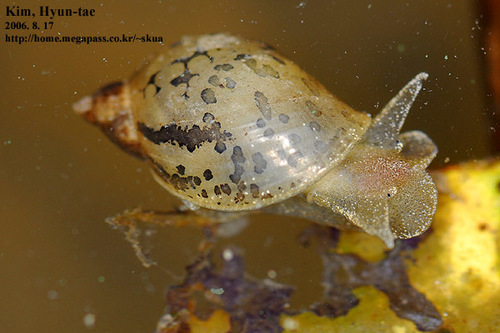
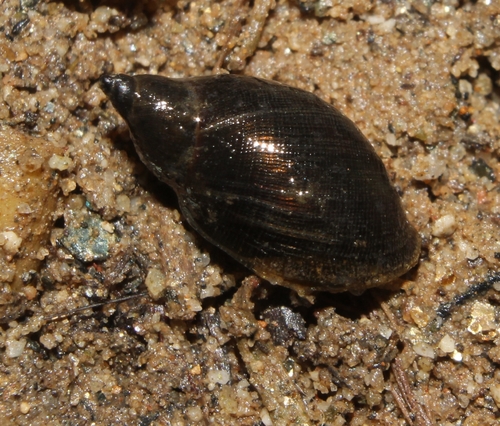
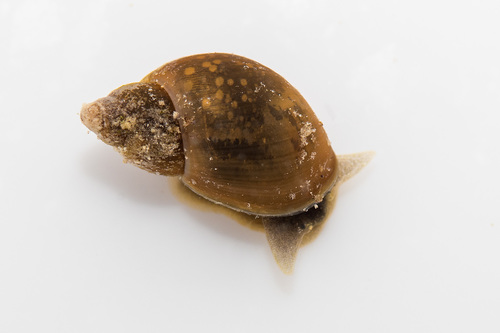
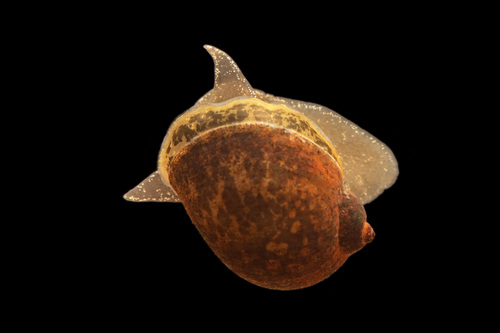
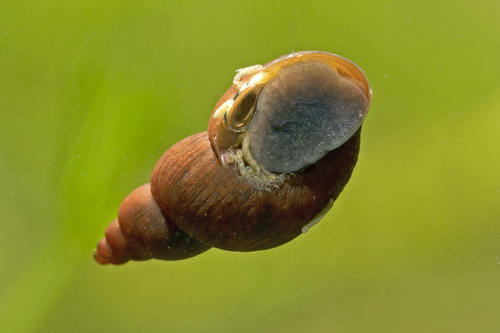
The shell of Galba truncatula measures 5–10 mm in height and 2.5–6 mm in width, with a maximum recorded shell length of 12.00 mm. Its whorls are stepped, and the columella is folded. This species has wider tentacles with broad bases, and small eyes. The roof of the mantle has large, unpigmented whitish spots; through transparency, these spots give the shells of living specimens a pale appearance. In the radula, the first bilateral teeth are tricuspid. The length ratio of praeputium to penis sheath ranges from 2.50–5.90, with a mean of 3.44.
Two other species, Galba neotropica and Galba schirazensis, share very similar morphology with Galba truncatula. While some phenotypic traits may help with preliminary classification of specimens, definitive identification can only be achieved through sequencing at least one of four standard molecular markers: ITS-2, ITS-1, 16S, and cox1. Mixed wild populations of Galba truncatula and Galba schirazensis have already been documented.
Galba truncatula is thought to be native to Europe, and has since been introduced to other regions across the globe. It is currently widespread in all European countries, including most Mediterranean islands such as Corsica, Malta, the Azores, Madeira, the Faroe Islands, the Balearic Islands, and the Canary Islands. Despite its global spread, no detailed exact distribution maps for this species exist. Additionally, most historical reports of the species rely on morphological identification, and molecular confirmation of Galba truncatula presence in non-European areas remains limited.
Confirmed finds of Galba truncatula have been made in North America, South America, multiple regions of Africa, and Asia. In South America, molecular testing has verified its presence in Bolivia, Peru, Argentina, Chile, and Venezuela. In Africa, the species occurs mainly in the northern part of the continent—including Morocco, Algeria, Tunisia, and Egypt—but has also been found in South Africa, Ethiopia, Kenya, and Tanzania. In Asia, it is present in Russia, with very rare confirmed reports from other Asian countries including Iran, Pakistan, and Kashmir.
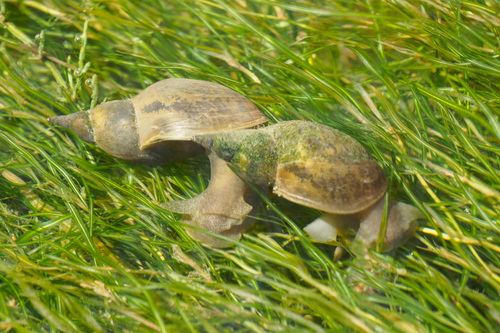
Galba truncatula can live in both temporary and permanent freshwater ecosystems. It is commonly found in shallow, well-aerated water, including marshes, ponds, lakes, streams, rivers, and water ditches. In larger bodies of water, the snail mostly occurs along the edge between water and land, and sometimes lives on mud outside the water layer. Populations of Galba truncatula in France are currently declining, because its natural habitat is threatened by modern agricultural practices.
This species can reach very high population densities and become extremely abundant. It shows clear anthropophily, and is commonly found living near human settlements. Galba truncatula is an amphibious organism that can survive long dry periods by aestivating in mud; in this state, it can survive between 6 weeks and 4.5 months of drought. In laboratory culture experiments conducted in 1949, Kendall observed that Galba truncatula could survive for more than 1 year in water-free Petri dishes. It requires alkaline water, with a preferred pH range between 7.0 and 9.6, and a calcium content above 0.3 mekv/L. The species can survive at very high altitudes, including the Northern Bolivian Altiplano, which sits between 3800 and 4100 m above sea level.
In Europe, Galba truncatula usually has 2 generations per year, and individual snails can live up to 2 years. During unusually wet years, the species may occasionally produce 3 generations in a single year. Galba truncatula hatches from eggs. Egg clusters are rounded to oval in shape, even when they contain multiple eggs. Most clusters hold between 2 and 15 eggs.