About Galaxias truttaceus Valenciennes, 1846
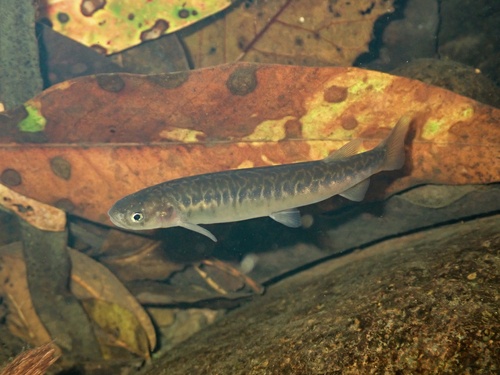
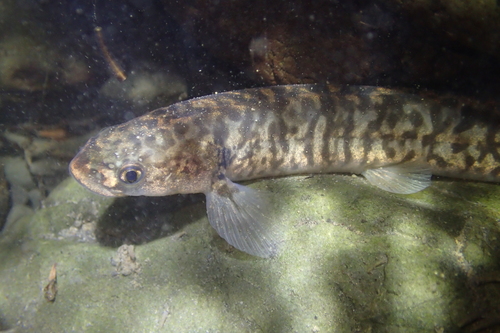
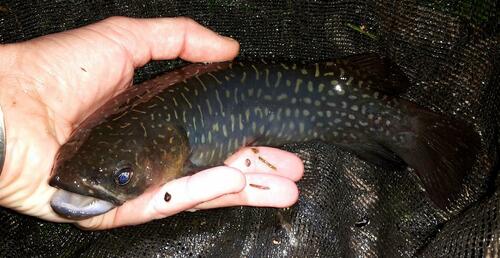
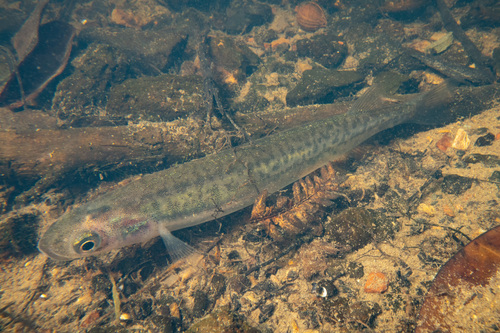
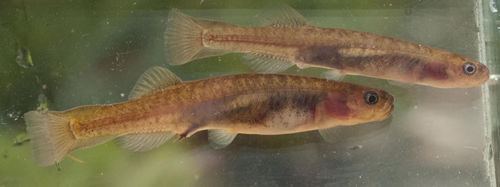
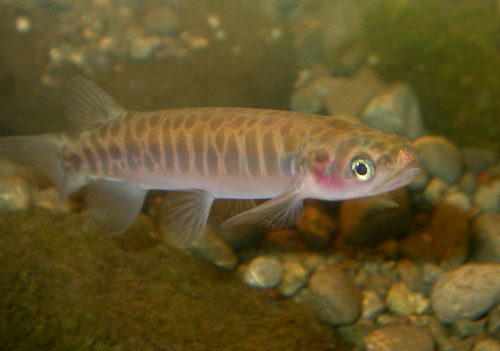
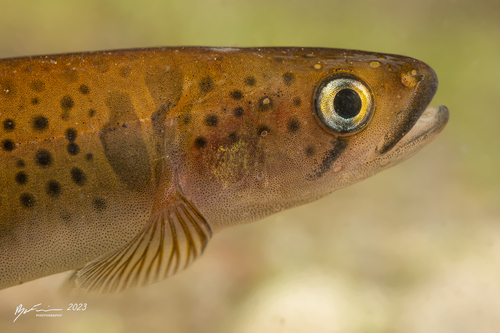
Spotted galaxias (Galaxias truttaceus Valenciennes, 1846) is a moderately large, primarily freshwater galaxias species found in southern Australia. It has a somewhat tubular, deep-bodied shape, with dusky brownish-red colouration marked by dark, haloed spots, bold black edges on the dorsal, anal and pelvic fins, and a dark diagonal stripe through the eye. Spotted galaxias has a very wide distribution across southern Australia. It occurs in southern Victoria, all of Tasmania, the offshore islands located between these two areas, and south-west Western Australia. On the Australian mainland, this species is classed as a freshwater fish with a marine larval phase: larvae are swept out to sea, then return to freshwater habitats as early-stage juveniles. Because of this life cycle, it is only found in coastal rivers on the mainland. In Tasmania, it is also generally found in coastal rivers, though natural landlocked populations exist in some of the island's freshwater lakes. The species was long thought to not be native to the Murray-Darling river system. However, 1850s native fish fauna records compiled by William Blandowski indicate the species occurred there historically. This may lead to a re-evaluation of occasional spotted galaxias specimens found in the Murray-Darling river system, which have so far been assumed to be accidental translocations via the Snowy Mountains Hydro-Electric Scheme. In Western Australia, spotted galaxias is restricted to the Goodga, Angove, and Kent river catchments on the southern coast. All three catchments drain into coastal lakes that only connect to the ocean during winter in wet years. Juvenile and adult spotted galaxias live in low to medium altitude coastal rivers. They prefer cool, flowing rivers in forested catchments with healthy riparian vegetation, good water quality, and cover from boulders, sunken logs, and overhanging banks. Spotted galaxias is a predatory fish that feeds in moving currents or drift, similar to non-native trout species. Its diet consists mainly of aquatic and terrestrial invertebrates. For most populations, spawning takes place in winter in rivers. Larvae are swept out to sea, before returning and migrating back up rivers as early-stage juveniles that initially do not look like adult fish. Returning early juveniles are sometimes caught by humans as whitebait, and were severely overfished in past decades. Landlocked lake populations spawn in spring. Before non-native trout species were introduced to Australia — an introduction that created major conservation problems for Australian native fish — spotted galaxias was actively fished by early Australian anglers using fly-fishing gear. Anglers valued the species for its beauty, its willingness to take both wet and dry flies, its strong fighting ability on very light tackle, and its relatively large size for a galaxias: it sometimes reaches 30 cm, and commonly grows to 20 cm. Average body size of spotted galaxias appears to have been larger before non-native trout were introduced. A small number of fly-fishers in Australia are now rediscovering the experience of fly-fishing for this striking native fish using ultra-light fly-fishing tackle. As noted earlier, early-stage juveniles returning to estuaries were, and sometimes still are, netted as whitebait for human consumption. Thanks to its attractive appearance, spotted galaxias has potential as an aquarium fish, though it requires cool water to survive.