About Galaxias olidus Günther, 1866
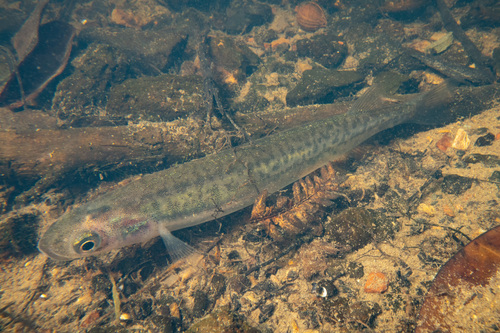
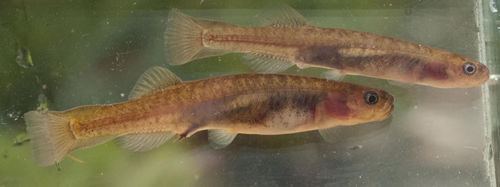
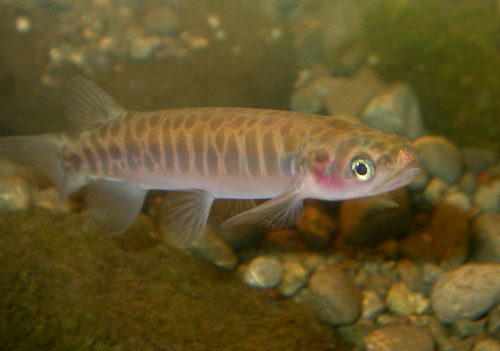
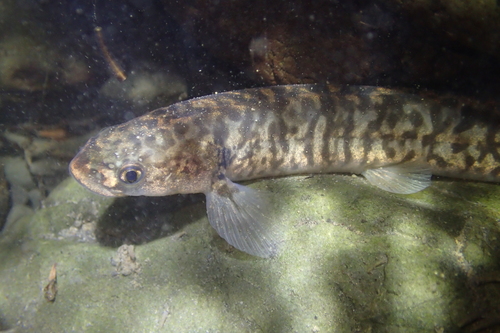
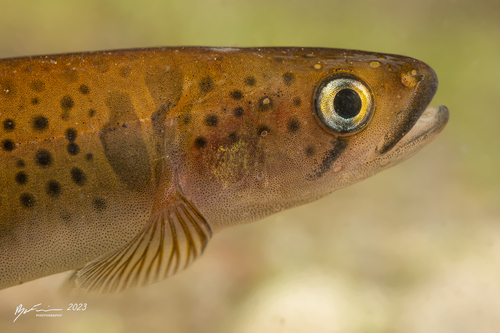
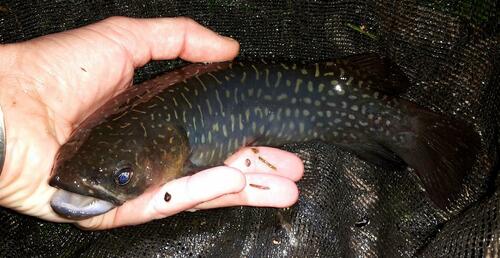
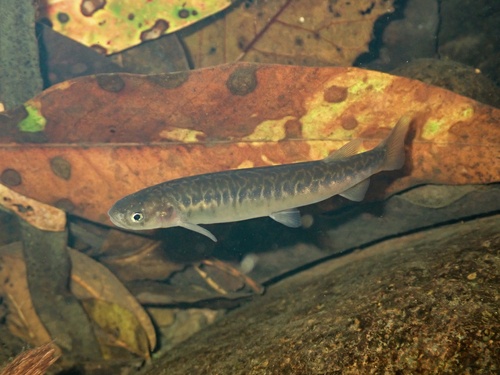
Like other members of its species complex, Galaxias olidus has a broader range of physical characteristics than other members of the group. This fish has a long tubular body, most commonly measuring 55–80 millimetres (2.2–3.1 in), and reaching up to 126 millimetres (5.0 in) in length. The upper and lower surfaces of the body are gently and evenly curved, while the upper surface is partially flattened before the pelvic fins. Its head is medium-sized, noticeably wider than it is deep, and slightly wedge-shaped when viewed from the side. It has a medium-length mouth: the tip of the upper lip is usually level with the middle of the eye, and the mouth extends down and back toward the belly to a point roughly even with the middle of the eye. Mountain galaxias (Galaxias olidus) show very high variation in base body color and markings across their entire range, although variation is much lower within individual populations. Most individuals have a body colored tan, light brown to brown, or olive, and occasionally orange-brown. This base color covers the head and snout, lightens below the lateral line, and becomes cream or sometimes nearly white on the belly. The base color is overlaid by an extremely variable pattern of dark markings including spots, blotches, and bands that sometimes merge to form irregular vertical bands. This pattern may be pale or absent in some populations and individuals; in addition, the body may be shaded by many tiny grey spots. A series of closely spaced, oval to almost circular very dark bars often runs along the sides of the body. These markings may be pale or absent in some populations, but when present, they are always more numerous, thinner, closer together, and more variable in shape than those of Galaxias fuscus, and generally extend further back along the body to at least as far as the anal fin. All fins have fleshy bases, with paired fins being less fleshy. Pectoral fins are medium-sized and paddle-shaped, set low on the body. Pelvic fins are also positioned low on the body, located at roughly the midpoint of the body. The anal fin is medium-sized, and the dorsal fin base is approximately 90 percent the length of the anal fin base. The caudal (tail) fin is medium-length, with well-developed flanges that commonly extend forward as far as the anal fin. Galaxias olidus occupies a vast geographic range on both sides of the Great Dividing Range, extending from southern Queensland south through eastern New South Wales, across most of Victoria, and further west to the Adelaide Hills in South Australia. It is found in both the Murray-Darling basin and in eastern and southern coastal drainages. It is not clear how much of its coastal distribution comes from natural river capture events (though most of it does) versus how much may result from migration, since many members of this species complex can climb over natural barriers using modified pelvic fin structures. Within the Murray-Darling system, mountain galaxias follows the group's pattern of habitat specialization, with this species generally found in upland habitats and flathead galaxias found in lowland habitats. However, G. olidus does stray down to the upland-lowland transition zone in some rivers, particularly in South Australia. Many other members of the mountain galaxias species complex have ranges limited to the upper reaches of their respective drainages. This species occurs in a wide variety of freshwater habitats across low to high elevations. Typical habitats include slow to moderately flowing, clear to turbid, medium to large rivers 4–20 metres (13–66 ft) wide, as well as moderate to fast flowing small to medium creeks around 0.5–5 metres (1.6–16.4 ft) wide. Mountain galaxias are also found in some low-elevation wetlands, billabongs, and on-stream farm dams throughout Victoria and central to northern New South Wales, as well as in some upland lakes and remnant pools in drying watercourses. This fish is generally found in shallow riffle zones or medium-depth runs, especially in areas that also host predators, or in deeper pools around 0.3–1.2 metres (0.98–3.94 ft) deep. It mostly occurs near the stream bed or shelters among thick macrophytes, rocks, woody debris, or undercut banks. It is occasionally found in mid-stream, but usually only in areas without predators. At high elevations along the Great Dividing Range, G. olidus lives in streams that are covered by snow for varying lengths of time during winter. Especially in Victoria and southern New South Wales in areas above the snow line, mountain galaxias inhabit streams that freeze over and remain snow covered for two to three months each winter. Galaxias olidus is confined to freshwater for its entire lifecycle, with no downstream migration to the sea or estuarine brackish waters. In the upper reaches of some streams, it may be the only fish species present, but at lower elevations it is often found alongside a wide variety of other fish and crustaceans including freshwater shrimp, prawns, and crayfish. Spawning timing for Galaxias olidus varies across its range: it occurs from early May to June in South Australia, from May to August in Victoria and the far south of New South Wales, and as late as August to October in northern New South Wales and southern Queensland.