About Galaxias fasciatus Gray, 1842
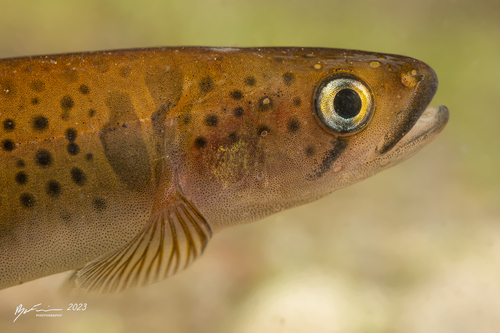
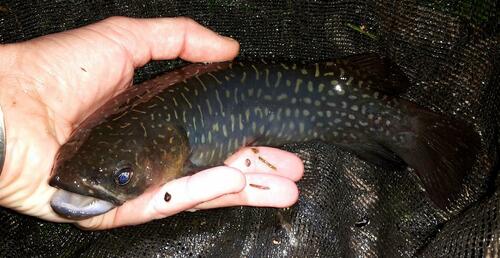
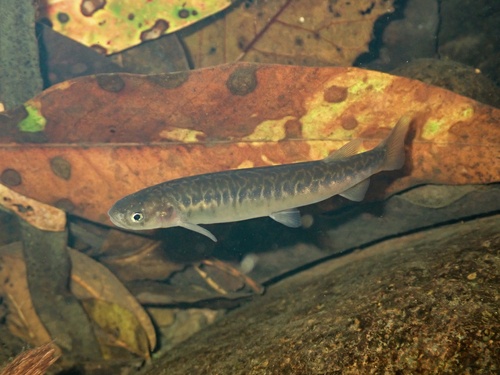
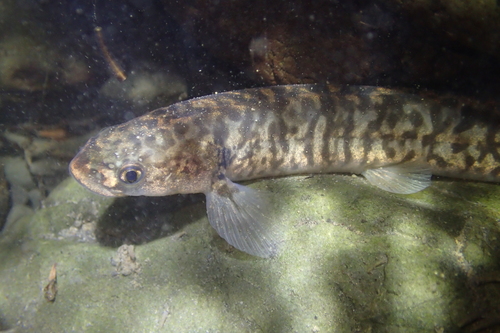
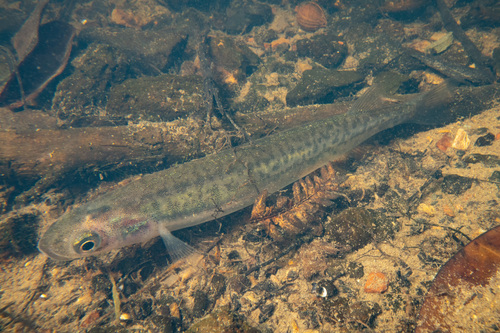
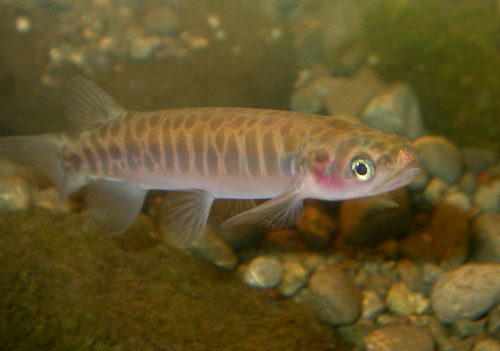
Banded kōkopu (scientific name Galaxias fasciatus Gray, 1842) are stout-bodied fish with large heads and mouths. Their bodies are strong, rounded, and fleshy. Like other galaxiids, their dorsal and anal fins are positioned close to their short, square-shaped tail fin. The caudal peduncle is short and deep, with thick fleshy flanges that connect to the tail fin. Adult banded kōkopu are usually a dark earthy brown or olive brown, with pale yellow vertical bands running along their bodies. The belly is light-colored and has no patterning. There is a silver or white mark behind the operculum and above the pectoral fin; sometimes a darker mark occurs just behind this pale mark. The body bands either fade out at the top and bottom of the body, or fork and crisscross across the fish’s back. In small juvenile banded kōkopu, the bands are usually numerous and run along the entire body. In adults, the bands become narrower and are often restricted to the rear third of the body. Although band shape and placement change as the fish ages, these traits remain consistent enough to be used for individual identification of banded kōkopu over several years. Medium and juvenile giant kōkopu can sometimes be mistaken for banded kōkopu, because giant kōkopu can also develop vertical stripes. The clearest way to tell the two species apart is that banded kōkopu have a white or silver mark immediately behind the operculum, above the pectoral fin, while giant kōkopu do not have this mark. Additionally, the body markings of banded kōkopu either fork and spread across the fish’s back, or fade out at the top and bottom, while markings on giant kōkopu never fork and have a crisp edge all the way around. Juvenile shortjaw kōkopu may also be mistaken for very pale, poorly marked banded kōkopu, but the small mouth of the shortjaw kōkopu is a definitive identifying trait. Banded kōkopu are found only in New Zealand, and only a small number of their spawning sites are known. In 2018, a new spawning site was discovered in a tributary of York Stream, Nelson, where fish habitat and passage restoration had been carried out as part of Project Maitai. In the Nelson region, banded kōkopu live in creeks and tributaries on lowland coastal flats, and can move inland to take shelter in pools or undercut banks in tributaries that have overhanging vegetation. Banded kōkopu are diadromous, meaning they spend the first 3 to 4 months of life at sea, before migrating back to freshwater as 40–45 mm (1.6–1.8 in) long whitebait. Banded kōkopu reach sexual maturity at two or three years old. They spawn in their adult habitats during flood events in autumn and early winter, laying eggs 2 mm (0.079 in) in diameter among flooded vegetation and leaf litter on the edge of the stream. As the flood recedes, the eggs are left to develop out of the water; the high humidity provided by the surrounding vegetation keeps the eggs moist. After three to four weeks the embryos are fully developed, and require a second flood to stimulate hatching. Once hatched, larvae are carried out to sea by the floodwaters. They live among plankton for 3–4 months before returning to freshwater. Juvenile banded kōkopu can detect and are attracted to odors produced by adult banded kōkopu. This suggests that during their migratory phase, juveniles can discriminate species-specific pheromones, which alert them to suitable habitat when adults are already present. Banded kōkopu can live for at least nine years, and possibly longer, and spawn multiple times over the course of their lifetime.