About Galaxea fascicularis (Linnaeus, 1767)
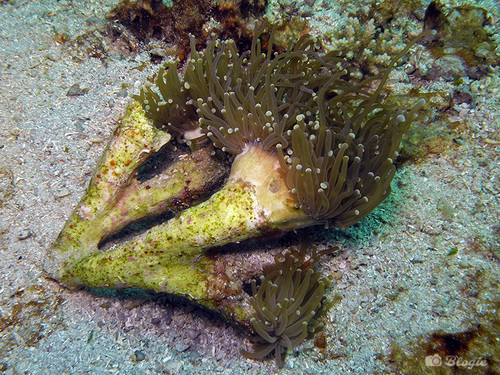
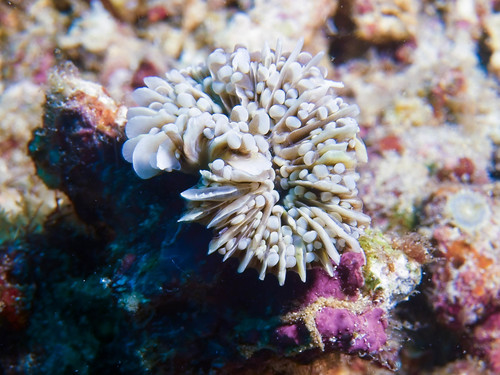
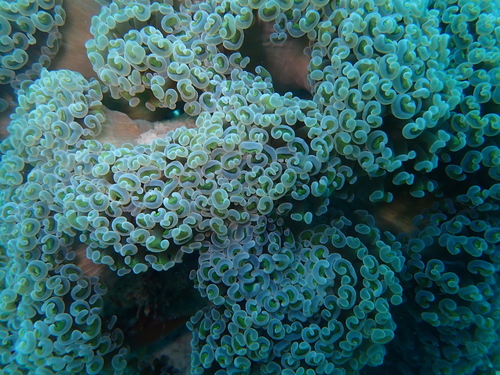
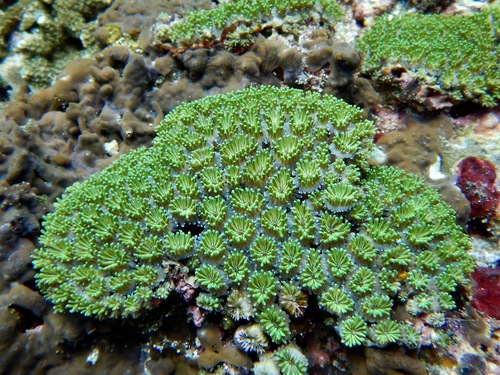
Small colonies of Galaxea fascicularis often form low domes. As colonies grow, they become more irregular, growing into massive hummocky or columnar shapes, and can eventually reach 5 metres (16 ft) across. Corals of this species are the calcareous skeletons formed by their polyps, and at least part of the shape variability in these skeletons comes from the boring activities of horse mussels of the genus Lithophaga. Individual polyps are embedded in circular, tube-shaped corallites made of limy material extruded by the polyps, and these corallites are less than 1 centimetre (0.39 in) across. The inside of each corallite is lined with many ridge-like septa that radiate out from the center. Polyps of Galaxea fascicularis often feed during the daytime, and when their tentacles are extended, the coral’s underlying skeleton is hidden from view. The general colour of the coral ranges from green and grey to reddish brown. The tentacles are often a contrasting colour and usually have white tips. A small number of the tentacles are modified into sweeper tentacles, which can extend to 30 centimetres (12 in) in length and function to stop other organisms from settling close to the coral. The size and spacing of corallites vary depending on how much light hits the coral, and this variation can even occur across different areas of the same colony. In brighter locations, small, closely packed corallites maximize the photosynthetic potential of the symbiotic zooxanthellae that live within the coral. In lower light locations, corallites are larger, and polyps have longer tentacles that are better able to capture food. Galaxea fascicularis is distributed across the Red Sea, the Gulf of Aden, and large areas of the Indo-Pacific. It grows on coral reef slopes, especially where wave action is weak, and it occurs at depths between 2 metres (6 ft 7 in) and 15 metres (49 ft). This species, commonly called galaxy coral, is widely available for use in home reef aquaria. Its skeleton is fragile, so it must be handled carefully. Aquarium tank temperature needs to be maintained between 23 and 27 °C (73 and 81 °F). This coral needs to be placed in a well-lit area with low or moderate water flow. It should not be placed within 30 centimetres (12 in) of any other coral or sessile invertebrate, because it uses its sweeper tentacles to sting intruders and defend its territory. Cultivated specimens can be propagated by sawing the skeleton into sections and suspending the pieces on threads. This coral can be conveniently fed using nauplius larvae of the brine shrimp Artemia salina. These larvae are commercially available for live feeding as cysts that hatch within 24 hours, or as a dead, pasteurized product called "Instant baby brine shrimp" (IBBS) that has a long shelf life. The nutritional value of these larvae can be improved by feeding them special lipid concentrates or other products that accumulate in their tissues. IBBS can also be enriched with probiotics this way, or used as a carrier for specific antibiotics to treat coral diseases.