About Galactia regularis (L.) Britton, Sterns & Poggenb.
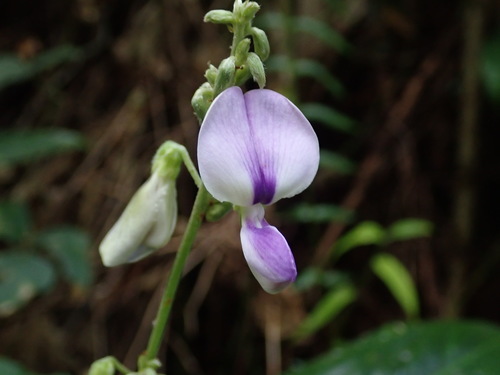
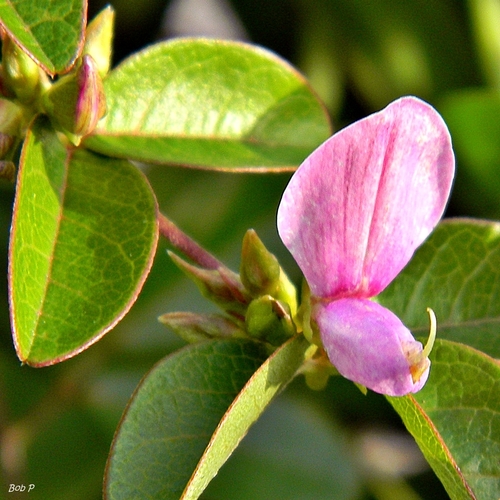
Galactia regularis (L.) Britton, Sterns & Poggenb. is an erect or climbing bine with hirsute to villous stems that bear deflexed hairs. It is most commonly found in dry forests, and is widespread across the eastern United States. Its leaves are palmately compound, made up of three elliptic leaflets that are roughly 5 to 25 mm wide. The leaflets are widest at their midpoint, have a thick texture, and do not have glaucous undersides. Within its native range, this species can easily be confused with related genera including Desmodium and Strophostyles. Its chasmogamous flowers grow in groups of 1 to 16 per 10 to 280 mm long peduncle, and can be white, pink, red, or purple. Across its entire range, Galactia regularis blooms from July to September, and produces fruits from August to October. This plant is eaten by bobwhite quail, and acts as a host for the subspecies Automeris io io. Its flowers are visited by Megachile brimleyi, the white-footed leaf-cutter bee, the golden sweat bee, and the common little leaf-cutter bee. As a legume, it maintains a symbiotic relationship with nitrogen-fixing Rhizobia bacteria. Though the species has overall secure status, it is considered relatively uncommon or potentially threatened in some US states; this may be partially caused by the spread of the introduced species Galactia officinalis. Galactia regularis is described as "gap-dependent": it is adapted to benefit from fires in forests or shrublands, taking advantage of the new gaps created in canopy cover.