About Gaillardia aristata Pursh
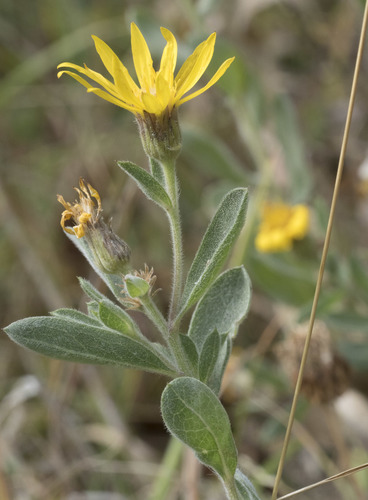
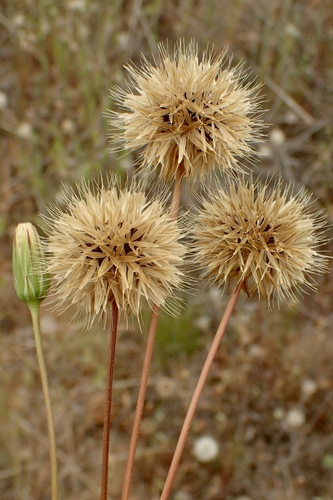
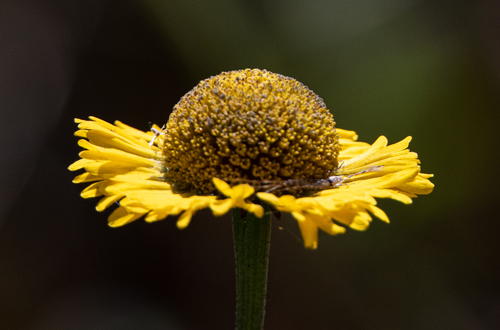
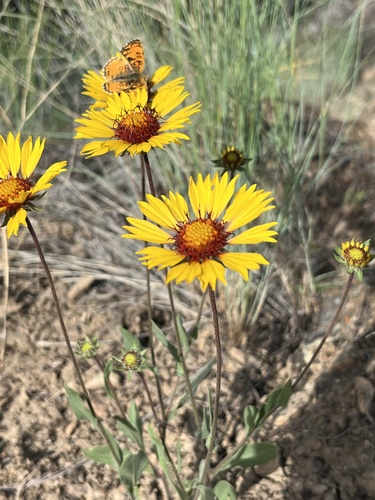
Gaillardia aristata Pursh, commonly called blanketflower, is a perennial herb that grows to a maximum height of 20 to 80 cm (7.9 to 31.5 in). It forms a slender taproot and one or a few stems. Its leaves are typically arranged to extend halfway up each stem, though they may grow only at the plant's base. Leaves range in shape from obolanceolate to lanceolate, measure 5 to 15 cm (2.0 to 5.9 inches) long, and have sparse to dense hair covering. Leaf margins can be lobed, toothed, or smooth and unbroken. The involucre of Gaillardia aristata measures 10 to 20 mm (0.39 to 0.79 in) tall, and is much larger than the involucres of other species in the Gaillardia genus. The phyllaries on the involucre are 9 to 11 mm (0.35 to 0.43 in) long, ovate in shape, and covered in bristles. G. aristata typically flowers between July and August, and may produce a second bloom between September and November. Each flower head holds two types of florets: ray florets along the head margin, and disc florets in the center. Between 6 and 33 ray florets have been recorded per head, though most flowers produce 12 to 18. Ray florets are usually flat, three-lobed, and yellow, but may also be five-lobed and tubular, and/or partially purple. They measure 10 to 35 mm (0.39 to 1.38 in) long. The center of the flower head holds 60 to 120 fertile disc florets. Their corollas are 7 to 9 mm (0.28 to 0.35 in) long, densely hairy, and often maroon, though they may have yellow tips. The fruit is a stout, hairy achene that can reach over 10 mm (0.4 in) long when including its long, spiky pappus. These achenes, the plant's seeds, are the only method of reproduction for G. aristata, and are dispersed by gravity or potentially caught on animal fur for dispersal. The genus Gaillardia originated in the Chihuahuan desert, and Gaillardia aristata moved northward following the uplift of the Rocky Mountains. Blanketflower is native to the Rocky Mountains and the upper Great Plains, where it occurs naturally in Alberta, Arizona, British Columbia, Colorado, Idaho, Manitoba, Montana, North Dakota, Oregon, South Dakota, Saskatchewan, Utah, Washington, and Wyoming. It is an introduced species in California, Connecticut, Illinois, Massachusetts, Michigan, New Hampshire, New York, Northwest Territories, Ontario, Quebec, Wisconsin, and Yukon. It has also been reported across much of Europe, as well as in Australia, Argentina, China, India, Mozambique, South Africa, and South Korea, and is classified as invasive in Hungary and Russia. G. aristata grows in a wide range of habitats, including prairies, sagebrush grasslands, and coniferous forests. It is typically found on coarse, well-drained, loamy to sandy soils at elevations between 50 and 2,900 metres (160 and 9,510 ft). It is tolerant of drought and moderately tolerant of salinity. Blanketflower is a fire-dependent, early- to mid-successional species. In addition to tolerating fire, it can survive grazing and mechanical disturbance. The leaves and flowers of blanketflower are eaten by domestic sheep, and may form part of the diets of bighorn sheep, mule deer, desert cottontail, and Richardson's ground squirrel. Gaillardia aristata is mainly pollinated by bees, including bumblebees, leafcutter bees, and sweat bees. Butterflies, wasps, and the soft-winged flower beetle also act as pollinators, and all feed on the plant's nectar. G. aristata serves as the host plant for Schinia masoni, a species of flower moth. S. masoni has maroon and yellow coloration that lets it blend into G. aristata flowers while feeding and resting. S. masoni lays its eggs between the plant's disc flowers, and its larvae feed on the blanketflower's seeds. Blanketflower seeds are also eaten by deer mice. Several Plateau Indian tribes used blanketflower to treat wounds and reduce fevers. The Okanagan and Colville peoples used it to treat backaches, kidney problems, and venereal disease, while Nlaka'pamux people used it to treat headaches, mumps, and tuberculosis. Blackfeet people used G. aristata to treat gastroenteritis, sunstroke, and skin disorders. The plant was also used to treat saddle sores on horses, and to make rawhide waterproof. Gaillardia aristata is a widely cultivated ornamental plant, grown as a perennial flower for gardens. It tolerates full sun to partial shade, and grows in USDA Hardiness Zones 2 and above. Notable cultivars include 'Amber Wheels' and 'Maxima Aurea,' which produce fully yellow flower heads, and the Sunrita series. Most commercially available cultivars are hybrids between G. aristata and the closely related G. pulchella. These short-lived perennials are classified as Gaillardia x grandiflora Van Houtte, flower from June through September, and typically tolerate USDA zones 3 to 10. Common cultivars of this hybrid include the Arizona series, 'Burgundy,' 'Goblin,' 'Oranges and Lemons,' and the Sunset series.