About Gahnia grandis (Labill.) S.T.Blake
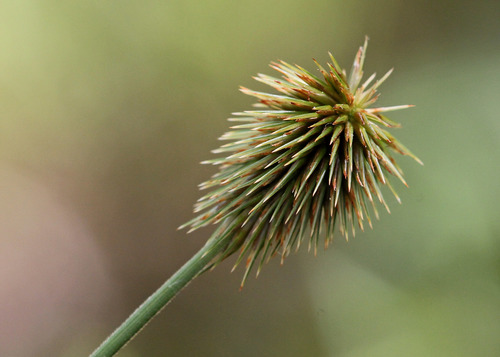
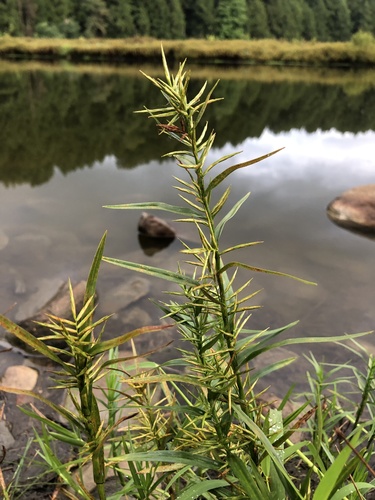
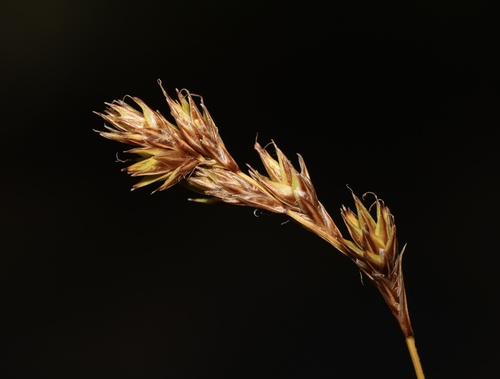
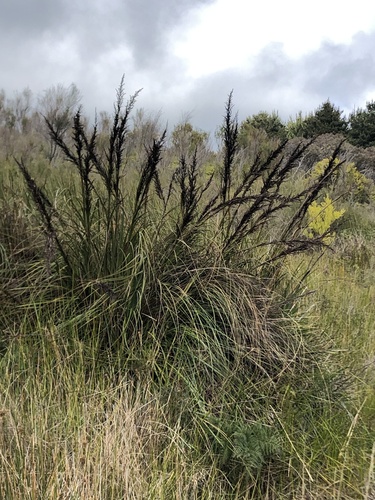
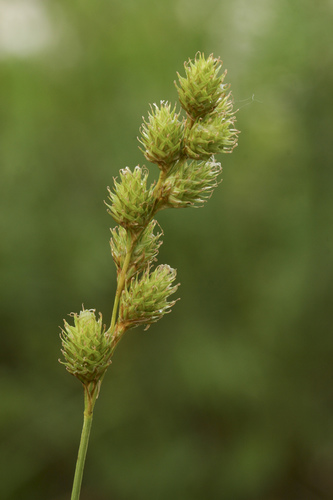
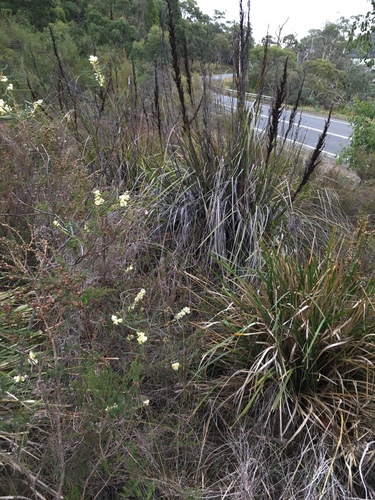
Gahnia grandis (Labill.) S.T.Blake, commonly known as cutting grass, is a perennial tussock-forming sedge that reaches 1–3 meters tall and forms tussocks 2–3 meters wide. Its stout flowering stems often sprawl before becoming erect, sprawling 1–2 meters from their base; culms are 1–3 m high and approximately 2–10 mm in diameter. The plant has sharp-edged, flat leaves with brown sheaths that channel along a 2.5 m long, narrow spiral stem. Inflorescences emerge from a long, tangled stem bearing weeping leaves. Flower spikes are 50–100 cm long, often drooping and one-sided, with lower bracts much shorter than upper bracts. Flower heads have a panicle-like shape, with flowers arranged in spikelets. Each spikelet holds two flowers: the upper flower is bisexual, while the lower flower is either sterile or male. There are 8–12 lowest glumes, which are much shorter than the upper glumes, and have irregularly toothed erose margins that range in color from brown to dark grey-brown and feel slightly rough to the touch. The apex of the upper glumes ranges from pointed to bluntly rounded. The cream-coloured flowers have 4-5 stamens with 2–3 mm long anthers. The seeds are smooth, dark reddish-brown to orange-brown, nut-like, oblong to narrowly ovaloid, measuring approximately 3.0–4.5 mm long and 1.2–1.9 mm in diameter. This species is native to southern Australia. Around 40 species of Gahnia are found across Australia, Asia, and the Pacific Islands. Gahnia grandis occurs natively in Western Australia, Queensland, New South Wales, Tasmania, and Victoria; in Victoria, it is native to the Gippsland Plain, Wilsons Promontory, and Highlands-Southern Fall bioregions, with past records only documenting two possible sites: the Gembrook-Beenak area, and the northern part of Wilsons Promontory. Seven native Gahnia species occur in Tasmania, where the genus as a whole is common. Gahnia grandis is widespread across all Tasmanian regions except the midlands and northeast; it grows in poorly-drained soils from sea level to mountain elevations, and can also be found on wetland and forest margins, riparian areas within button grass heaths, and along road cuttings and ditches. Gahnia species generally are widespread in wet forest, seen more frequently after fire, also occur in coastal areas, and sometimes grow in dry woodland. Gahnia rodwayi, a small, grass-like Gahnia species found in dry forests of southeastern Tasmania, typically flowers between October and January, and grows in moist soil beside water, shady forest gullies, and areas with dappled to semi-shade. Gahnia grandis is a very hardy perennial with woody rhizomes that forms large tussocks. It grows in moist soil that is often subject to periodic inundation, and once established, it is tolerant of drought and wind. Its flowering season runs from spring through summer. Seed maturity can be predicted by flower head color: bright brown immature fruits turn black when mature, at which point they are ready for use in food preparation. This species is resistant to disease caused by the water mould Phytophthora cinnamomi, but is highly flammable. Many species in the family Cyperaceae, including cutting grass, act as important food sources and safe habitat for native birds such as currawongs, native insects, moths, and butterflies including the chaostola skipper (Antipodia chaostola leucophaea). Chaostola skipper larvae feed nocturnally on Gahnia species, including Gahnia radula and Gahnia grandis, and the butterfly contributes to pollination. Many other insects also feed exclusively on Gahnia species. Cutting grass depends on birds such as currawongs for seed dispersal: birds eat the fruit, then regurgitate the partially-digested hard inner nut. One hypothesis holds that germination is facilitated by contact with the birds' stomach acid, which weakens the tough seed coat. Gahnia grandis is also a key habitat species for the rare and threatened Burnie burrowing crayfish (Engaeus yabbimunna). Indigenous peoples and Aboriginal Islanders have traditionally used cutting grass for basket-weaving and rope-making. The nuts were pounded and ground into flour to make bread, and the young bases of plants growing in wetter locations may be eaten. Seed heads are valued as an attractive ornamental decorative element. Gahnia species may also be used to attract birds and butterflies, and provide safe habitat for nesting birds, butterflies, caterpillars, other insects, and other animals including the threatened eastern barred bandicoot. In late 2007, with financial support from the World Wide Fund for Nature (WWF), the Hobart City Council, the Threatened Species Network (TSN), the Tasmanian Parks and Wildlife Services, and the Tasmanian Department of Primary Industries and Water released a primary school education package and organized a teacher training workshop. This initiative was aimed at encouraging community participation in eastern barred bandicoot conservation efforts, and highlighted the need to conserve Gahnia grandis and other native vegetation. Gahnia grandis tolerates damp soil, drought, full sun or shade, and moderate frost down to −4 °C (25 °F), so it can be grown in a wide range of locations. It is planted to improve soil fertility and prevent soil erosion. It is also planted along roadsides and surrounding farmland to act as a natural protective boundary for marsupials and provide insect habitat. After drying, it can be used as fire fuel. It can be used to make craft objects, baskets, ornaments, and decorative artwork, and used decoratively in vases and flower pots; it can also be planted as an ornamental garden species. Its long, sharp-edged leaves and untidy growth habit make cutting grass relatively unsuitable for ornamental horticulture. However, the species is widely used for vegetation rehabilitation and regeneration, because its hardiness and soil-retaining properties make it effective for preventing soil erosion. Gahnia species as a whole are generally difficult to propagate. Seed germination is the most successful method, as plant division and transplantation produce only limited results. Due to seed dormancy, seeds will not germinate earlier than 12 months after maturity. To collect seeds, cut off seed heads at the base with secateurs, then place them on a groundsheet to dry for several days. Thrashing may be needed to dislodge the seeds, which should then be stored dry for best conservation results.