About Gadus chalcogrammus Pallas, 1814
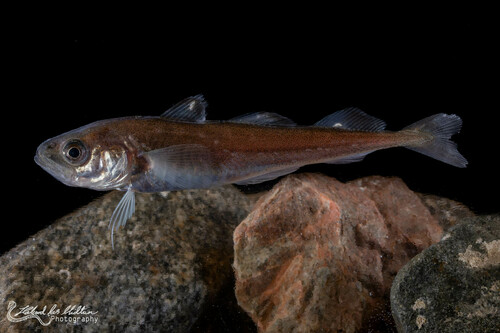
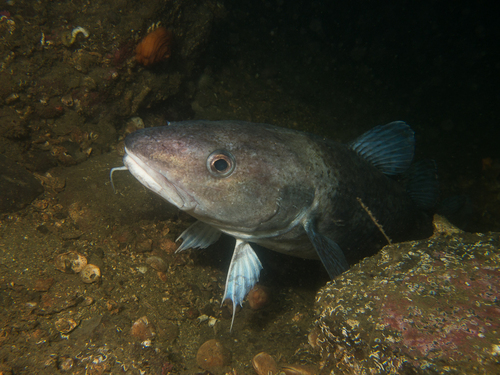
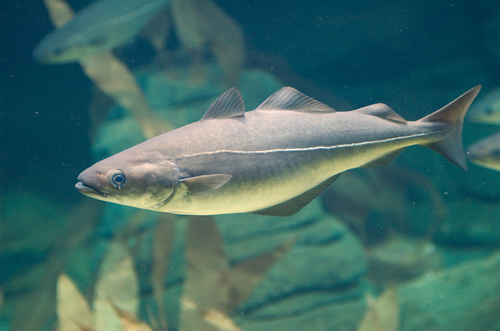
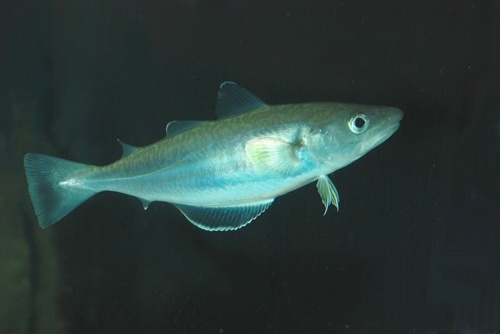
Alaska pollock, also called walleye pollock, has the scientific name Gadus chalcogrammus Pallas, 1814. It is a marine fish species belonging to the cod genus Gadus and the family Gadidae. It is a semi-pelagic schooling fish that is widely distributed across the North Pacific, with the largest concentrations of individuals found in the eastern Bering Sea.
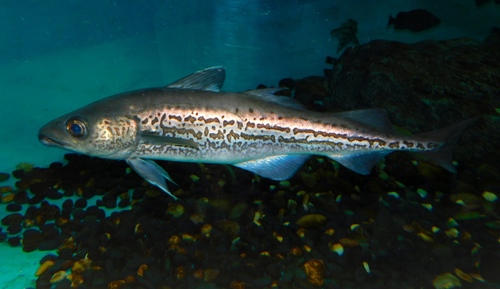
Its speckled body color makes it harder for predators to spot Alaska pollock when they are near sandy ocean floors. It is a relatively fast-growing and short-lived species, and it is currently a major biological component of the Bering Sea ecosystem. Research shows that commercial catches of Alaska pollock increase three years after stormy summers. Storms stir up ocean nutrients, which allows phytoplankton to remain abundant for a longer period, and this in turn supports higher survival rates for pollock hatchlings. Like many other gadids, Alaska pollock has well-developed drumming muscles that it uses to produce sounds during courtship.
Compared to other cod species and other types of pollock, Alaska pollock has a milder taste, whiter flesh, and lower oil content. Alaska pollock is considered the "national fish" of Korea. Its Korean name myeongtae (명태; 明太) has spread to some neighboring countries: it is called mintay (минтай) in Russia, and its roe is known as mentaiko (明太子) in Japan, while the Japanese name for the fish itself is suketōdara (介党鱈). In Korea, myeongtae has more than thirty additional common names, which refer to different forms and ages of the fish, including saengtae (생태, fresh Alaska pollock), dongtae (동태, frozen Alaska pollock), bugeo (북어, dried Alaska pollock), hwangtae (황태, dried in winter through repeated freezing and thawing), nogari (노가리, dried young Alaska pollock), and kodari (코다리, half-dried young Alaska pollock).
Koreans have eaten Alaska pollock since the Joseon era. One of the earliest written mentions comes from the Seungjeongwon ilgi (Journal of the Royal Secretariat), where a 1652 entry notes that the management administration should be strictly interrogated for bringing in pollock roe instead of cod roe. In 1940, Alaska pollock was the most commonly caught fish in Korea, with more than 270,000 tonnes caught from the Sea of Japan. This total is higher than the estimated annual consumption of Alaska pollock in South Korea in 2016, which stood at 260,000 tonnes. Today, however, South Korea relies heavily on imports from Russia to meet its Alaska pollock consumption demand, due to rising sea water temperatures. In 2019, South Korea implemented a total ban on pollock fishing to help replenish the fish's depleted local stocks.