About Fuscoporia torulosa (Pers.) T.Wagner & M.Fisch.
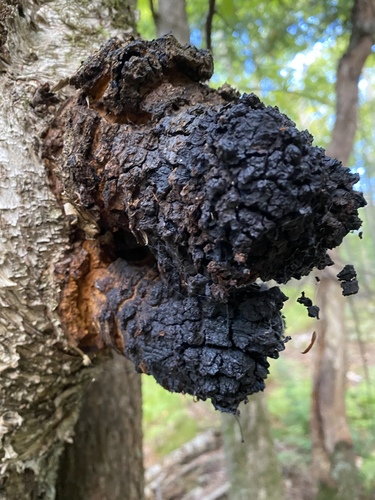
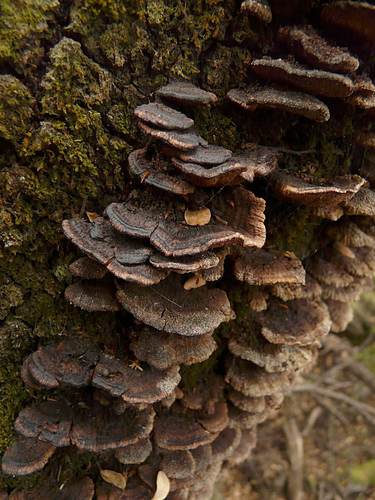
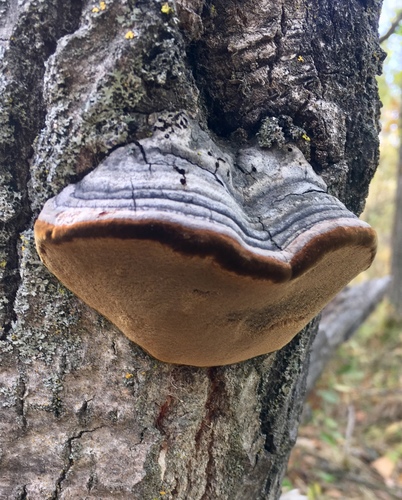
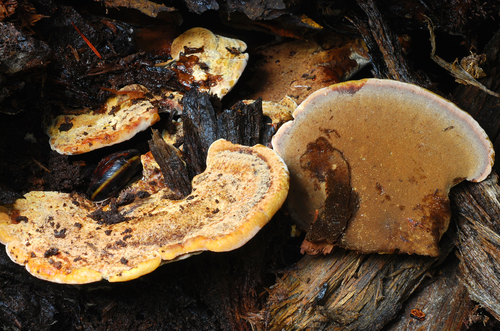
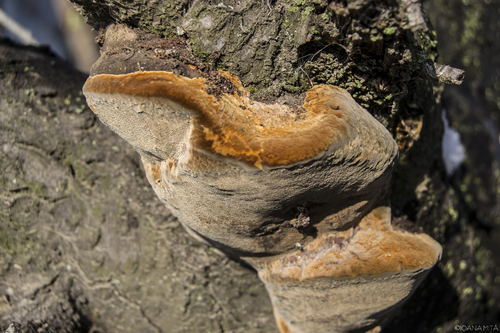
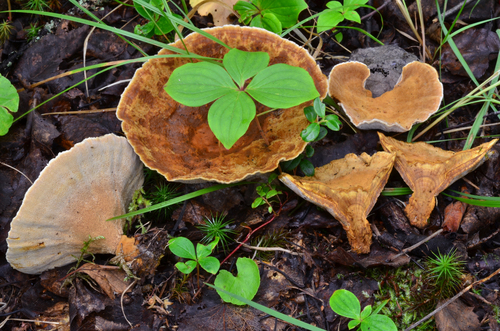
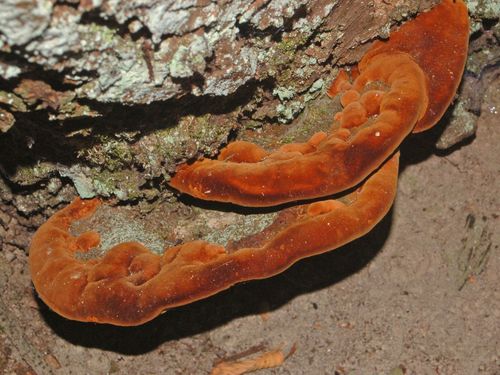
The scientific name of this species is Fuscoporia torulosa (Pers.) T.Wagner & M.Fisch. The fruiting bodies of Fuscoporia torulosa are semicircular or shell-shaped, measuring 12–30 centimetres (4+1⁄2–12 in) broad by 4–10 cm (1+1⁄2–4 in) long. The brackets are typically 1–3 cm (1⁄2–1 in) thick, and they can be considerably thicker at the point where they broadly attach to a tree. Ryvarden and Gilbertson recorded maximum fruiting body dimensions of 46 cm (18 in) wide by 28 cm (11 in) long by 11 cm (4+1⁄2 in) thick. The fruiting body margin is rounded, and sometimes wavy; the flattened upper surface is felt-like or tomentose, and typically orange-brown to rusty-brown in color. The lower pore-bearing surface is cinnamon-, rust-, or olivaceous-brown, and has 5 to 6 pores per millimetre. Fuscoporia torulosa does not produce visible fruiting bodies until long after a tree is first infected, because the fungal mycelia need time to colonize the host. Because of this, it often escapes detection until it is too late to save the tree. In 2007, a rapid detection method was reported that uses DNA technology, specifically polymerase chain reaction, to detect fungal mycelia in infected tissues in roughly six hours. Although its preferred host is Quercus, Fuscoporia torulosa has been reported growing on a variety of hardwood trees, including Acer, Arbutus, Calluna, Castanea, Celtis, Ceratonia, Cercis, Cistus, Citrus, Cornus, Crataegus, Cydonia, Erica, Eucalyptus, Euonymus, Fagus, Fraxinus, Grevillea, Helianthemum, Juglans, Laurus, Malus, Melaleuca, Morus, Myrtus, Olea, Ostrya, Parrotia, Phillyrea, Pistacia, Pittosporum, Populus, Prunus, Punica, Pyrus, Robinia, Rosa, Salix, Spartium, Ulex, Ulmus, Viburnum, and Vitis. It also grows more rarely on conifers, including Cedrus, Cupressus, Larix, Picea, and Pinus. Recently, F. torulosa has been reported to infect more than 160 species of plants; most of these infections lead to the premature death of the infected plant.