About Fuscopannaria leucosticta (Tuck. ex E.Michener) P.M.Jørg.
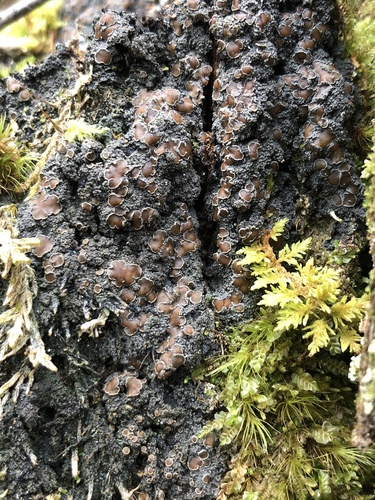
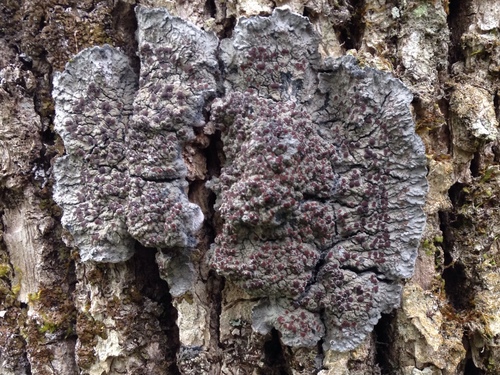
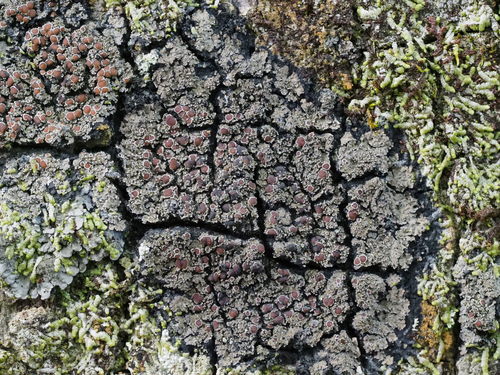
Fuscopannaria leucosticta (Tuck. ex E.Michener) P.M.Jørg. is a lichen species that forms abundant, round or scalloped-edged squamules 2–3 mm in diameter. These squamules are chestnut-brown with white felty margins, and frequently grow on a black prothallus. The lichen does not produce soredia or isidia. It typically bears lecanorine apothecia with distinct white rims. Its ascospores measure 23–27 by 9–11 μm, with a relatively thick, transparent outer wall that often tapers to a fine point at one or both ends. All standard chemical spot tests return negative results for this species. This lichen was once widely distributed across temperate eastern North America, but its range has declined due to habitat loss and destruction. In eastern Canada, it favors old, wet forests. Its overall distribution extends to Central America and the Caribbean, as far south as Cuba. In Chiapas, Mexico, it occurs at 2,400 m (7,900 ft) elevation in a misty montane pine-oak forest. It most commonly grows on bark, though it is occasionally found growing on rock, usually associated with mosses. A study of habitat associations and distribution in Nova Scotia, Canada, found that temperature is the strongest influence on the species’ predicted range. In the early 2000s, Fuscopannaria leucosticta was listed as Yellow status on Nova Scotia’s species at risk list, meaning it is sensitive and may need special attention to prevent extinction or extirpation. Its rarity in Eastern Canada means its full distribution and total population size are not confirmed, which complicates conservation planning. A MaxEnt maximum entropy distribution model, a machine learning method that predicts species distribution from environmental variables, incorporated multiple environmental factors including cedar presence and low human disturbance to identify areas with high probability of the lichen’s occurrence. Subsequent field surveys confirmed 13 new populations in these predicted high-probability areas, a result that can guide future conservation management for this rare at-risk species. In 2007, the species was reported from Ecuador. Researchers noted this record was remarkable because no collections had been made from intermediate locations between North America and Ecuador, suggesting it may be an example of long-distance dispersal or a relict species. A surprising record from Tanzania was published the year before, in 2006. According to Jørgensen and Sipman, this record from Tanzania’s Uluguru forest region supports the species’ ancient history, as it existed around the Tertiary Madro-Tethyan sea—an area that hosts multiple other relict species. They propose the species expanded southward into East Africa along the route formed by Tertiary forests of Egypt and Sudan. In these tropical and subtropical locations, the lichen grows at high elevations over 2,000 m (6,600 ft) in mountain mist zones, reflecting its requirement for humid environments. Although the species is very rare in Europe, it was rediscovered there in 2006 when a specimen was collected in Greece. This was the first confirmed collection of the species in Europe in more than a century.