About Furnarius figulus (Lichtenstein, 1823)
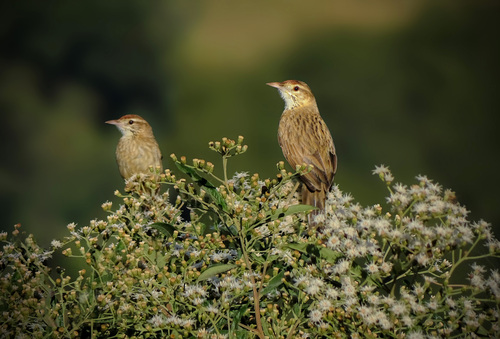
The band-tailed hornero, with the scientific name Furnarius figulus (Lichtenstein, 1823), measures 15 to 16 cm (5.9 to 6.3 in) long and weighs approximately 28 g (0.99 oz). It is a small hornero characterized by a long, nearly straight bill. The plumage of males and females is identical. For adults of the nominate subspecies, markings include a wide white supercilium, dingy rufous lores, a dark stripe through the eye, dull rufous ear coverts, and a tawny buff malar area. Their crown is chestnut-rufous, while their back, rump, and uppertail coverts are a slightly paler chestnut-rufous. Their tail is also chestnut-rufous, with brownish black tips on the inner feather webs. Their wing coverts and secondaries are rufous, and their primaries are fuscous with two dark rufous bands. Their throat is whitish, transitioning to pale tawny-brown across most of their underparts, with exceptions of a whitish belly center and nearly white undertail coverts. Their iris, bill, legs, and feet are all brownish. The subspecies F. f. pileatus has much darker brown crown and ear coverts, and more black on the tail, compared to the nominate subspecies.
The two recognized subspecies of the band-tailed hornero have widely separated ranges within Brazil. F. f. pileatus occurs along the Amazon River from eastern Amazonas to central Pará, and extends south along the Araguaia and Tocantins rivers through Tocantins and eastern Mato Grosso into Goiás. F. f. figulus is found in eastern Brazil, ranging from Maranhão east to the Atlantic coast, and south into the states of Rio de Janeiro and São Paulo. Its expansion into Rio de Janeiro and São Paulo from Espírito Santo and Minas Gerais had already begun by the 1980s.
The band-tailed hornero lives in a range of landscapes, most of which are semi-open to open. Habitats include woodlands, scrublands on deforested land, pastures, marsh edges, and urban and suburban gardens and parks. It is most commonly found near water, particularly rivers. Across most of its range, it occurs at elevations below 600 m (2,000 ft), though it reaches up to 900 m (3,000 ft) in a small number of areas, and has been recorded at 1,250 m (4,100 ft) in Minas Gerais.