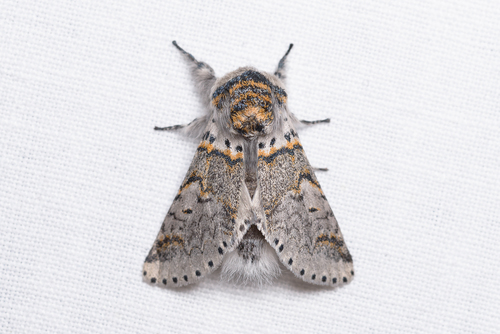
About Furcula furcula (Clerck, 1759)
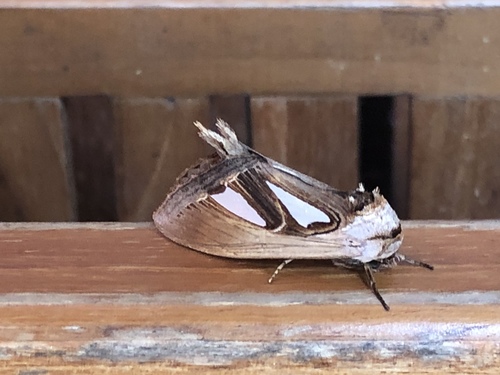
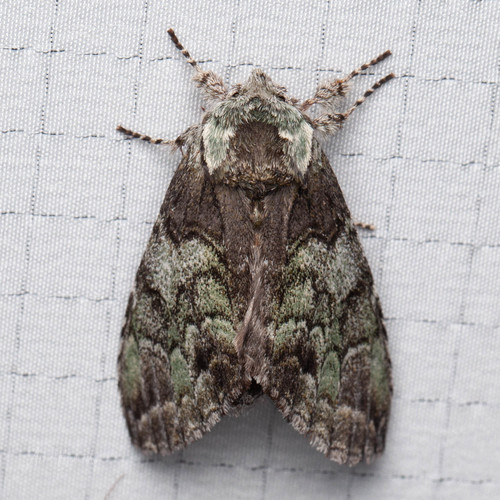
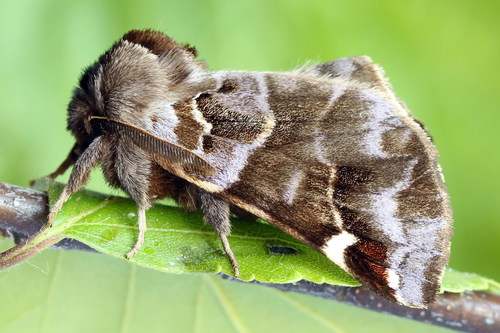
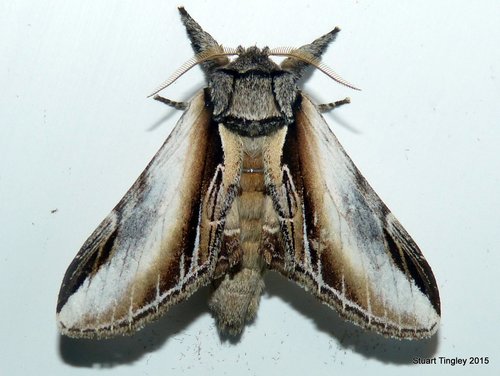
This moth, commonly called the sallow kitten, has the scientific name Furcula furcula (Clerck, 1759). The adult moth is grey-white in colour, with a wingspan ranging from 27 to 35 mm. A large grey middle band is present on the proximal portion of the wing. It can be distinguished from the related poplar kitten (Furcula bifida) by its generally smaller overall size, and most notably by the shape of the black line that forms the outer margin of the central band. In the sallow kitten, this line is always more or less angled or dentate toward the front margin of the wing; in the poplar kitten, this section of the line forms a smooth, even curve. The technical description from Seitz notes that the blackish-grey median band is sharply edged with black, and its distal sinus usually only extends to the apex of the cell; three parallel dentate lines are present beyond the middle of the wing. The subspecies borealis Borkh., found in Lapland and Northern Russia, has blackish smoke-coloured thorax and wings; specimens from Amurland are also somewhat darker than individuals from Central and Southern Europe. The subspecies sangaica Moore, which lives in North and Central China, is set apart by its narrower median band. The egg of Furcula furcula is black. Young larvae are blackish; in later larval stages, they are yellowish green with scattered red markings, with a large patch on the thorax that is continuous with dark red-brown dorsal spots on abdominal segments 1 to 8. The spot on the fourth abdominal segment is the largest, extending sideways to the stigmata. The head matches the colour of these spots, and the anal filaments are red-brown. The pupa develops inside a brown cocoon, and is yellowish brown with greenish wing cases; it frequently hibernates twice. This moth occurs across Europe (including the Mediterranean region), Anatolia, and extends through Asia to China, and it is also found in North America.