About Furcula bifida (Brahm, 1787)
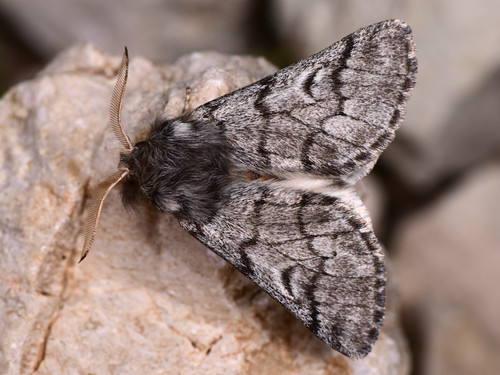
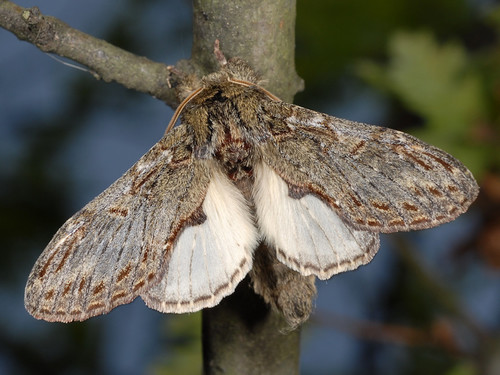
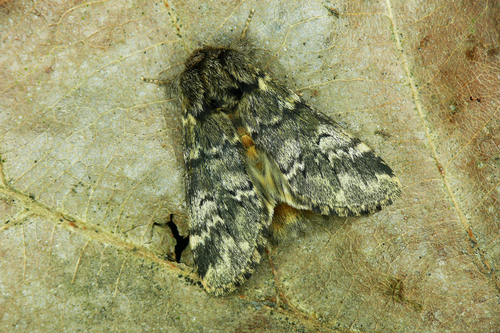
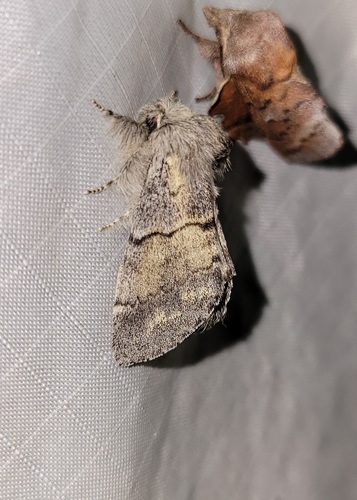
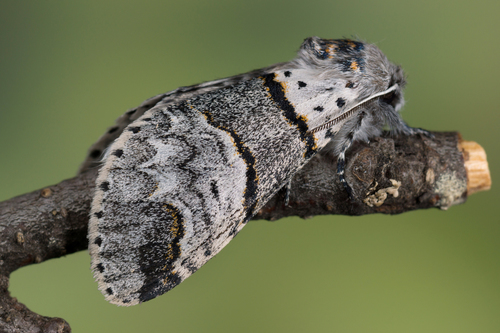
This moth species, Furcula bifida, has grey forewings marked with a broad dark grey central band and a cloud of the same dark grey colour near the wing tips. The central band is inwardly bordered by an almost straight black line, and outwardly bordered by a curved line. A third double line curves toward the wing costa, forming the inner edge of the dark grey apical cloud, with a wavy lower portion. The first black line has an inward ochreous edge, and the second black line has an outward ochreous edge, with a series of black dots preceding the first line. Its hindwings are white with brown dots along the margin. The species has a wingspan of 44–48 mm. It can be distinguished from the closely related Furcula furcula (the alder kitten) by its generally larger size, and most noticeably by the shape of the black line that forms the outer margin of the central band, which forms a smooth curve, while the same line in the alder kitten is always more or less angled or toothed toward the front margin of the wings. Per Seitz, the median band has sharper black edges, and bears an evenly curved shallow indentation on its distal side extending down to vein 2; usually only 2 of the outer toothed lines are well developed. Like Furcula furcula, this species has a distinct dark smoky ground-coloured race in northern Scandinavia and Lapland, named saltensis Schoyen. Southern France and Spain host a separate specialized race, urocera Bdv., in which the moth's markings are less developed, and some markings are even entirely absent, particularly in the marginal wing area. The variants fuscinula Steph., arcuata Steph., integra Steph. and latifascia Curt., originally described from specimens collected in England, are barely distinguishable from true Furcula bifida. The eggs of Furcula bifida are black. Its larvae are similar in appearance to the larvae of Furcula furcula, and share similar dark red-brown dorsal spots. Newly hatched first instar larvae are blackish; older larvae are yellowish green with sparse red dots along the sides. The large triangular patch on the thorax is divided by a narrow pale median line, irregularly mottled with light spots, and edged with reddish yellow. The dorsal abdominal spots extend all the way to the anal segment. Larvae are active from the end of July to September, feeding on Populus species, especially aspen. The pupa is pale brown, and develops inside a dark brown cocoon. Adult moths emerge in early June.