About Furcraea tuberosa (Mill.) W.T.Aiton
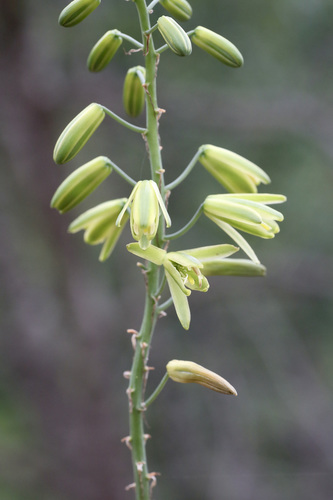
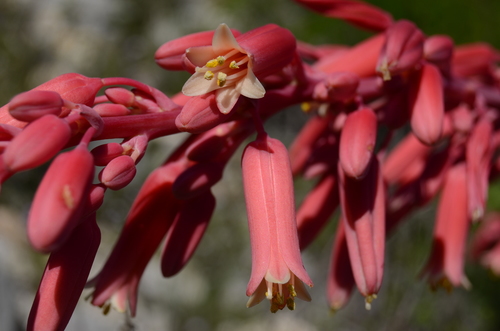
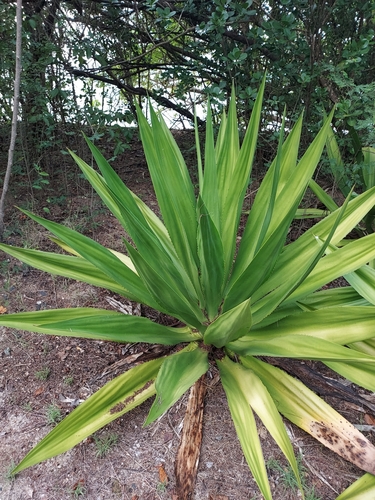
Furcraea tuberosa (Mill.) W.T.Aiton is a large perennial succulent plant. It is either stemless or has a stem shorter than 30 cm (1 ft) tall. Numerous leaves arranged in a rosette, ranging from roughly upright to spreading in growth habit. Leaves are 1.0–1.8 m (3–6 ft) long, with reddish-brown marginal teeth approximately 5 mm (0.2 in) long. Its inflorescence is a highly branched panicle that reaches around 5–8 m (16–26 ft) tall. The flowering stem produces many ovoid bulbils. Flowers grow in groups of three on 6–10 mm (0.2–0.4 in) long stalks called pedicels. Each flower is roughly 4 cm (1.6 in) long, with six greenish-white tepals. This species is native to the Caribbean, occurring in Cuba, the Dominican Republic, Haiti, Jamaica, the Leeward Islands, Puerto Rico and the Windward Islands. It has become naturalized in Mpumalanga Province, South Africa, where it appears to be invasive; it spreads via bulbils, as seed production has never been observed. In Haiti, Furcraea tuberosa is harvested for its fibres, which are used to make hammocks and ropes. It is thought that Haitian slaves may have spread the species through Cuba in the past, and it is most often found near roads and in small towns.