About Furcraea foetida (L.) Haw.
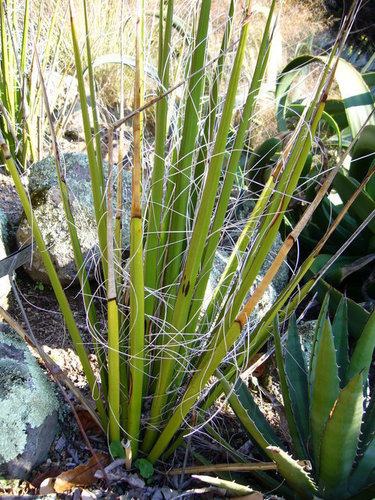
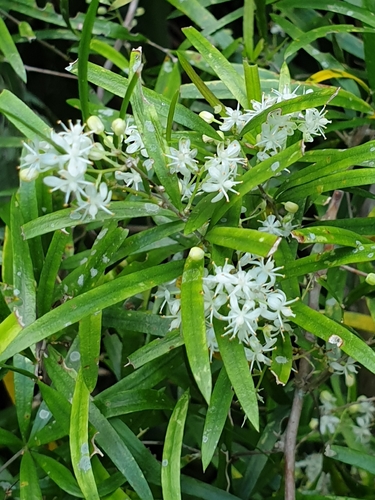
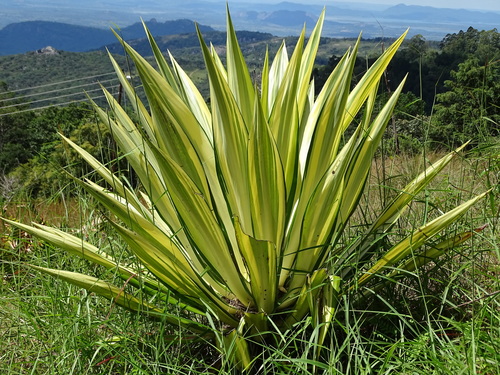
Furcraea foetida is a monocarpic perennial subshrub that can also be evergreen, and is closely related to the North American Agave and Yucca genera. Most plants of this species are stemless, but larger mature individuals can develop a short, trunk-like stem over time, reaching a total height of approximately one meter (3 feet). Its sword-shaped leaves are somewhat more flexible than agave leaves. They measure 1 to 1.8 meters in length, 10 to 15 centimeters wide at their widest point, and narrow to 6 to 7 centimeters wide at the leaf base, ending in a sharp spine at the tip. Leaves emerge one at a time from the ground, unfurling sequentially to form an almost rosette-like arrangement. Leaf margins are completely smooth in some varieties, and edged with hooked spines in others. The flowers are greenish to creamy white, 4 centimeters long, and have a strong scent. They grow on a large inflorescence that can be up to 7.5 meters tall. Like other monocarpic plants, the flowering part of the plant dies back after it blooms and sets seed. It normally leaves behind young plants called "pups" that grow from the roots and rhizome, surrounding the base of the original mother plant. This species is cultivated in subtropical and tropical regions, both to produce fiber for textiles and as an ornamental garden plant. Its leaves are primarily used to make a natural fiber similar to sisal, and large commercial plantations of Furcraea foetida are grown in East Africa.