About Furcifer pardalis (Cuvier, 1829)
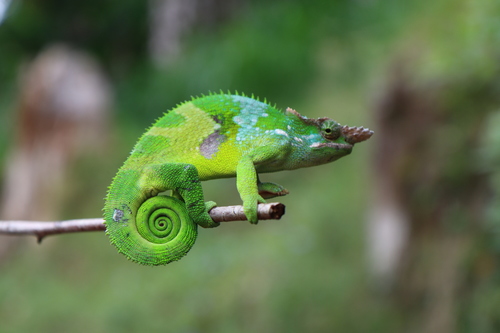
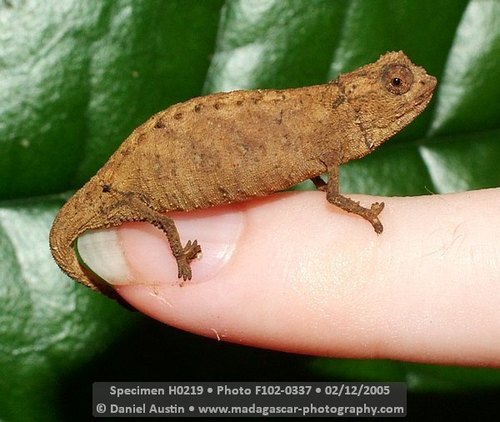
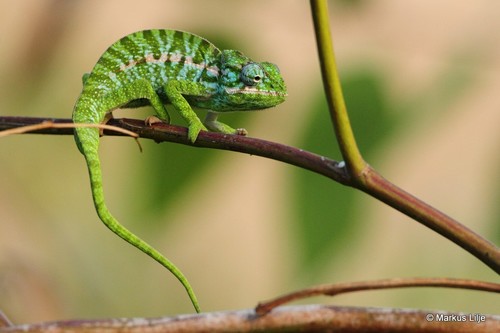
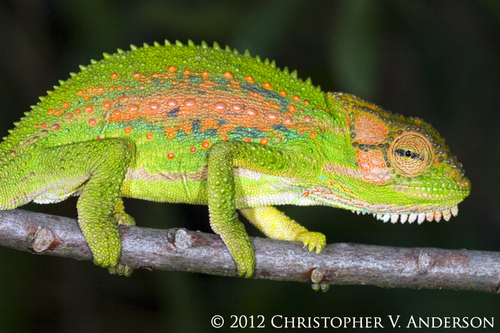
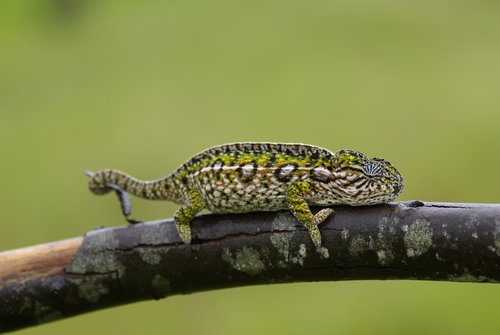
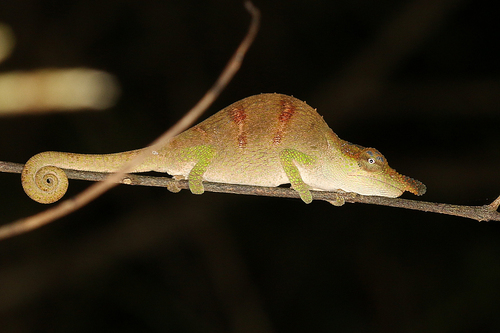
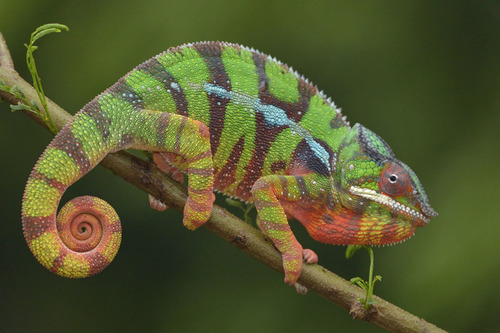
Panther chameleons (Furcifer pardalis) reach 16–20 inches (40–51 cm) in total length, with females typically smaller than males. This species shows multiple forms of sexual dimorphism: males are not only much larger and heavier than females, but also have more vibrant coloration. The panther chameleon's coloration varies based on its geographic origin, and distinct regional color variants are commonly called 'locales', named for the area they come from. Individuals from Nosy Be, Ankify, and Ambanja are most often vibrant blue, while those from Ambilobe, Antsiranana, and Sambava are typically red, green, or orange. Specimens from Maroantsetra and Tamatave are primarily red. Many additional color phases and patterns exist both between and within regions. Across all locales, females are generally tan or brown with subtle hints of pink, peach, or bright orange, with only minor pattern and color differences between different color phases. Like all chameleons, panther chameleons have a specialized toe structure. On each foot, five toes are fused into two groups: one group of two toes and one group of three. This grouped arrangement lets panther chameleons grip narrow branches tightly. Each toe also has a sharp claw that provides traction on surfaces like bark while climbing. On the front feet, the two-toe group is on the outer (distal) side of the foot, and the three-toe group is on the inner (medial) side. This arrangement is reversed on the hind feet: two toes are fused on the medial side, and three on the distal side. Panther chameleons have very long tongues, sometimes longer than their entire body length, that they can rapidly extend out of their mouth to catch prey. Their diet consists mostly of terrestrial invertebrates, with plant matter consumed very rarely. Once the tongue tip adheres to prey, the tongue pulls the prey quickly back into the mouth, where strong jaws crush the prey before it is swallowed. Panther chameleons are native to Madagascar, where they are widespread across lowland areas of the eastern and northeastern parts of the island. They have also been introduced to Réunion and Mauritius, and more recently to the U.S. state of Florida via escape or release from the pet trade. In their native range, panther chameleons live in eastern rainforests, and in the drier broken forest and savannah habitats of northwestern Madagascar. While most original native plant communities in their range have been degraded by human activity, panther chameleons actually thrive in these altered habitats, and are commonly found near roads, human homes, and in agricultural plantations. Panther chameleons are highly territorial, and spend almost all of their lives alone except during mating. When two males encounter each other, they respond by changing color and inflating their bodies to assert dominance over one another. Most conflicts end at this display stage: the losing male retreats and shifts to drab, dark coloration. Occassionally, if neither male backs down from the display, the confrontation will escalate to physical combat. Panther chameleons are facultative thermoregulators. When they need to raise their body temperature, they bask—basking in sunlight in the wild, or under heat lamps in captivity. They have a broad thermoneutral zone, a range of temperatures where they do not actively adjust their body temperature. This allows their body temperature to drift between 24 and 36 degrees Celsius during the daytime. Panther chameleons reach sexual maturity at a minimum age of seven months. When females are gravid (carrying eggs), they shift to a dark brown or black base color with orange striping to signal to males that they will not mate. Gravid females also become highly defensive, and may bite any males that approach them. The exact color and pattern of gravid females varies based on the chameleon's color phase, which can be used to distinguish different locales. Females typically only live two to three years after they begin laying eggs, over which they produce between five and eight clutches. Their shortened lifespan is caused by the physiological stress of reproduction. Per clutch, females lay between 10 and 40 eggs, with clutch size depending on how much food and nutrients the female consumed during egg development. Panther chameleon eggs typically hatch after 240 days of incubation.