About Furcifer oustaleti (Mocquard, 1894)
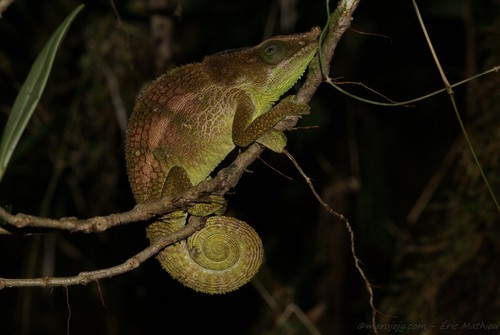
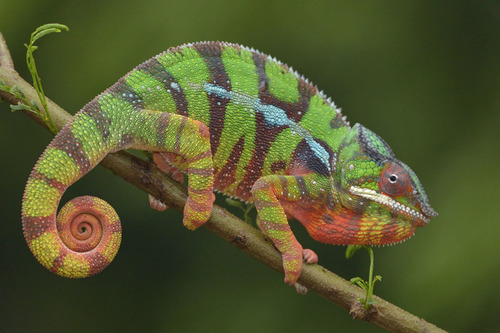
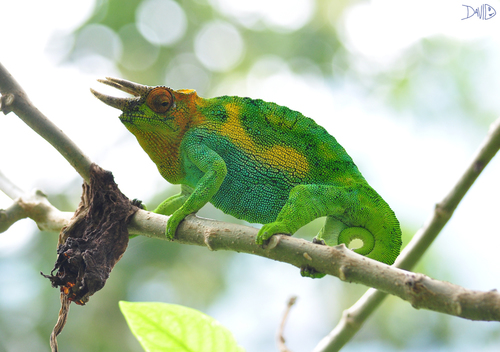
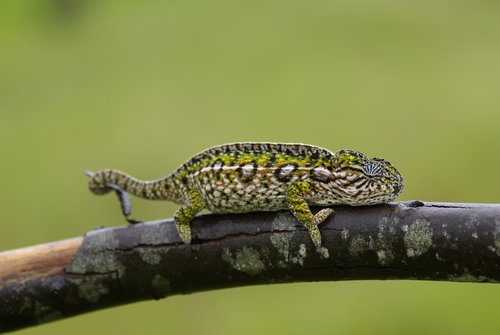
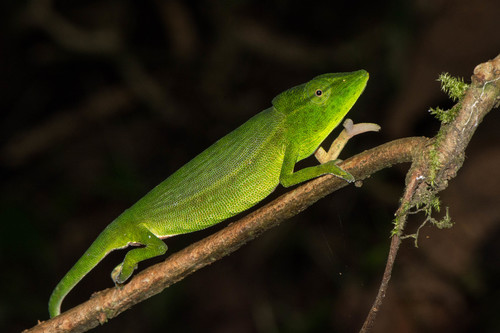
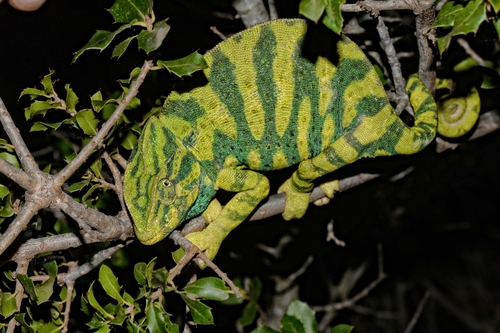
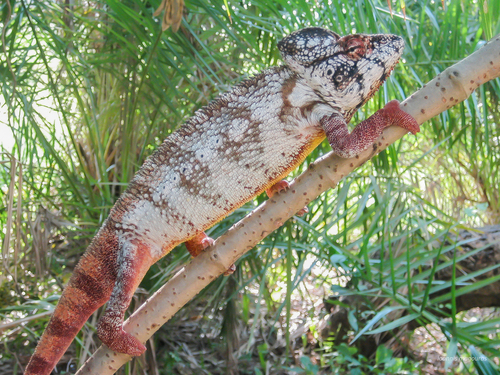
Furcifer oustaleti, measured from snout to tail tip, reaches a maximum total length of 68.5 cm (27 in), and is generally considered the world's largest chameleon species by this measurement. While exceptionally large individuals of two other species—Calumma parsonii (Parson's chameleon) and Trioceros melleri (Meller's chameleon)—have been reported to reach even greater lengths, these reports have not been verified. Furcifer oustaleti has a relatively slender build, so its body weight is lower than that of certain more robust large chameleon species, most notably C. parsonii. Large adult males of F. oustaleti typically weigh between 400 and 500 g (14–18 oz), though lower weights are common, and females are consistently lighter than males. Females are also considerably smaller than males in total length, reaching a maximum of around 40 cm (16 in). F. oustaleti has a high casque on its head with several crests, and a dorsal crest made of 45 or more small triangular spines that runs along its spine. The species' colouring is highly variable. Males are usually mostly grey or brownish, and sometimes have reddish-orange feet or underparts. Females have more variable colouring and are often more colourful than males, with possible base colours or markings in red, yellow, and green, and they may sometimes have blue eyelids. F. oustaleti is endemic to Madagascar, where it is found across the entire island. It occupies a very wide range of habitat types, including dry deciduous forest, humid evergreen forest, montane savanna, degraded forests, agricultural areas, and even urban settings. It is rarely found deep in forest interiors, and is more common along forest edges.