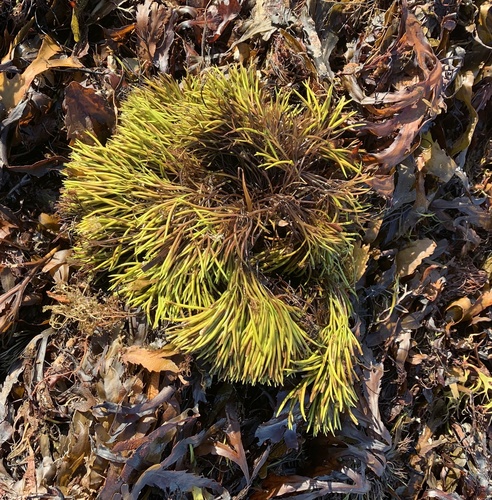
About Furcellaria lumbricalis (Hudson) J.V.Lamouroux
Furcellaria lumbricalis (Hudson) J.V.Lamouroux is a common red macroalgal species. It has two distinct ecotypes: attached and loose-lying (drifting) thallus forms, which were previously classified as Furcellaria fastigiata f. aegagropila. Attached Furcellaria lumbricalis is a widely distributed sublittoral species found on both sides of the North Atlantic. This attached form typically grows as an epilith on stable hard substrates, including stony bottoms, boulder fields, and rocks. It is a perennial macroalgae with a lifespan of up to 10 years, and can tolerate salinities as low as 3.6 psu. While individual specimens have been recorded growing as deep as 30 m, the species occurs most commonly between 8 and 12 m depth. In the central and northern Baltic Sea, where most other perennial red algae cannot survive low salinity conditions, Furcellaria lumbricalis forms dense, monotypic meadows. Over the past fifty years, loose-lying Furcellaria lumbricalis communities in Kattegat, Denmark and Puck Lagoon, Poland have disappeared, due to overharvesting or eutrophication. In other areas where the species grows, it is too sparsely distributed to support industrial harvesting. In Kassari bay, drifting forms of Furcellaria lumbricalis and Coccotylus truncatus form a loose-lying algal stratum that hosts the most abundant algal community in the Baltic Sea. Due to the site’s unique location and the community’s relatively high biomass, this stratum has been harvested for furcellaran production since the mid-1960s, and serves as an example of sustainable bioresource use. The stratum has an average depth of 7.5 m, and its total density varies greatly between years, ranging from 100 000 to 200 000 tons in wet weight. These annual changes are thought to be driven by meteorological factors, including harsh winters, hot summers, and storms. The Estonian Marine Institute monitors key quantitative characteristics of the loose-lying Furcellaria-Coccotylus community in Kassari Bay. The species is commonly found near the coasts of Eastern Canada and the British Isles, and it is the only widely distributed red algal species in the Baltic Sea. It is also found in Northern Russia, Iceland, the Faeroe Islands, and along the European coast from Norway to France. To form a strong gel in an aqueous solution, cations must be present. This gelling process depends on the nature of the polysaccharide, polymer concentration, temperature, and the type of ions present. K+, Rb+ and Cs+ ions produce strong gels with κ-carrageenan and furcellaran, while Ca2+ ions support gelling of ι-carrageenan, which is extracted from the cell walls of Coccotylus truncatus. The first observable change in the gelling process is an initial coil-to-helix transition, followed by aggregation of these helices to form a gel. Gels formed this way are thermoreversible: they gel as temperature drops, and melt when heated. The food industry relies on this natural component, which is added as a texture-modifying additive to products including candies, ice cream, and puddings. In the European Union, carrageenans used as food additives are designated as E407; E407a refers to Processed Eucheuma seaweed, which retains most of its original cellulose after most impurities are washed out. Furcellaran from Furcellaria lumbricalis is also used in the pharmaceutical and cosmetic industries, as an ingredient in products such as foams and soluble tablets. Furcellaran can also be used as a beer wort fining agent, in place of κ-carrageenan.

