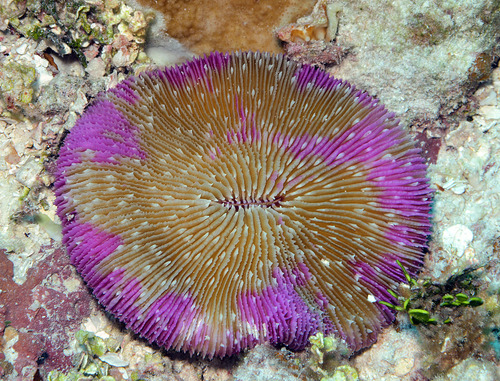
About Fungia fungites (Linnaeus, 1758)
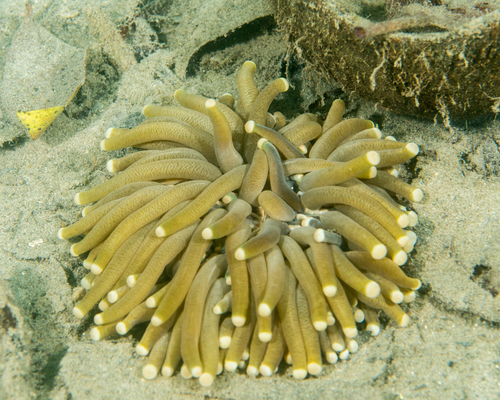
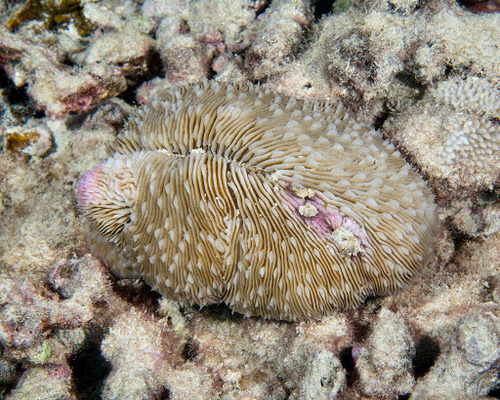
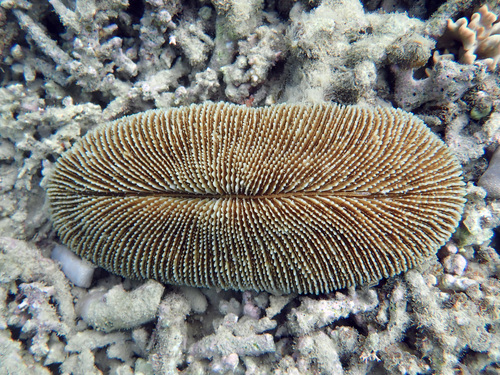
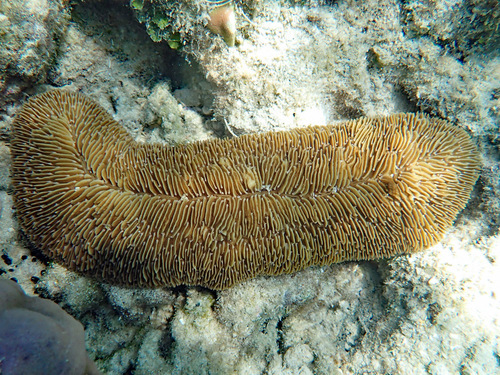
Fungia fungites corals are mostly solitary, and some individuals can reach 30 centimetres (12 inches) in diameter. Juvenile individuals attach themselves to rock, while larger individuals detach to become free-living. This coral species occurs in a range of bright colours, including white, pink, red, purple, blue and yellow, and is popular among reef aquarium keepers. Its coral discs are either round or oval, and the central mouth, which is surrounded by tentacles, may be shaped like a slit. The polyp rests inside a calcareous cup called the corallite. Septa are vertical skeletal elements located inside the corallite wall; costae connect to the septa, and extend outside the corallite wall and underneath the coral. Both the septa and costae are robust. Fungia fungites can be mistaken for members of the related genus Cycloseris, but all Cycloseris are free-living even when juvenile, while young F. fungites retain a scar that marks where they were attached when young. Like other large polyp stony corals, Fungia corals have developed several different feeding strategies. They capture planktonic organisms and food particles from the water column, and can also absorb dissolved organic matter. Feeding tentacles are usually visible at night. Fungia also reproduces asexually. Daughter colonies or polyps can form, the species can produce new offspring from broken fragments, and it is capable of regeneration.