About Fundulus zebrinus Jordan & Gilbert, 1883
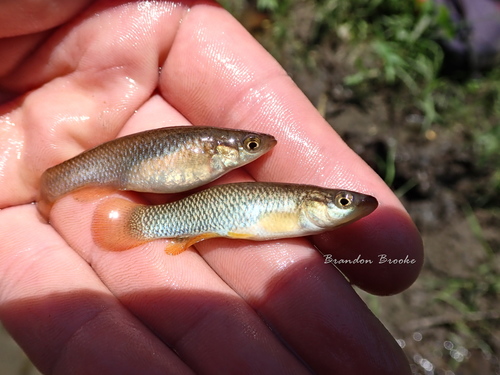
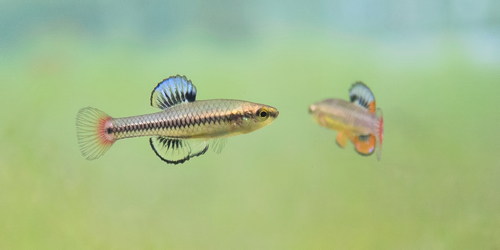
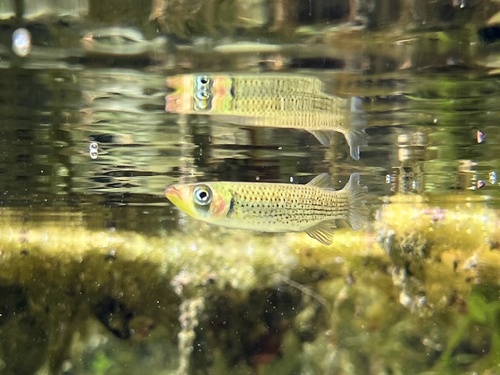
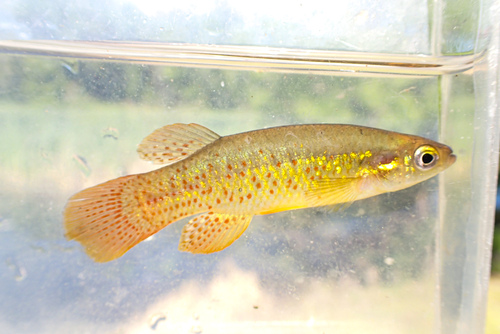
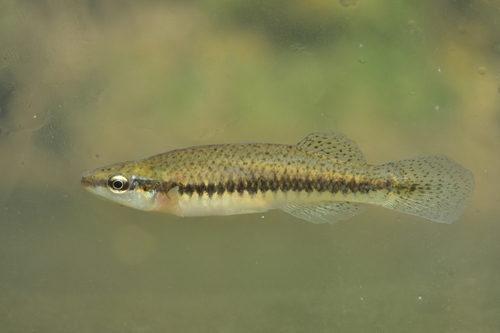
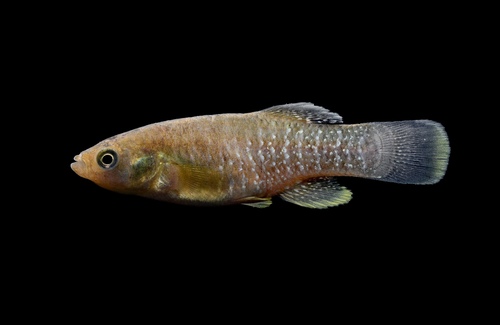
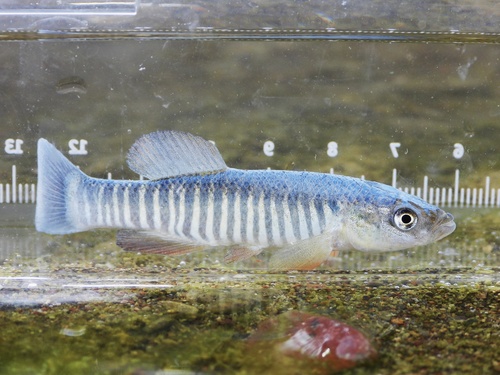
This species, Fundulus zebrinus (the plains killifish), generally grows to around 6.9 cm (2.7 inches) long, and reaches a maximum total length of 8–10 cm (3.1–3.9 inches). It can live up to 3 years, though most individuals do not live past 2 years of age. It has a flat head with a protruding jaw that lets it feed at the water surface. The species is variable in color, with individuals being brown, black, greenish, or straw-colored, and having a paler yellowish or silvery belly. It is marked with 12 to 28 dark vertical stripes, which give the species its scientific name meaning "like a zebra". Males have wider, darker bars than females. Breeding males develop bright orange color on most of their fins. The killifish feeds on chironomid larvae, copepods, nematodes, other small animals, and also consumes plant matter as a herbivore. It may feed by scooping up and swallowing mouthfuls of riverbed substrate to reach buried food items. It usually spits out most sand and undigestible material, but its digestive tract still typically contains some amount of sand. When available, it eats mosquito larvae, and research suggests it could be useful for mosquito abatement work. It occupies a variety of shallow river and stream habitat types, and can live in lower, moderate, and swift, turbid water flows. It can also be found in lakes. It is more tolerant of brackish, alkaline, and salty water than most other co-occurring fish species. It can bury itself in the stream substrate, leaving only its eyes and mouth exposed. This behavior is thought to be a possible stress response, and may also protect the fish from sunlight, heat, predators, or low water levels, or help it remove parasites. Populations of this killifish drop where the predator green sunfish (Lepomis cyanellus) is present. Spawning is triggered by water temperature, typically occurring when temperatures rise above 26 °C (79 °F). The spawning season runs from April through August. A number of parasites have been recorded infecting this species. Gills are infested by the myxozoan Myxosoma funduli, the protozoan Trichodina species, the fluke Urocleidus fundulus, and the monogenean Gyrodactylus bulbacanthus. Gyrodactylus stableri infests the fins, while flukes of the genus Neascus infest the fish's eye and internal tissues. The monogenean gill parasite Salsuginus thalkeni was first formally described from specimens collected from this killifish. For a long time, individuals of the closely related Fundulus kansae were classified as part of F. zebrinus, with the two names treated as synonyms; F. kansae was sometimes also considered a subspecies of F. zebrinus. Molecular and genetic studies have since supported separating the two species. F. zebrinus is slightly larger than F. kansae, and has larger scales and larger eyes. Breeding male F. zebrinus develop more red fin coloration, while breeding male F. kansae have more yellow-orange fin coloration. This species has a wide distribution, mostly across the central United States, with its native range centered in the Great Plains. Its native distribution covers much of the Mississippi River drainage, portions of the Colorado and Brazos Rivers, and some areas in the Rio Grande region, particularly the Pecos River. Pleistocene changes to local river system geography, such as glaciation, shaped its current distribution. Many recorded populations are the result of introductions, including populations at Lake Powell in Arizona and Utah, Fort Peck Reservoir in Montana, and multiple Colorado River tributaries in Colorado, Utah, and Nevada. Some existing populations have an unclear native status. Purposeful and accidental introductions became common starting in the 1930s. Most introductions happened when this species was used as bait by anglers, and the fish escaped into the wild to establish new populations.