About Fundulus stellifer (Jordan, 1877)
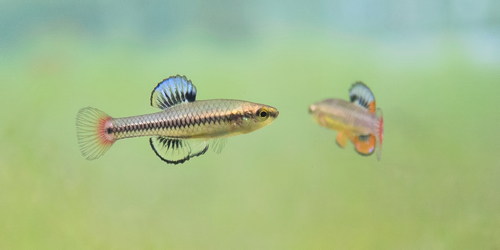
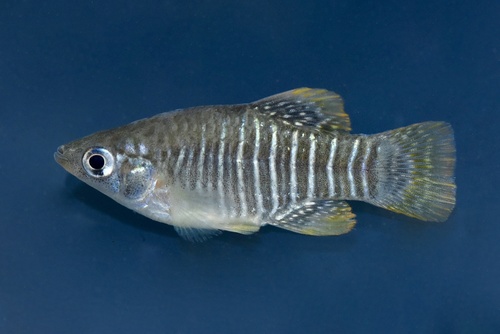
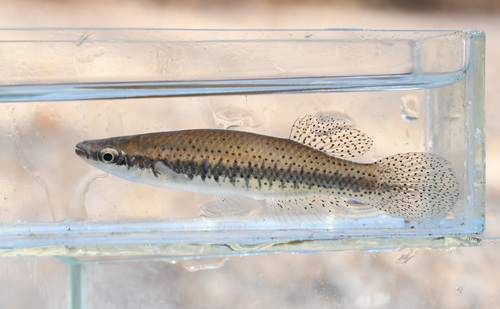
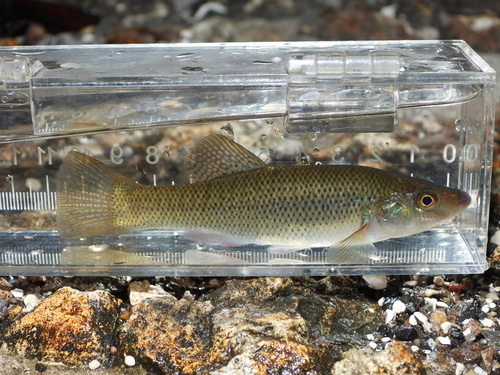
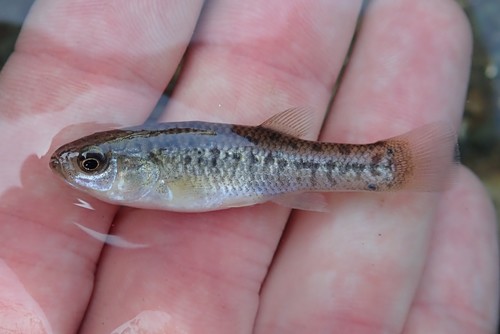
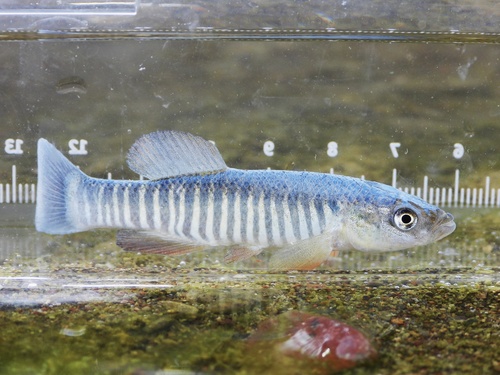
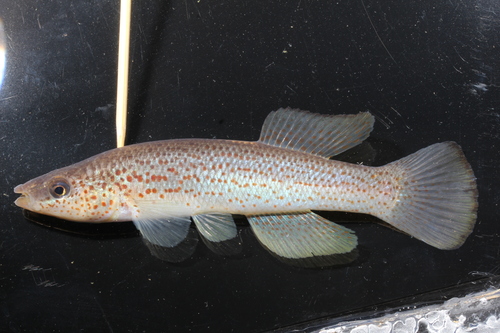
Fundulus stellifer, commonly called the southern studfish, measures 2.2 to 3.9 inches (5.6 to 9.9 cm) in length. Males have elongated posterior dorsal fin rays that may reach the base of the caudal fin. In both sexes, the dorsal fin starts almost directly above the anal fin, and each fin has 12 to 13 rays. Breeding males have striking coloration: distinct, irregular orange spots are speckled across the entire body, extending to the head and fin bases. The body may be iridescent blue, with a gold appearance around the opercula. The pale dorsal and caudal fins may have a variable black margin, and these fins along with the anal fin also carry orange spots. Females have rows of irregular, smaller olive-colored spots, smaller than the orange spots of breeding males. Female fins are olive, rather than pale orange. In 1876, David Starr Jordan reported observing a large pale yellow blotch on the back of living specimens, located in front of the dorsal fin, and he could identify this killifish in the water by searching for this marking. Historically, the southern studfish was distributed across upland tributaries of the Alabama River in Alabama, excluding the Tallapoosa River system; in a small number of headwater tributaries of the Chattahoochee River in northern Georgia; in upper Chattahoochee River drainages in northern Alabama and southeastern Tennessee; and in Tennessee and Cumberland River drainages in eastern Tennessee. Currently, the species still occupies all of its historical distribution range and maintains sustainable populations, unlike the northern studfish (Fundulus catenatus), which appears to be displaced from these areas. There have been minor, non-significant declines in small local areas such as parts of Alabama, and the failure to collect new specimens from previously sampled sites suggests the southern studfish may have been extirpated from the Cahaba River system. It is also thought to have been displaced from the Tallapoosa River system by the stippled studfish (Fundulus bifax). The observed declines are linked to increased road runoff entering local waterways, and increased competition for food and breeding habitat. Abiotic factors that impact this species include its very limited native geographic range and its specific environmental preferences, particularly for water temperature, dissolved oxygen concentration, and salinity. Ambient temperature is widely considered a key abiotic condition that shapes the distribution and abundance of aquatic organisms, and it expands the area suitable for egg laying, because chemical activity generally increases as temperature rises. Both ambient temperature and salinity are critical factors for this species’ survival, due to their effects on the distribution of aquatic organisms. Human activities that alter relevant abiotic factors include modifications to road crossings and urbanization of runoff areas. These changes impact both the physical structure of the southern studfish’s aquatic habitat and the biological conditions of the habitat.