About Fundulus sciadicus Cope, 1865
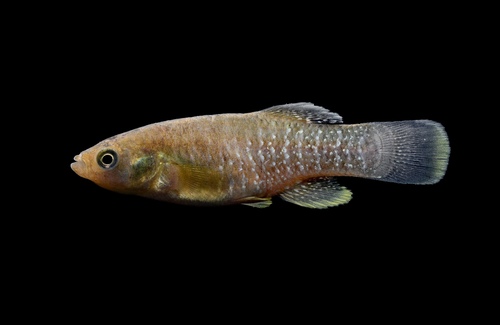
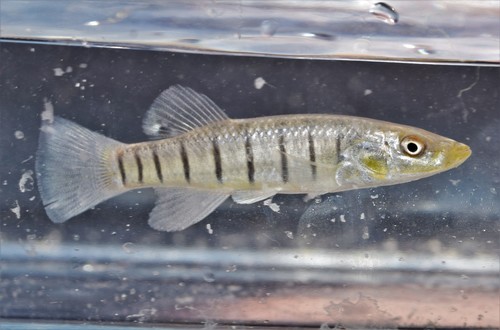
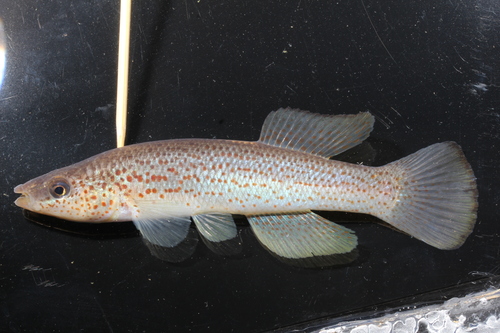
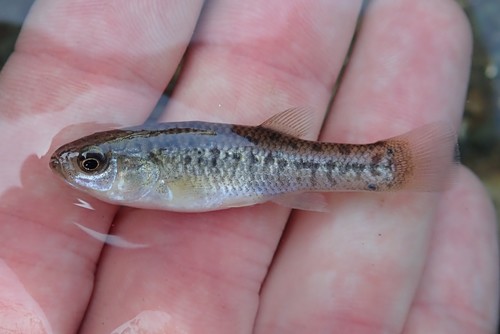
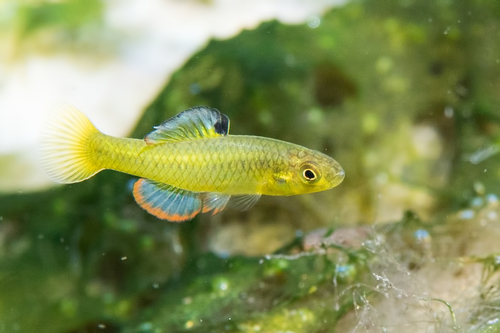
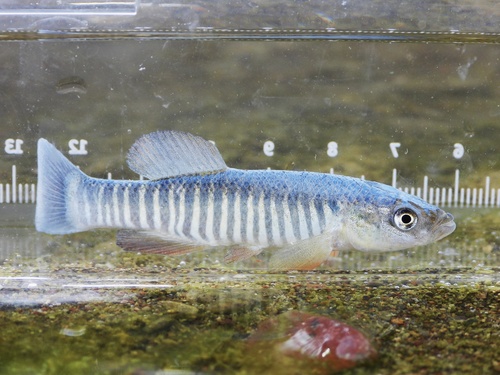
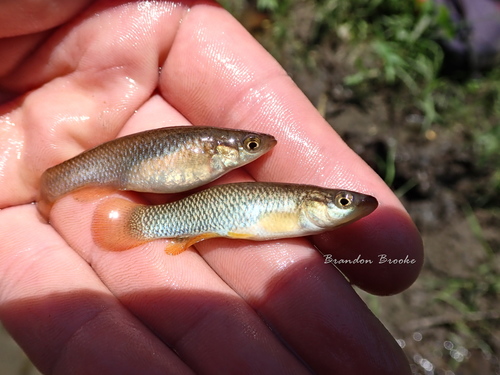
Fundulus sciadicus, commonly called the plains topminnow, is a small fish that almost always grows shorter than 2.5 inches (6.35 cm). It has a flat head and an upturned superior mouth, and lacks any distinctive markings. Breeding males have iridescent fins with red tips marked by blue-purple bands, plus a gold stripe along the body. Both sexes are typically olive-brown with a white underside, and show bronze reflections alongside faint blue-green cross-hatching on the back and sides. The fins of immature fish, females, and non-breeding males are colorless or yellowish. The absence of black bars on its body distinguishes this species from the more common banded killifish, which often shares the same habitats. Other distinct features of the plains topminnow include a rounded or squared caudal fin (squared caudal fin is a shared trait among many topminnows and killifish), and no externally visible lateral line; it has 33 to 37 ctenoid scales along its lateral line. The dorsal fin holds 9–12 rays, the anal fin has 12–15 rays, and the anal fin originates slightly forward of the dorsal fin. Its pelvic fin is small and located in the abdominal position. Apart from breeding season, there is very little sexual dimorphism between males and females; during breeding, males develop bright orange-red fin tips. Historically, the plains topminnow has two main geographically separated populations. The first is centered primarily in Nebraska, extending into Iowa, southwestern Minnesota, northeastern Colorado, and southern South Dakota. The second is found across Missouri, Kansas, and extends south into Oklahoma. The species was historically recorded from only one county each in Iowa and Kansas, and recent studies confirm it is now believed to be extirpated from both states. Plains topminnows prefer shallow, clear, slow-moving water with heavy vegetation; typical habitats with these conditions include sloughs, backwaters, and pools. While they can tolerate somewhat turbid water with moderate currents, they strongly favor the preferred habitat conditions. Most research classifies the plains topminnow as moderately tolerant of hyperthermic and hypoxic conditions, and habitat loss is a major conservation concern for the species. They prefer water temperatures between 5 °C and 22 °C. Plains topminnows spawn in the same vegetated areas they inhabit. When breeding, males develop red coloring on their fins, and both sexes gain a black border along their medial fins. In the well-studied Nebraska populations, males display breeding coloration from June 20 to July 21. Overall, spawning has been observed anywhere from late March to early August; this broad range is thought to be tied to water temperature, so spawning timing generally depends on the latitude of a given population. Despite this variation, the total breeding season lasts 60 days in both Missouri and Nebraska, regardless of latitude or water temperature. Breeding behavior observed in wild individuals moved to aquariums includes direct competition between males. Males size each other up by swimming in circles and attempting to bite each other’s dorsal fins; this contest can last up to 90 minutes, and the behavior results in a small number of dominant breeding males in each population. Males and females have been observed wiggling through algae in their habitat, which is assumed to be ovipositing behavior, as eggs were found in the algae after this activity. Mature eggs of the plains topminnow measure 1.8 to 2.0 mm in diameter.