About Fundulus olivaceus (Storer, 1845)
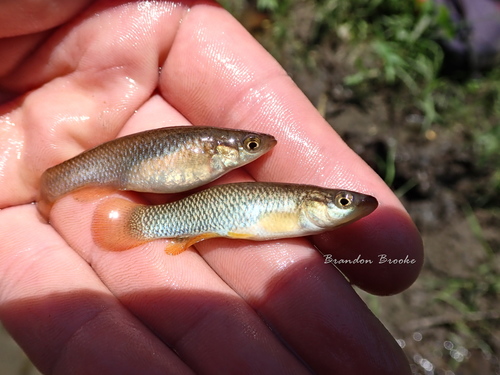
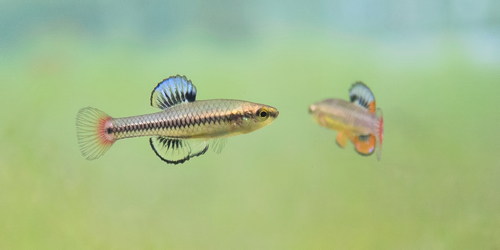
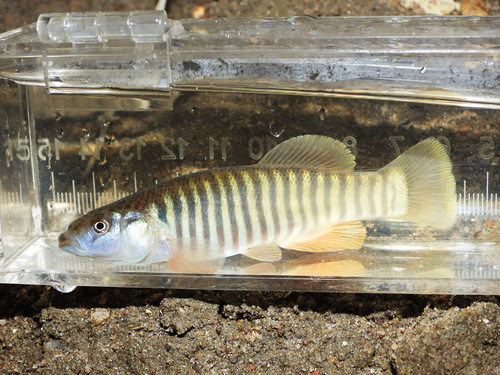
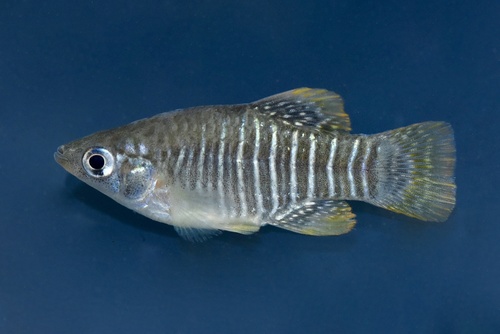
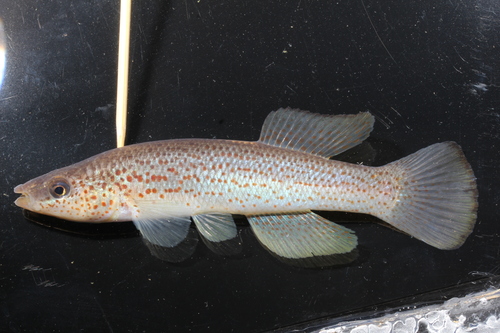
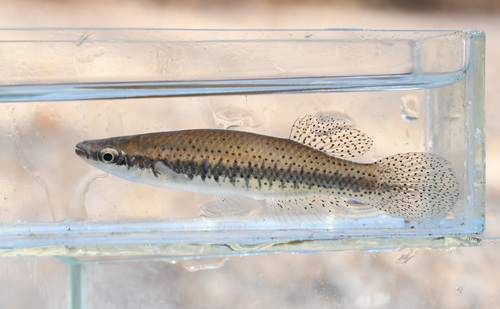
The blackspotted topminnow, Fundulus olivaceus, has an elongated body that reaches up to 9.7 centimetres (3.8 in) in length. Its upper body is brownish yellow to olive green, marked by a wide dark lateral band and distinct dark spots. Males have longer fins than females, and their fins may turn yellowish during the breeding season. This species is very similar to the blackstripe topminnow (Fundulus notatus), which also has a dark lateral band, but can be distinguished by its darker, more numerous spots. The two species are known to hybridize. In F. olivaceus, the gill slit extends dorsally to the uppermost pectoral fin ray. The distance from the origin of the dorsal fin to the end of the hypural plate is less than the distance from the dorsal fin origin to the preopercle, or occasionally equal to this distance. The mouth is slightly supraterminal. Blackspotted topminnows live near the surface of quiet or flowing, relatively clear headwaters, creeks, and small rivers with sand-gravel bottoms. They are often found along margins near thick stands of emergent vegetation. The distribution of the blackspotted topminnow covers the Gulf Slope from the Galveston Bay drainage in Texas, east to the Choctawhatchee River system in Florida, and the middle Chattahoochee River drainage in Georgia. It also occupies the Mississippi River basin from the Gulf north to southeastern Kansas, central Missouri, southern Illinois, western Kentucky, and eastern Tennessee. The spawning season of the blackspotted topminnow runs from March to early September, with peak spawning in May. Large males have occasionally been observed defending open territories of three square meters. In the wild, males rarely tolerate females except during spawning activity in the morning or evening. In aquariums, this fish loses its wild traits and becomes less aggressive, though males will redevelop their wild aggressive traits when spawning approaches. Males will approach each other head-on, flare their opercula and gular areas in a behavior very similar to cichlids or bettas, then slap and bite each other's flanks until one individual retreats. Ripe eggs average 2.14 mm in diameter. The outer membrane of the egg has filaments that are typically concentrated in one area to form a tuft. The eggs hatch in 10–14 days, and the fish has a total lifespan of around 3 years.