About Fundulus dispar (Agassiz, 1854)
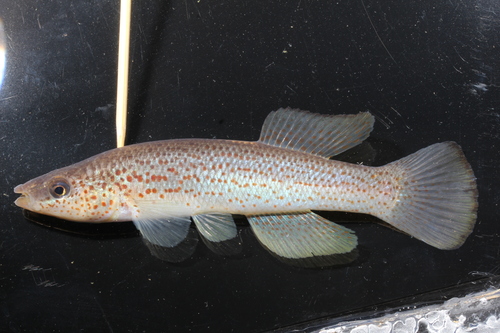
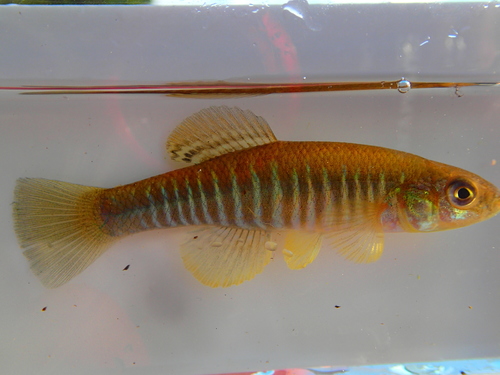
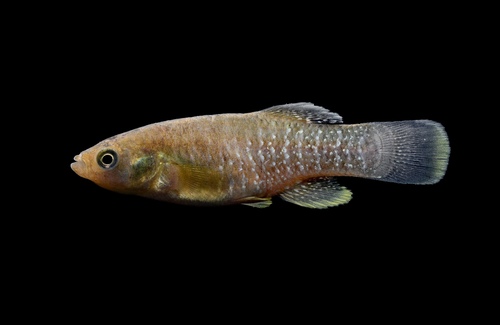
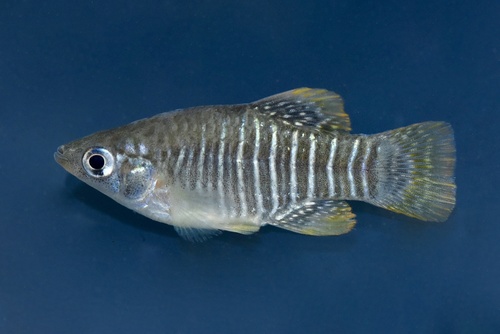
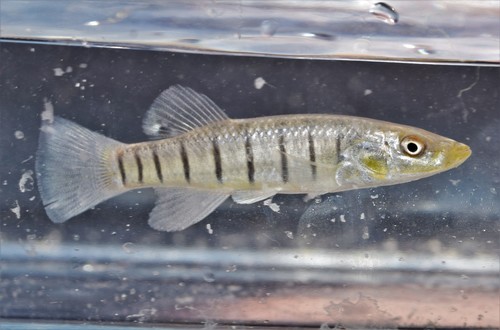
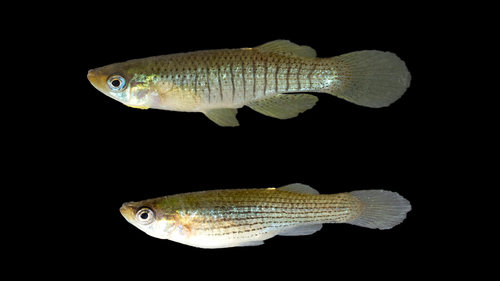
Fundulus dispar, commonly called the starhead topminnow, is identified by a light olive tan back and upper sides, with lighter to yellowish lower sides and belly. It has a series of red to brown lines along its sides: 6 to 8 on females, and 3 to 13 on males. A prominent dark, teardrop-shaped blotch sits beneath its eye. The dorsal fin is positioned far back on the posterior end of the back. Adult starhead topminnows reach 1.8–2.2 inches (47–55 mm) in length. There are 16 to 20 scales around the caudal peduncle, most often 18 to 20. It gets its common name from a bright gold spot on the top of the head, and also has a smaller spot in front of the dorsal fin. This is a freshwater fish that inhabits glacial lakes and clear, well-vegetated floodplain lakes, swamps, and marshes. It prefers quiet areas with abundant submerged vegetation for living and hiding, and spawning occurs within aquatic vegetation beds from June through July. The starhead topminnow is found in the central Mississippi River drainage. Its range extends from the Ouachita River drainage in Louisiana north to the Wisconsin River drainage, and east to the headwaters of the Kankakee River drainage in Indiana. In Illinois, the species has a sporadic distribution, with records from the Fox River Chain of Lakes, Pecatonica, Kankakee, central and lower Illinois, and lower Wabash river drainages, as well as the LaRue-Pine Hills Ecological Area. In 2024, after decades of being presumed extirpated, an isolated starhead topminnow population was discovered in an Iowa Mississippi River slough; this was the first population recorded in Iowa since 1938. The starhead topminnow mating season runs approximately from June to August. During mating season, the maximum number of eggs recorded from a single female is 33. The species does not reproduce when water temperature is below 18.4 °C (65.3 °F) or above 29 °C (84.2 °F). Females prefer to lay eggs among vegetation or on the substrate of their environment. After a single egg is produced and deposited against a substrate among vegetation, both parents abandon the egg. Less than 24 hours after fertilization, eggs are spherical and translucent, with an average diameter of about 1.9 mm. When incubated at approximately 25 °C, eggs hatch in 9–11 days.