About Fundulus diaphanus (Lesueur, 1817)
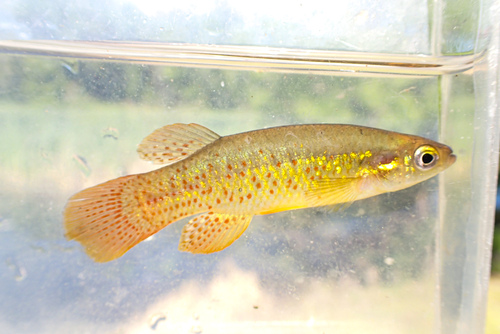
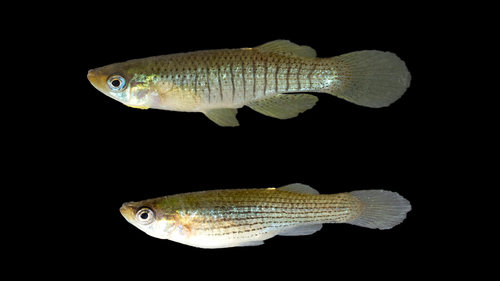
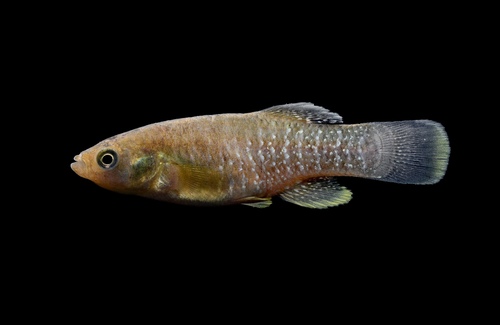
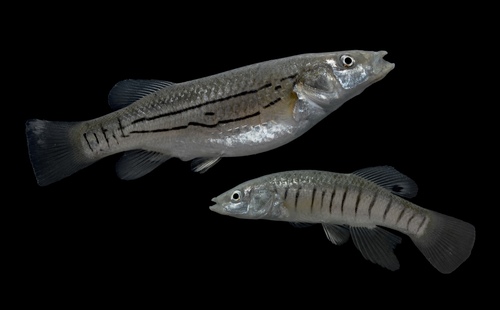
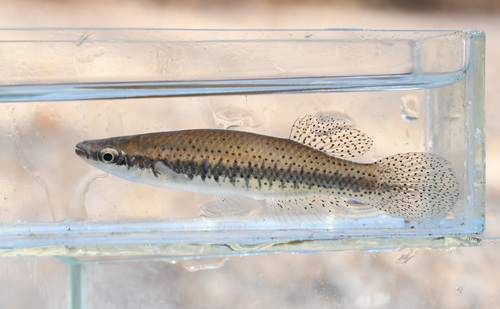
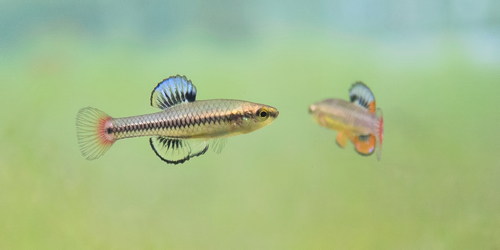
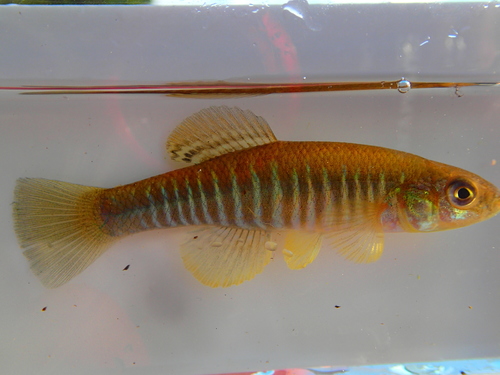
Fundulus diaphanus (Lesueur, 1817), commonly called the banded killifish, has a narrow, elongated bluish-gray or olive body, with a darker upper dorsal surface and white or yellow underparts that reach the anal fin. When spawning, males develop yellow pectoral and pelvic fins, a bright blue patch on the anal fin, and brilliant blue iridescence on the lower body, including the area around the anal fin. There are 12 to 20 vertical bands along the fish's sides. In females, these bands are typically thin, distinct black bands that often do not cover the full width of the body. In males, the bands are silvery, less distinct, and positioned closer together. The number of bands can be used to determine an individual's sex: male banded killifish have more than approximately 9 bands located anterior to the dorsal fin. All fins are rounded; the base of the first dorsal ray sits slightly ahead of, or directly above, the first anal ray. The species has a blunt snout, a small superior mouth, and a projecting lower jaw. A lateral line is absent; there are 39 to 43 scales along the lateral series. There are 10 to 13 dorsal fin rays, 9 to 11 anal fin rays, and 6 pelvic fin rays. The species reaches a maximum total length (TL) of 13 cm (5.1 in), with an average TL of 6.3 cm (2.5 in).
The two recognized subspecies can be distinguished by several traits. The eastern subspecies, F. d. diaphanus, has a more anteriorly positioned dorsal fin than the western subspecies F. d. menona. Males of the eastern subspecies have 9 to 15 anterior bars, compared to 0 to 5 in F. d. menona, and the eastern subspecies also has more intense side bars that remain intact along the anterior back. Eastern subspecies have 45 to 49 scale rows, while western subspecies have 40 to 44. The combined total of dorsal and anal fin rays is 24 to 26 for the eastern subspecies, versus 23 to 24 for the western subspecies. F. d. diaphanus also reaches a larger maximum size than F. d. menona.
The banded killifish shares similar habitat preferences and appearance with the mummichog, Fundulus heteroclitus, and the two species interbreed where their ranges overlap. While banded killifish are euryhaline, they are most often found in freshwater, while mummichogs primarily live in brackish and coastal waters. The two can be distinguished visually by their bands: banded killifish have thin dark bars, while mummichogs have thin light bars. Mummichogs also have a thicker caudal peduncle; banded killifish most often have 6,6 branchiostegal rays, versus 5,5 in mummichogs. Banded killifish also have larger and more numerous gill rakers than mummichogs, with 8 to 12 compared to 4 to 7 in mummichogs. The closely related Waccamaw killifish, Fundulus waccamensis, is endemic to Lake Waccamaw, North Carolina and its tributaries, and differs from the banded killifish by having a slimmer profile; the two species have no overlapping range.
The banded killifish is widely distributed across eastern North America, ranging from the Pee Dee River in South Carolina north to Newfoundland. It is also found in southern Pennsylvania, northeastern Nebraska, northern Illinois, and extends north into the St. Lawrence-Great Lakes and Mississippi River basins from Manitoba to Quebec. The eastern subspecies occurs on the Atlantic Slope, while the western subspecies occupies the remainder of the species' range. Westward range expansion by the eastern subspecies may be the result of introductions as bait or aquarium fish into new water bodies, climate change expanding favorable habitat, or higher pollution tolerance than the western subspecies. The Newfoundland population of banded killifish has been assigned special concern status by the Committee on the Status of Endangered Wildlife in Canada (COSEWIC) due to its biogeographical isolation and limited potential for range expansion. In the United States, Ohio lists the western subspecies as endangered, and Illinois lists it as threatened, both due to range expansion of the eastern subspecies, which hybridizes wherever the two subspecies' ranges overlap. Ohio also classifies F. d. diaphanus as an injurious aquatic invasive species. Intergrades form in the Saint Lawrence and Lake Erie drainages, where the two subspecies naturally come into contact. Banded killifish have been introduced outside of their native range to the U.S. states of Idaho, Ohio, Oregon, Pennsylvania, South Dakota, Washington, and West Virginia; in Oregon and Washington, the introduced subspecies is reported to be the western banded killifish.
Adults of the species typically live 2 to 3 years. Banded killifish are schooling fish: adults usually swim in groups of 3 to 6 individuals, while juveniles swim in groups of 8 to 12. They are most often found in shallow, quiet areas of clear lakes, ponds, rivers, and estuaries with sandy gravel or muddy bottoms and abundant aquatic vegetation. Sandy gravel substrates provide hiding spots for hatchlings and juveniles avoiding predatory fish such as largemouth bass (Micropterus salmoides), northern pike (Esox lucius), bluegill (Lepomis macrochirus), and trout. Due to their small size, banded killifish generally do not enter deeper waters, where they would be more vulnerable to predation and unable to navigate fast currents. However, adult banded killifish have been observed moving into deep water to feed. They often gather near aquatic vegetation, which provides both protection and breeding habitat. While they are euryhaline, they most often live in freshwater streams and lakes. The largest recorded adult, from Indian Bay, Canada, measured 12.8 cm (5.0 in) TL.
Humans use banded killifish as fish bait. They are not popular as aquarium pets because they require high maintenance and do not survive well in home aquariums. The species plays an important role in aquatic ecosystems as a food source for larger predatory fish, including largemouth bass, northern pike, and trout, as well as for birds including the belted kingfisher (Megaceryle alcyon), common merganser (Mergus merganser), and herons. In January 2005, the Newfoundland population of banded killifish was listed as vulnerable under the Newfoundland Labrador Endangered Species Act and the Canada Species at Risk Act (SARA). This population faces habitat degradation from industrial development, motorized watercraft activity, and removal of aquatic vegetation.
Banded killifish spawn in dense aquatic vegetation; they use external fertilization, and females lay eggs fitted with adhesive threads that stick to plants. Spawning takes place from June to mid-August in shallow waters, at water temperatures between 21 and 23 °C (70 to 73 °F). During the spawning season, males undergo color changes, developing the bright blue anal fin patch and blue lower body coloration described above. Males claim and defend a spawning site in shallow water from other males. When a female arrives, the male courts her and fights other competing males. The female releases one egg as the male pursues her; after pairing, the female releases 10 eggs that either fall to the substrate or attach to aquatic plants in the chosen spawning area. Males continue pursuing females until they have laid a total of 50 to 100 eggs. A single female can lay several clutches of eggs over one summer. After fertilization, both parents leave the area and do not provide any parental care to the eggs. Fry, which are 6–7 mm (0.24–0.28 in) long when they hatch, emerge 10 to 12 days after laying, depending on water temperature. Banded killifish reach maturity at around 1 year old, with an average length of 6 cm (2.4 in). The species generally lives a little over 2 years, though some individuals have been recorded living up to 3 years.