About Funambulus pennantii Wroughton, 1905
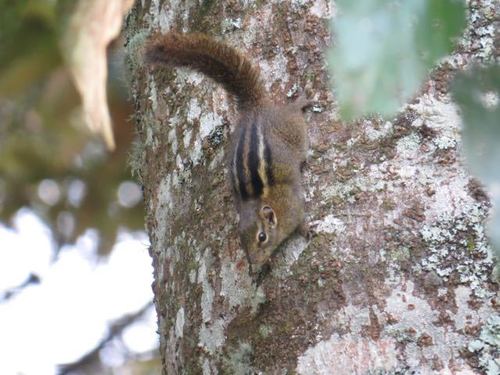
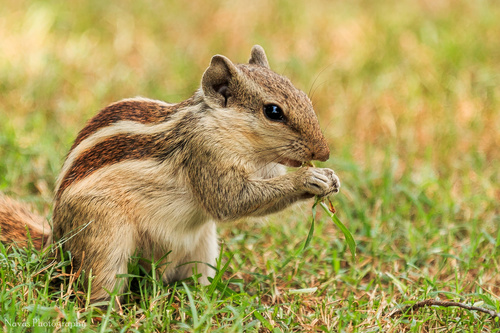
The northern palm squirrel (Funambulus pennantii), also called the five-striped palm squirrel, is a rodent species in the family Sciuridae. Some taxonomic authorities recognize two subspecies: F. p. pennantii and F. p. argentescens. Wroughton originally suggested two additional subspecies (F. p. argentescens and F. p. lutescens) alongside the nominate race, but more recent researchers do not recognize this distinction. Thorington and Hoffman, in Wilson and Reeder (2005), only listed the two subspecies F. p. pennantii and F. p. argentescens. Ghose et al. (2004) described two further subspecies: F. p. chhattisgarhi, found in eastern Maharashtra, Madhya Pradesh, Orissa, West Bengal, and Bihar, and F. p. gangutrianus, found in West Bengal, Madhya Pradesh, Uttar Pradesh, and Nepal. However, Talmale (2007) treated Maharashtra populations as only F. p. pennantii, due to overlapping measurements and observed color variation in specimens. This is a semi-arboreal species that can live in a wide variety of habitats. It is very adaptable, occurring in tropical and subtropical dry deciduous forests, montane forests up to altitudes of 4,000 m (13,123 ft), scrublands, plantations, grasslands, arable land, rural gardens, and urban areas. Its native range covers the Andaman Islands, India, Nepal, Bangladesh, Pakistan, and Iran. It was introduced to the Nicobar Islands, and has also been introduced to Australia and the United Arab Emirates through the exotic pet trade. In Australia, it occupies a very limited area. An established population exists around Perth, Western Australia, originating from individuals that escaped from Perth Zoo; this feral population (called the five-lined palm squirrel locally) lives on Perth Zoo grounds and extends into surrounding suburbs. A population was recorded near Taronga Zoo in Mosman, New South Wales, but this population may now be extinct. In the introduced Perth population, births occur from August to May, with the highest intensity of birthing around Australian spring and autumn. In its native India, this squirrel is fairly common in urban areas, even in large cities such as Delhi and Kolkata. The southern boundary of the species' range in India is not clearly defined. Recent records suggest its range may extend as far south as Madanapalli. On the Western Ghats side, the southern range boundary reaches localities including Dharwar and Mysore in Karnataka. The northern palm squirrel is a common species with a wide distribution range, and the International Union for Conservation of Nature has assessed its conservation status as least concern.