About Fumaria officinalis L.
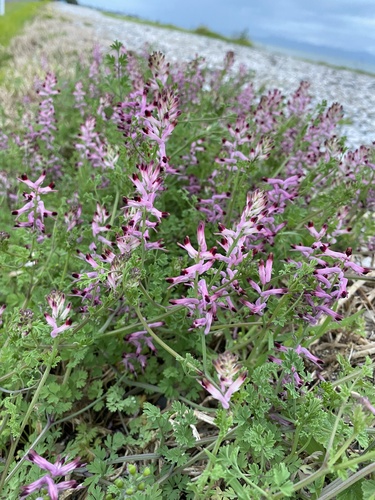
Fumaria officinalis L. is an herbaceous annual plant with a weakly erect, scrambling growth habit. Its stalks grow between 10 and 50 cm (3.9 to 19.7 in) long, and it produces slender green leaves.
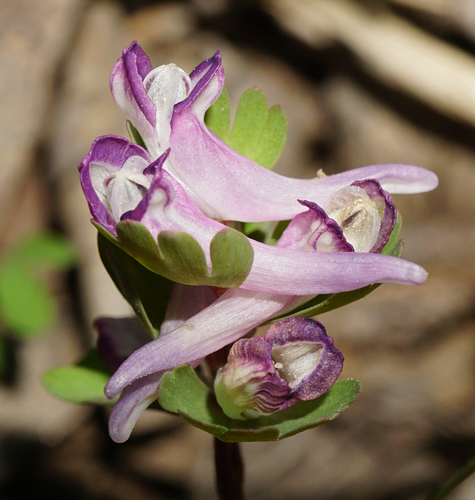
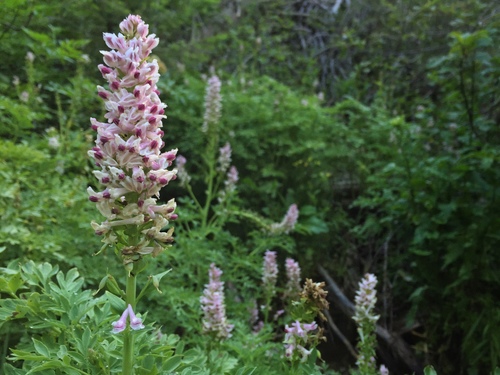
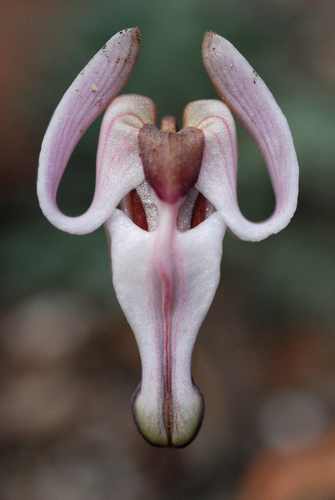
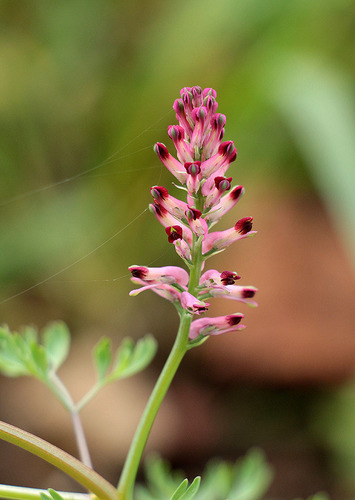
Its 7 to 9 mm (0.28 to 0.35 in) pink flowers are bilabiate (two-lipped) and spurred, with sepals that reach one quarter the length of the petals. In the northern hemisphere, flowers bloom from April to October; in the UK specifically, blooming occurs from May to September. Flower spikes typically hold more than 20 and up to 60 flowers each.
The fruit is a single-seeded achene. It is roughly globular in shape, slightly wider than it is tall, and has an apical notch. This plant contains alkaloids, potassium salts, tannins, and is a source of fumaric acid.
Fumaria officinalis is native to temperate regions of North Africa, Europe, and parts of Western Asia. Within its native North African range, it occurs in Macaronesia, the Canary Islands, Algeria, Egypt, Libya, Morocco, and Tunisia. In native Western Asia, it is found in the Caucasus, Cyprus, Iraq, Israel, Lebanon, Siberia, Syria, and Turkey. Across Europe, it is native to eastern Europe (Belarus, Estonia, Latvia, Lithuania, and Ukraine), middle Europe (Austria, Belgium, Germany, Hungary, Netherlands, Poland, Slovakia, and Switzerland), northern Europe (Denmark, Ireland, Norway, Sweden, and the United Kingdom), southeastern Europe (Albania, Bosnia and Herzegovina, Bulgaria, Croatia, Greece, Italy, Montenegro, North Macedonia, Romania, Serbia, and Slovenia), and southwestern Europe (France, Portugal, and Spain). It has been introduced to Australia, where it is now common.