About Fulmarus glacialoides (A.Smith, 1840)
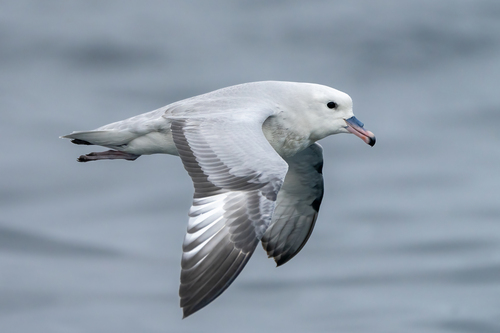
Fulmarus glacialoides (A.Smith, 1840) is a fairly large, bulky petrel. Adults measure 45 to 50 cm (18–20 in) in length, with a wingspan of 110 to 120 cm (43–47 in). Males have an average weight of 795 g (28.0 oz), while the smaller females average around 740 g (26 oz). At the start of an incubation shift, average weights increase to 1,005 g (35.5 oz) for males and 932 g (32.9 oz) for females. Standard measurements for males are 34 cm (13 in) wing length, 44.6 mm (1.76 in) bill length, 52.1 mm (2.05 in) tarsus length, and 12.4 cm (4.88 in) tail length. For females, standard measurements are 33.9 cm (13.3 in) wing length, 43 mm (1.69 in) bill length, 51.5 mm (2.03 in) tarsus length, and 12.1 cm (4.8 in) tail length. This species flies using a combination of shallow wing flaps and long glides, and often looks downward to scan the water. Its wings are fairly broad and rounded, and held stiff during flight. Its plumage is mostly pale silvery-grey on the upper body and white on the lower body. The head is white, with a pale grey crown. Wingtips are blackish with a large white patch, and the wings have a dark rear edge. Legs and feet are pale blue. The bill is pink with a black tip and dark bluish naricorns. First-year individuals have a more slender bill than full-grown adults. The species is usually silent, but produces loud cackling calls at the nest or in feeding flocks. Courting birds make soft droning and guttural croaking calls. Breeding colonies are located on a number of islands around Antarctica, including the South Sandwich Islands, South Orkney Islands, South Shetland Islands, Bouvet Island, and Peter I Island. It also breeds at multiple sites along Antarctica's mainland coast. At sea, it is mainly found along the outer edge of pack ice in summer, in water with temperatures between −1.5 and 0.5 °C. In winter, it regularly ranges north to around 40°S latitude. It travels further north into the cool waters of the Humboldt Current, reaching as far as Peru. Small numbers have been sighted off the coasts of South Africa, southern Australia, and New Zealand. Large numbers of individuals may wash up on beaches after storms. There are several unconfirmed reports of this species from the west coast of North America. It is a common species with a total population of at least 4 million individuals. Around one million breeding pairs live on the South Sandwich Islands alone. The species is not considered at risk of extinction, and is classified as Least Concern by BirdLife International.