About Fulica rufifrons Philippi & Landbeck, 1861
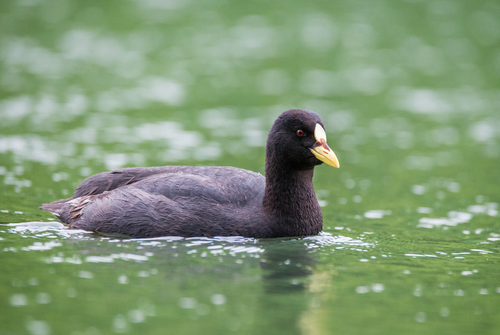
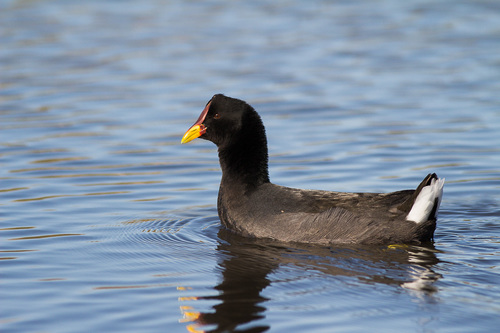
The red-fronted coot (Fulica rufifrons Philippi & Landbeck, 1861) measures 38 to 43 cm (15 to 17 in) in length. Male individuals weigh between 685 and 735 g (24 and 26 oz), while females weigh approximately 550 g (19 oz). The two sexes have identical appearance. Adult red-fronted coots have a yellow bill, a dark chestnut-red frontal shield, and olive legs and feet. Unlike all other coots, this species does not have lobed feet. Its plumage is almost entirely dark slate gray, with the only exception being white undertail coverts. Juveniles have a blackish bill, white spots on the throat, and gray-brown plumage that shares the same white undertail coverts seen in adults. The species is found along the coast from southern Peru to central Chile, in at least one site in Bolivia, and from southeastern Brazil south through Uruguay to east central Argentina. It has also been recorded as a vagrant in Paraguay and the Falkland Islands; the most recent sighting in the Falkland Islands was in 1924. The Clements checklist extends the species' range to include Tierra del Fuego. Fossils of the red-fronted coot have been recovered from the Laguna de Tagua Tagua formation in Chile. The red-fronted coot is primarily a lowland bird, normally found between sea level and 800 m (2,600 ft). However, it occurs casually up to 2,100 m (6,900 ft) in Argentina, and is regularly found at 3,700 m (12,100 ft) at Alalay Lake, Bolivia. It inhabits the shallow waters of semi-open marshes and reedy lakes, particularly those that host floating vegetation like duckweed.