About Fulica gigantea Eydoux & Souleyet, 1841
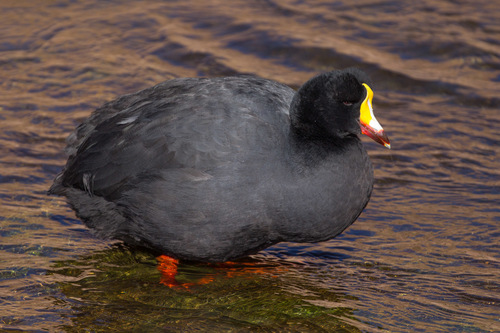
This species, the giant coot, has the scientific name Fulica gigantea Eydoux & Souleyet, 1841. It is the second largest extant member of the Rallidae family, only smaller than the New Zealand takahē. Adult giant coots measure 48 to 59 cm (19 to 23 in) in length and weigh between approximately 2,000 and 2,500 g (4.4 to 5.5 lb). Adults are too heavy to fly, though immature birds are smaller and can fly easily. The two sexes have identical appearance. Adults have a bulky body paired with a disproportionately small head. Their plumage is a deep slaty gray, and appears blacker on the head and neck. Their undertail coverts have faint white streaking. Their bill is deep red, with some yellow coloring at the base of the maxilla, their frontal shield is yellow, and unlike all other coots, their legs and feet are deep red. Immature birds have dark gray underparts, and paler bills and legs than adult birds. Juvenile giant coots are dark dull gray, with some white marking on the face and dusky legs. The giant coot ranges across southern Peru, through western Bolivia, and into northern Chile and northwestern Argentina. It lives on the Altiplano, a generally barren high-elevation landscape. Within this region, it lives in ponds and lakes, particularly those with weedy shallow areas. It is mostly found at elevations between 3,600 and 5,000 m (11,800 and 16,400 ft), but occurs regularly as high as 6,540 m (21,500 ft), and occasionally wanders as far as the Pacific coast.