About Fulica cristata Gmelin, 1789
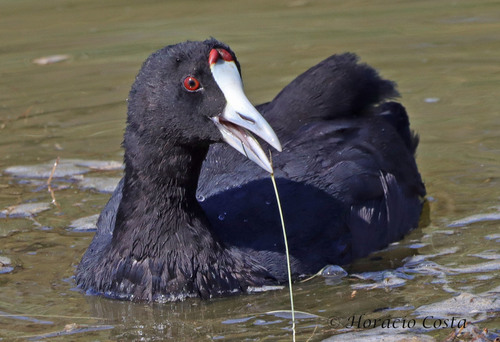
Description: The red-knobbed coot is mostly black, with the exception of a white frontal shield. It is 35–42 cm (14–17 in) in length, with a wingspan of 75–85 cm (30–33 in). Males weigh between 770–910 g (27–32 oz), while females are slightly smaller, weighing 455–790 g (16.0–27.9 oz). Male and female red-knobbed coots look identical. As a swimming water bird, it has partial webbing on its long, strong toes. Juvenile red-knobbed coots are paler than adults, have a whitish breast, and lack the adult’s facial shield. The adult’s solid black plumage develops when the bird is about 3 to 4 months old, but the white facial shield only becomes fully developed at around one year of age. A clear close view is required to tell this species apart from the Eurasian coot, which shares an overlapping range with the red-knobbed coot in northwestern Africa and southern Iberia. Red-knobbed coots have two tiny red knobs at the top of their facial shield; these knobs are not visible from far away and only grow during the breeding season. The black feathering between the red-knobbed coot’s shield and bill is rounded, while this same feathering forms a point on the Eurasian coot. The red-knobbed coot’s bill also has a faint bluish grey tinge. When in flight, the red-knobbed coot lacks the white trailing edge on the secondaries that is present on the Eurasian coot. Food and feeding: The red-knobbed coot is an omnivore that eats a wide range of small live prey, including the eggs of other water birds. In most of the watery habitats it occupies, the main part of its diet is made up of various waterweeds, such as species in the genus Potamogeton, which it commonly dives to obtain. The red-knobbed coot is a noisy bird during the mating season, and its vocalizations are quite different from those of the Eurasian coot. It produces a fast kerrre call similar to that of the little crake, a harsh ka-haa call, and a grunting hoot that sounds like "oot oot". This call pattern has led to suggestions that the name "coot" might be onomatopoeic, but a review of the etymology of the word "coot" clearly rules out this idea.