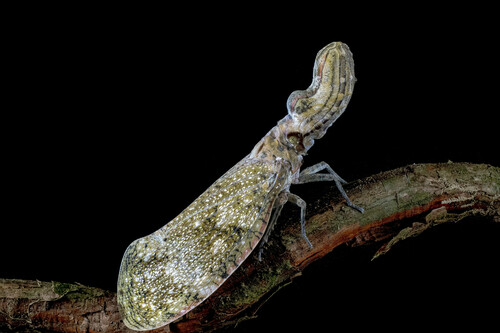
About Fulgora laternaria (Linnaeus, 1758)
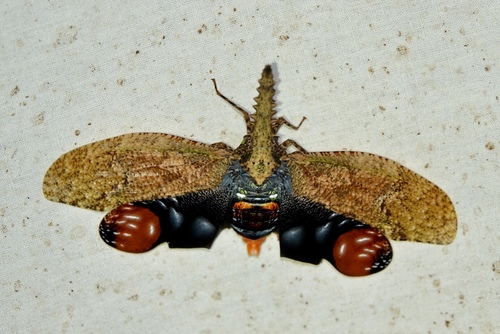
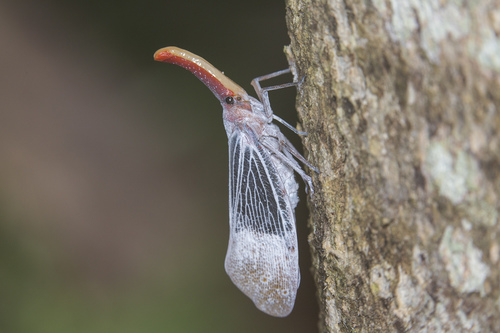
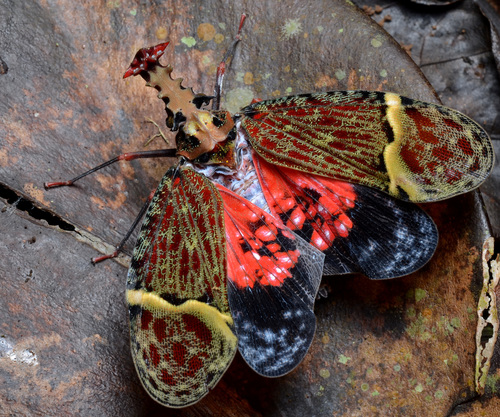
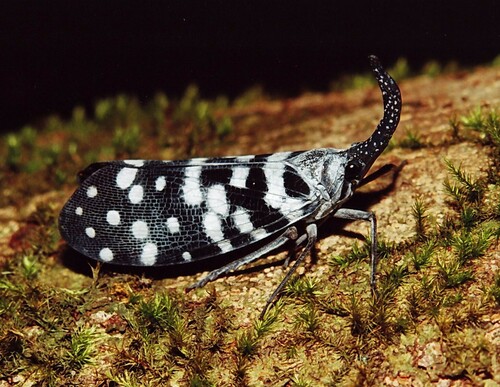
Fulgora laternaria (Linnaeus, 1758) can reach a body length of 85–90 millimetres (3.3–3.5 in), with a wingspan ranging from 100–150 millimetres (3.9–5.9 in). This insect has a 10–15 millimetre (0.39–0.59 in) protuberance on its head that looks like a peanut, and it also bears false eyes that make it resemble a lizard or serpent. Originally, this species was mistakenly thought to be luminescent. When attacked, Fulgora laternaria defends itself by displaying large yellow fake eyes on its hind wings to startle aggressors, and also releases a foul-smelling substance. Adult individuals of this species are active and can be found between June and December each year. They feed on plant sap, primarily obtained from tree species including Hymenaea courbaril, Simarouba amara, and members of the Zanthoxylum genus. During the day, this insect generally stays camouflaged against tree trunks. To attract mates, it knocks its head against hollow trees to produce vibrations. It lays its eggs on the Hymenaea courbaril, or quapinol, tree, and coats the eggs with a waxy protective substance. Multiple very similar species in the Fulgora genus are found from Central to South America, and many museum and commercial specimens labeled as Fulgora laternaria are actually other distinct species. This species lives in tropical forests across Mexico, Central America, and South America.