About Fuchsia perscandens Cockayne & Allan
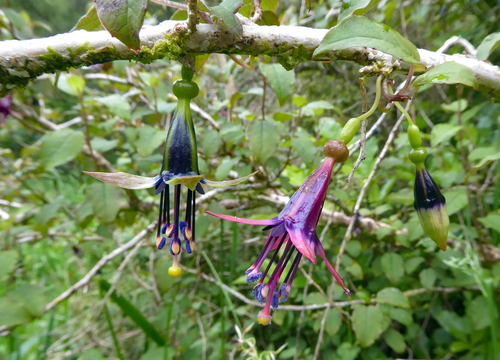
Fuchsia perscandens Cockayne & Allan is a semi-trailing climbing shrub, which is also classified as a scrambling liane. Per the work of Godley, Berry, and Wilson, the plant's growth form depends on the support it receives. Its primary shoot begins growing upward without support, then climbs over other shrubs or crawls along the ground in search of support. It can develop into a shrub in exposed sites, or grow into a lianoid climbing form. This species has thick main stems that reach up to 5 cm (2.0 in) in diameter and approximately 5 m (16 ft) in length. It is sparingly branched, with pale brown bark; older stems have pale orange-fawn bark. The bark typically peels off in papery-thin flakes and strips, and new small branches are covered in fine hairs when young. Fuchsia perscandens is endemic to New Zealand. It occurs on both of the country's main islands but is not common. It is not found in the warmer northern region of the North Island. While specimens were recorded north of Auckland in the 19th century, these populations have likely been lost to deforestation. It is thought that the species was once common in the lower Waikato area, growing at the base of trees in white pine (Dacrycarpus dacrydioides) forests. Only a small number of plants remain in this area, where the species is now rare, and this area is currently considered the most northerly location of the species. Fuchsia perscandens is most often found in forests, particularly in forest clearings or along forest edges, as well as in coastal shrub and shrubland. It sometimes grows among rocks in open areas, and can be found at altitudes ranging from sea level up to 750 m. Its preferred habitats are river terraces and remnants of white pine swamp forest, but it has also been recorded growing on limestone, for example in the Wairarapa and Marlborough regions. Fuchsia perscandens flowers from July or August through to December. Godley and Berry collected the most flowering specimens in October (14 specimens) and November (7 specimens). Open flowers last approximately 11 days, and change color during this period: they start green with purple streaks, and turn deep purple. This species can reproduce in two ways: sexually via seed, and asexually via division. As Sweetman notes, Fuchsia perscandens has a generally spreading growth habit: shoots layer themselves to produce new independent plants. Sexual reproduction occurs after pollination, when fruits develop. Seeds are dispersed by animals that eat the berries, a dispersal method called endozoochory. The fleshy texture of the berries attracts animals and acts as a reward to encourage further seed dispersal activity. Wilson states that there is insufficient available information about the timeframe when Fuchsia perscandens produces fruit, though Eagle observed berries on plants in a Taumarunui reserve in December.