About Fritillaria pudica (Pursh) Spreng.
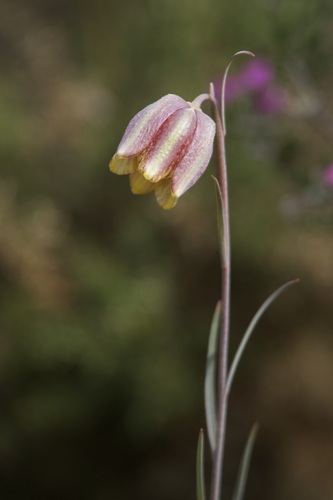
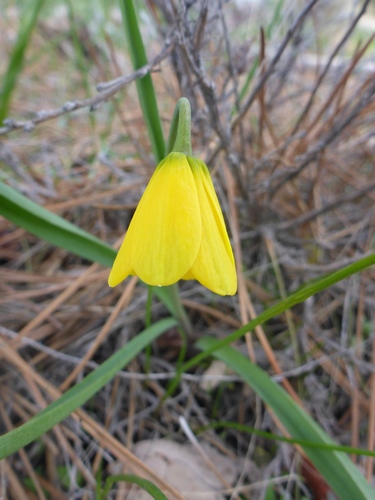
Fritillaria pudica (Pursh) Spreng., commonly known as the yellow fritillary, is a small perennial plant in the lily family Liliaceae. Another common but somewhat ambiguous name for this species is "yellow bells", which comes from its bell-shaped yellow flower. This plant is found in sagebrush areas of the western United States, including Idaho, Montana, Oregon, Washington, Wyoming, very northern California, Nevada, northwestern Colorado, North Dakota and Utah, and in the Canadian provinces of Alberta and British Columbia. It typically grows in dryish, loose soil, and is among the first plants to flower after snow melts. Its flowers do not last very long; as petals age, they turn brick-red and begin to curl outward. Flowers grow singly or in pairs on stems, and all floral parts grow in multiples of three. The species produces a small corm, and the production of multiple small corms gives the whole genus the nickname "riceroot". Meriwether Lewis collected a specimen of this species during his historic journey while passing through Idaho in 1806. The corm can be dug up and eaten either fresh or cooked. It was historically a good food source for Native Americans, and is still eaten occasionally today. Because the species is no longer common, digging and consuming its corms is not encouraged. This plant is called [q̓aw̓x̌e] in the Salish language and [ˈsɨkni] in the Sahaptin language. Yellow bells corms have a similar nutrient profile to potatoes, but contain 50 percent more protein, six times as much calcium, and nearly 30 times more iron. Per 100g of fresh weight, yellow bells corms have 64 calories, which is higher than the 61 calories per 100g of common camas, but lower than the 98 calories per 100g of northern riceroot. Compared to both common camas and northern riceroot, yellow bells corms are slightly higher in fat, much higher in calcium, and lower in carbohydrates.