About Fritillaria meleagris L.
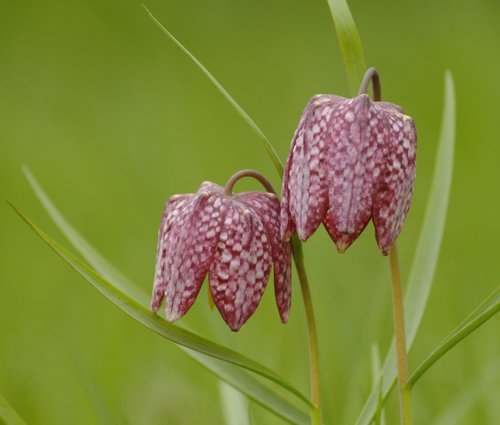
Fritillaria meleagris L. (snake's head fritillary) has flowers with a chequered pattern in purple shades, and occasionally produces pure white flowers. It blooms from March to May, and reaches a height between 15–40 cm (6–16 in). The plant grows from a button-shaped bulb, around 2 cm (0.79 in) in diameter, that contains poisonous alkaloids. Its natural habitat is grasslands with damp soil and river meadows, growing at altitudes up to 800 m (2,625 ft). This species is native to Europe and western Asia. In many parts of its range, it is classified as an endangered species that is rare in the wild, but it is widely cultivated in gardens. In Croatia, this flower is called kockavica, and is linked by some to the country's national symbol. It is the official flower of the Swedish province of Uppland, where it forms large spring populations in the meadows of Kungsängen (King’s Meadow), just outside Uppsala. This location gives the flower its Swedish common name, kungsängslilja, meaning "king's meadow lily". It can also be found in sites including Sandemar Nature Reserve, a reserve west of Dalarö in the Stockholm Archipelago. In cultivation, this plant is widely available as an ornamental spring bulb for gardens, and it is commonly sold as a mix of different colored cultivars. Both the standard species and the pure white-flowered variety F. meleagris var. unicolor subvar. alba have been awarded the Royal Horticultural Society's Award of Garden Merit. Fritillaria meleagris is used for many different planting settings, including borders, containers, cottage gardens, informal gardens, woodland gardens, wildflower meadows, rock gardens, and naturalized areas.