About Fritillaria imperialis L.
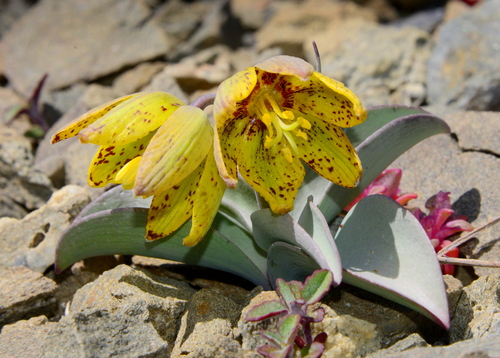
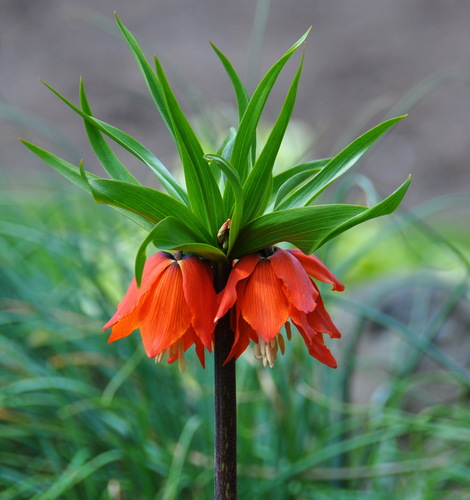
Fritillaria imperialis L. grows to about 1 m (3 ft) in height. It produces glossy, lance-shaped leaves spaced at intervals along its stem. At the top of the stem, it grows a prominent whorl of downward-facing flowers, which is topped by a small-leaf 'crown'—this structure gives the species its common name. While wild Fritillaria imperialis are typically orange-red, cultivated varieties come in a range of colors from nearly pure scarlet through orange shades to yellow. These pendulous flowers create a striking display in late spring gardens; in the northern hemisphere, flowering occurs in late spring. The flowers also produce a distinct foxy scent that repels mice, moles, and other small animals. Due to its large size, Fritillaria imperialis is pollinated by the Eurasian blue tit, making it a rare example of bird pollination (ornithophily) at northern latitudes. In cultivation, both the unmodified species and the yellow-flowered cultivar 'Maximea Lutea' have earned the Royal Horticultural Society's Award of Garden Merit. Additional cultivars in red, yellow, and orange shades are also available for garden use. Like other members of the lily family, Fritillaria imperialis is vulnerable to damage from the scarlet lily beetle (Lilioceris lilii). Fritillaria imperialis is easy to grow when planted in well-drained soil in a sunny location. The plant is drought tolerant, and its bulbs should be planted in early autumn. Bulbs of this species cannot tolerate being left exposed to open air for long periods.