About Fringilla montifringilla Linnaeus, 1758
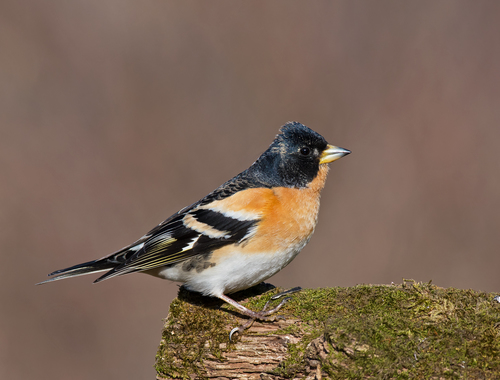
The brambling (scientific name: Fringilla montifringilla Linnaeus, 1758) is similar in size and shape to the common chaffinch. Breeding-plumaged male bramblings are very distinctive, with a black head, dark upperparts, orange breast, and white belly. Females and younger birds are less distinct, and more similar in appearance to some chaffinches. In all plumages, however, bramblings differ from chaffinches in a number of features: bramblings have a white rump, while the common chaffinch's rump is grey-green; bramblings have an orange breast that contrasts with a white belly, while the common chaffinch's underparts are more uniformly coloured, either pink or buff; the brambling's scapular feathers are orange, while the common chaffinch's are grey or grey-brown; bramblings have dark-spotted flanks, while common chaffinches have plain flanks; bramblings lack the white outer tail feathers that common chaffinches have. An additional difference for all plumages except breeding-plumaged males is bill colour: bramblings have yellow bills, while common chaffinches have dull pinkish bills. Breeding-plumaged male bramblings have black bills, and common chaffinches in the corresponding plumage have grey bills. Standard measurements for the species are: length 16 cm, weight 23–29 g, and wingspan 25–26 cm. During the breeding season, this bird is widespread throughout the forests of northern Europe, and ranges east across the Palearctic. It is a migratory species, wintering in southern Europe, North Africa, northern India, northern Pakistan, China, and Japan. It frequently strays into Alaska during migration, and there are scattered records of the species across the northern United States and southern Canada. The global population of bramblings is approximately 100 to 200 million individuals, with a decreasing population trend. For breeding, bramblings favour open coniferous or birch woodland. In terms of feeding, bramblings mostly eat seeds during winter, and eat insects during summer.