About Freycinetia arborea Gaudich.
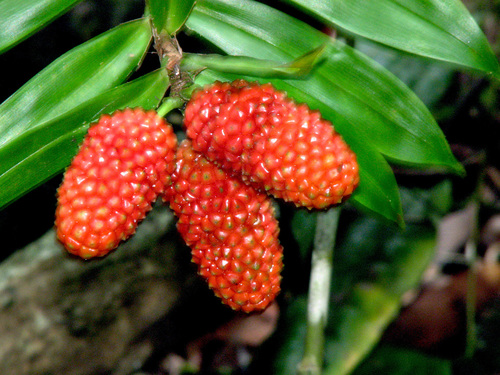
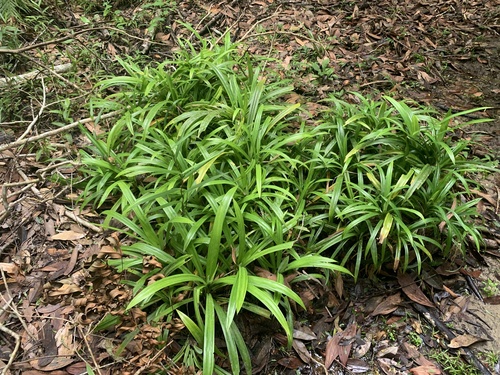
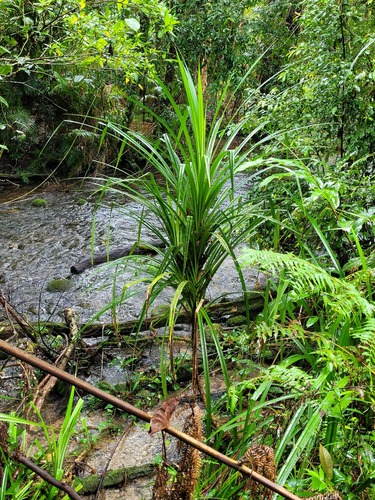
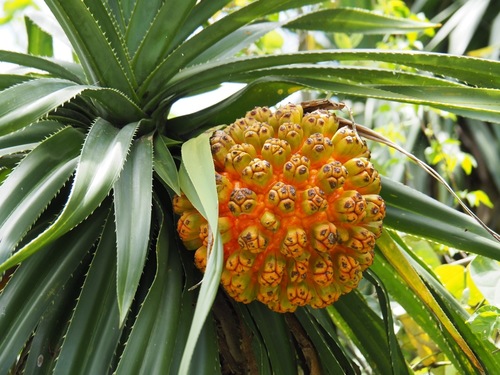
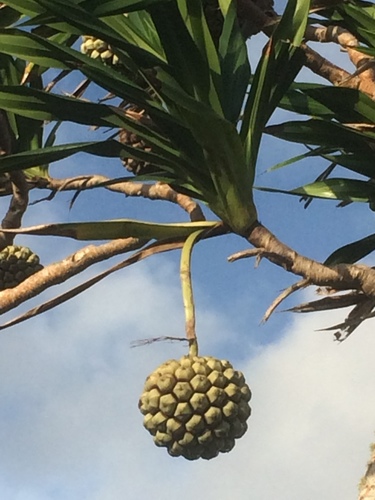
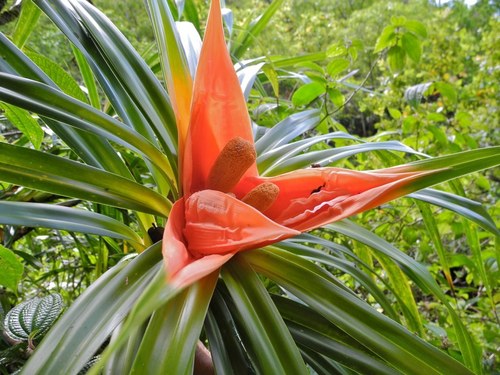
Freycinetia arborea Gaudich. (ʻieʻie) has shiny green leaves with pointed tips. The leaves bear spines along the lower surface of their midrib and along their edges. They measure 40–80 centimetres (16–31 in) long and 1–3 centimetres (0.39–1.18 in) wide, and grow in a spiral arrangement around the ends of branches. Flowers develop in spike-shaped inflorescences at branch ends, and individual plants produce either staminate (male) or pistillate (female) flowers. Staminate spikes are yellowish-white and reach up to 10 centimetres (3.9 in) in length. Pistillate spikes are initially 3–4 centimetres (1.2–1.6 in) long, and elongate to 7.5–9.5 centimetres (3.0–3.7 in) as fruit develops. Groups of three to four spikes are enclosed by orange-salmon colored bracts. Its fruit is 1 centimetre (0.39 in) long and holds many 1.5-millimetre (0.059 in) seeds. The bracts and fruit of ʻieʻie were a preferred food of the ʻōʻū (Psittirostra psittacea), an extinct Hawaiian honeycreeper that was once a main seed disperser for small-seeded fleshy-fruited plants in low elevation Hawaiian forests. ʻieʻie bracts and fruit are also a favored food of the ʻalalā (Corvus hawaiiensis), a species that is currently extinct in the wild. For uses, Native Hawaiians plaited ʻieʻie into hīnaʻi hoʻomoe iʻa (fish baskets) and hīnaʻi hoʻoluʻuluʻu (fish traps). Split aerial roots of the ʻieʻie were also used to make the framework for helmets worn by aliʻi (Hawaiian nobility), called mahiole iʻe.