About Fregetta grallaria (Vieillot, 1818)
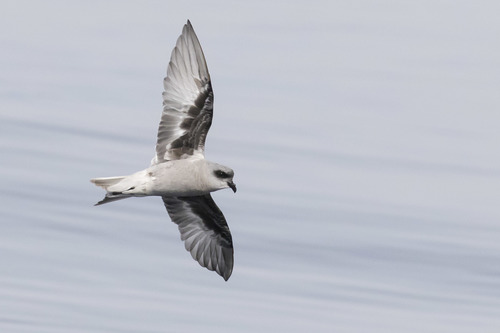
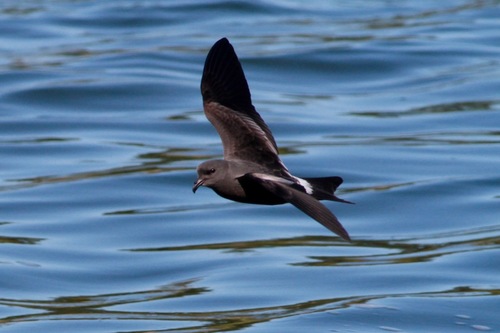
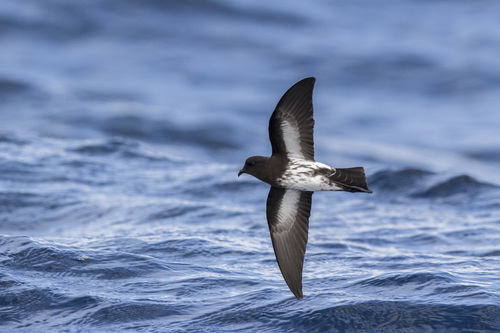
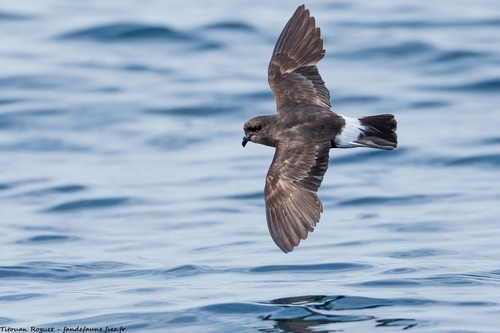
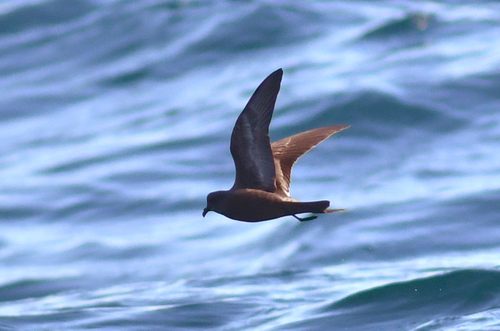
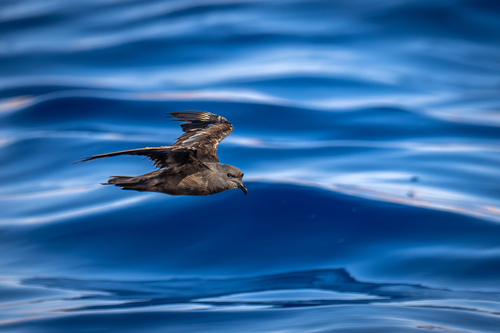
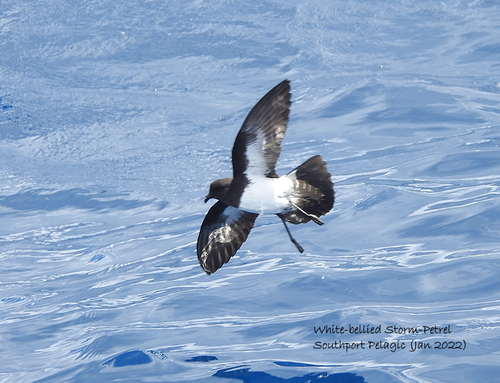
Fregetta grallaria, commonly called the white-bellied storm petrel, is characterized by specific color patterns, the form of its nasal tubes, tail shape, claw structure, and leg bone proportions. All species in the Fregetta genus have black plumage on their upper bodies, white plumage on their underbodies, and white upper tail coverts. Their nasal tubes are free at the tip, upturned, and half the length of the culmen; the front of the tarsus is booted, webbing is black, the basal joint of the middle toe is flattened, and claws are blunt and flattened. The white-bellied storm petrel is a small seabird, measuring around 18 to 20 centimetres (7.1–7.9 in) in length with a wingspan of 46–48 cm (18.1–18.9 in). It has a tubular nostril structure, a fine black bill, a square tail, and polymorphic plumage with black, grey, and white patterns. As its common name suggests, its upper body parts are dark and underparts are light colored, though many plumage variations are observed, including a largely dark variant. It has long legs; the specific epithet grallaria comes from the Latin word for stilts, and a key distinguishing feature is that its toes usually do not extend past the tip of the tail. No plumage variation has been observed between sexes, or between adult and juvenile individuals. The species is thought to be typically silent at sea, and vocal only when on land at nests. Its voice is described as "soft high-pitched twittering calls, such as pee-pee-pee-pee repeated up to 20 times."
This storm petrel has a widespread range across the Southern Hemisphere oceans, including the Pacific, Atlantic, and Indian Oceans, though little detailed information is available about its pelagic distribution. Sources disagree on whether it is nonmigratory or fully migratory, a discrepancy that likely reflects the limited understanding of this elusive seabird. It is thought to migrate some distance north, but its full sea movements remain unknown. Maximum dispersal distance has been estimated at several thousand kilometers.
Dietary components of the white-bellied storm petrel include small crustaceans, small squid, and sea skaters. It feeds by skimming across the water surface and dipping to catch prey near the surface. Both parents feed chicks with crustaceans and squid.