About Fregata minor (Gmelin, 1789)
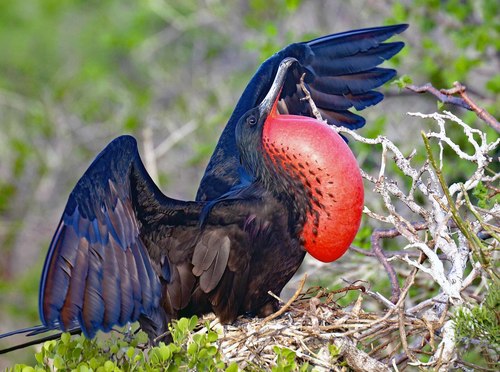
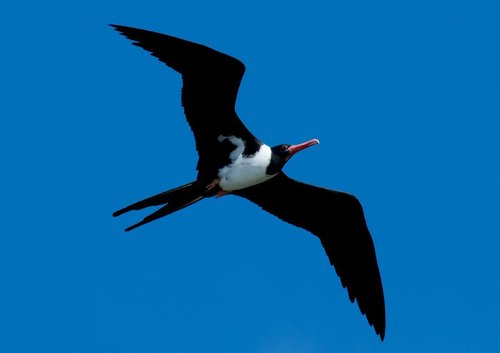
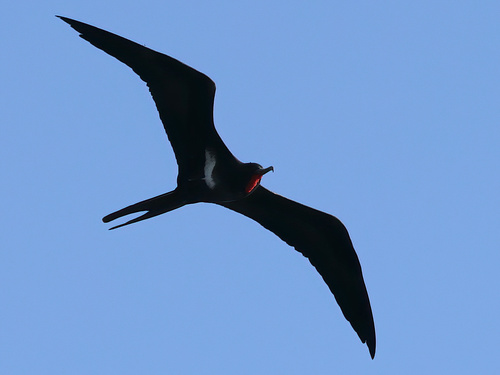
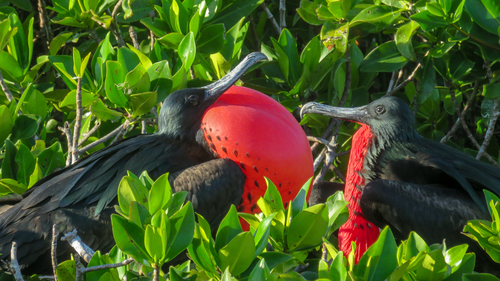
The great frigatebird (Fregata minor) measures 85 to 105 cm (33 to 41 in) in length, with a wingspan ranging from 205 to 230 cm (81 to 91 in). Males are smaller than females, and the degree of this size difference varies across different geographic regions. Males weigh between 1,000 and 1,450 g (2.20 to 3.20 lb), while heavier females weigh 1,215 to 1,590 g (2.679 to 3.505 lb). This species has long, narrow, pointed wings and a long, narrow, deeply forked tail. It has the highest ratio of wing area to body mass and the lowest wing loading of any bird. Researchers have hypothesized that this trait allows great frigatebirds to use marine thermals formed by small temperature differences between tropical air and water. Male great frigatebirds have entirely black plumage, with scapular feathers that show green iridescence when they refract sunlight. Females are black with a white throat and breast, and have a red eye ring. Juveniles are black with rust-tinged white coloring on their face, head, and throat. The great frigatebird has a broad distribution across all the world’s tropical oceans. In the Pacific Ocean, Hawaii marks the northern edge of its range, with roughly 10,000 breeding pairs nesting mostly in the Northwestern Hawaiian Islands. In the Central and South Pacific, colonies occur on most island groups from Wake Island to the Galápagos to New Caledonia, with a small number of pairs nesting on Australian-held territories in the Coral Sea. Colonies also exist on many islands in the Indian Ocean; the most well-known of these are the Seychelles islands of Aldabra and Aride, Christmas Island, the Maldives, and Mauritius. The Atlantic population is very small, and is limited to Ascension Island, St. Helena, and the Brazilian islands of Trindade and Martin Vaz. Great frigatebirds make regular migrations throughout their range, including both routine trips and more uncommon widespread dispersal. Great frigatebirds fitted with wing tags on Tern Island in the French Frigate Shoals were recorded regularly traveling to Johnston Atoll, 873 km away, and one individual was reported in Quezon City, the Philippines. One male great frigatebird moved 4400 km from Europa Island in the Mozambique Channel to the Maldives, where it stayed for four months feeding on rich fishing grounds. Even though they travel over very large areas, great frigatebirds show philopatry, returning to breed in their natal colony even after traveling to other areas.