About Fraxinus velutina Torr.
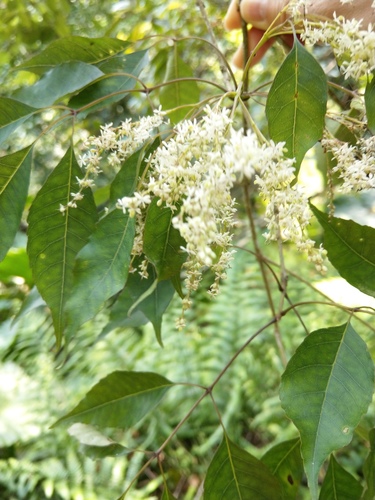
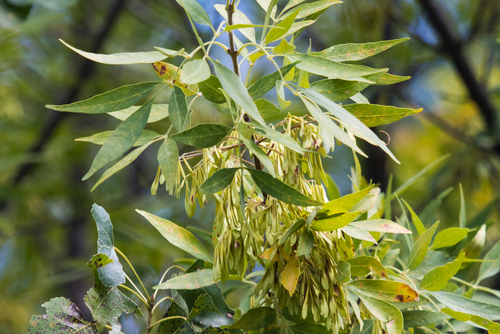
Fraxinus velutina Torr. is a small deciduous tree that reaches up to 10 m in height, with a trunk that can grow up to 30 cm in diameter. Its bark is rough, gray-brown, and fissured, while its new shoots are covered in velvety down. Its leaves are pinnately compound, 10–25 cm long, and typically made up of five or seven leaflets (occasionally three). Each leaflet is 4 cm or longer, with either an entire or finely serrated margin. It produces small clusters of flowers in early spring, and is dioecious: male and female flowers grow on separate individual trees. Its fruit is a samara 1.5–3 cm long, with an apical wing that measures 4–8 mm broad. Fraxinus velutina is closely related to Fraxinus latifolia (Oregon Ash) and Fraxinus pennsylvanica (Green Ash), and grows in areas south of the ranges of both these species. It intergrades with F. latifolia in central California, around Kern County, with no clear boundary between the two species. In Arizona, the center of Fraxinus velutina's range is the Mogollon Rim. Its distribution extends from the Grand Canyon feeder canyons of southern Utah and Nevada in the northwest, to the White Mountains of central-eastern Arizona, merging into the same mountainous area of western New Mexico, and continuing through the Rio Grande valley south into trans-Pecos Texas. In Arizona and northern Sonora, it also grows in the sky island mountain ranges known as the Madrean Sky Islands. It can be found from central-southern Arizona in the Sonoran Desert mountains, and extends through desert ranges south into northern Sonora and the far north of the Sierra Madre Occidental cordillera of Sonora and Chihuahua. Scattered populations occur eastward across the Chihuahuan Desert regions of Chihuahua, Coahuila, and Nuevo León. In California, Fraxinus velutina occurs in the southern Sierra Nevada, the Mojave and Colorado Deserts, and the California chaparral and woodlands ecoregion, with scattered populations extending into Baja California.