About Fraxinus latifolia Benth.
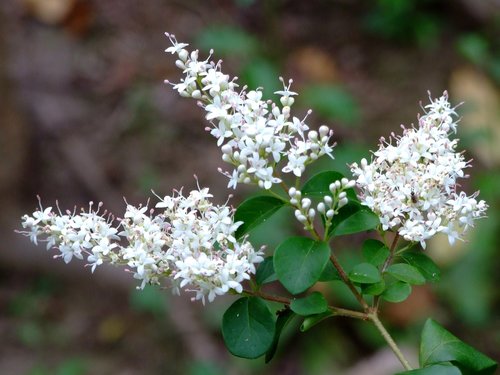
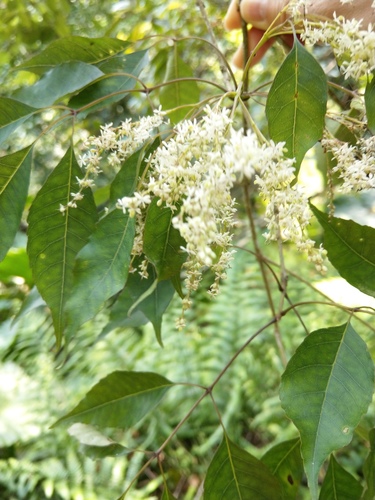
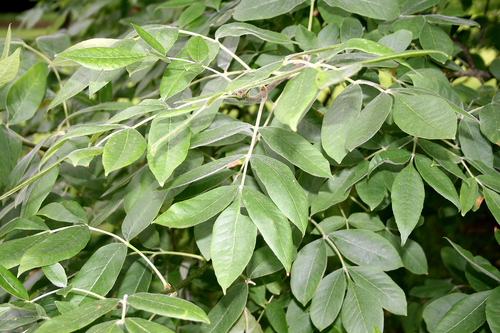
Fraxinus latifolia Benth., commonly known as Oregon ash, is a medium-sized deciduous tree. In its average 100–150-year lifespan, it reaches 20–25 metres (65–80 feet) in height, with a trunk diameter of 40–75 centimetres (16–30 inches). Specimens can grow considerably larger and live well over 200 years, or become stunted and very small in drier habitats. When growing in the open, it can develop a broad crown almost as wide as that of bigleaf maple (Acer macrophyllum). In denser tree stands, its crown remains narrow, similar to that of red alder (Alnus rubra). Its bark is a distinct dark gray-brown, and over time it develops a woven pattern of deep fissures and ridges. Its leaves are pinnately compound, 12–33 cm (4+3⁄4–13 in) long, with 5–9 leaflets attached in pairs to a linear stalk plus an additional leaflet at the tip. Each leaflet is ovate, 6–12 cm (2+1⁄4–4+3⁄4 in) long and 3–4 cm (1+1⁄8–1+5⁄8 in) broad. The leaves are noticeably lighter green than the leaves of associated broadleaf species, turn bright yellow, and fall off early in autumn. It is common for leaves and bark to show signs of disease and brown rot even on otherwise healthy plants. After autumn leaf drop and before new leaves emerge, Oregon ash can be identified by its stout twigs, opposite branching arrangement, and opposing buds. Unlike bigleaf maple twigs, Oregon ash twigs have woolly hairs. In mid to late spring, the tree produces small, inconspicuous flowers. It is dioecious, meaning pollination and successful reproduction requires separate male and female plants. Female trees produce clusters of samara fruits, 3–5 cm (1+1⁄8–2 in) long, with wings similar to those of maple trees. Each fruit is canoe-shaped, with the small seed located near one end.
Fraxinus latifolia is distributed on the west side of the Cascade Range from southwestern British Columbia, south through western Washington, western Oregon, and northwestern California; it also occurs in the Sierra Nevada in central California. Oregon ash grows mostly in wet habitats and prefers damp, loose soils in locations such as sloughs, swales, wet meadows, swamps, streams, and bottomlands. It grows from sea level to 900 m (3,000 ft) in elevation, and up to 1,700 m (5,600 ft) in the southern part of its range in California. In central Southern California, it intergrades with Fraxinus velutina (velvet ash), a species that ranges from southern California east into Arizona.
Oregon ash is shade-intolerant, and may eventually be replaced by more competitive trees such as bigleaf maples or conifers that block light with their foliage or size. This tree flourishes when its habitat is opened by floods, blowdowns, or other disturbances. Oregon ash sprouts vigorously from cut stumps or fire-killed trees. Young trees typically grow vigorously for their first 60 years, after which growth slows considerably. This ash species is well adapted to soggy ground, thanks to its moderately shallow, but extensive and wide-spreading root system. This root system also lets the tree withstand wind storms exceptionally well. Oregon ash tolerates flooding considerably better than Douglas-fir and grand fir. Its seeds provide food for songbirds, squirrels, and waterfowl, while deer and elk are known to graze its foliage and sprouts.
The wood of Oregon ash compares favorably to the valuable lumber of eastern ashes, but it is seldom used for commercial hardwood products due to its limited availability and restricted distribution. The Cowlitz Indian Tribe used its wood to make canoe paddles and digging sticks. Europeans, and later European Americans, have long preferred similar ash species for uses such as tool handles and sports equipment. Oregon ash wood is light-colored, somewhat lustrous, hard, strong, stiff, high in shock resistance, flexible, workable with machine tools, and wears smooth with use. Commercial use of Oregon ash has been limited because eastern ashes are far more abundant. Young, fast-growing ash wood is more elastic and better suited for handles and baseball bats, due to its wider growth rings. Old ash tree wood is generally valued for firewood because of its fine grain and brittleness. Oregon ash is commonly grown as an ornamental or shade tree within and beyond its native Pacific Northwest range, thanks to its rapid growth rate, symmetrical shape, and hardiness. It is also used for wind breaks and for riparian restoration, due to its wide root system and quick growth. Thomas Nuttall recorded that stories persisted in 19th-century Oregon that rattlesnakes would avoid sticks made from this tree; a similar historical claim was originally reported by Pliny the Elder.