About Fratercula cirrhata (Pallas, 1769)
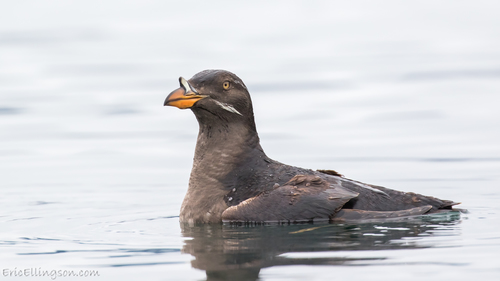
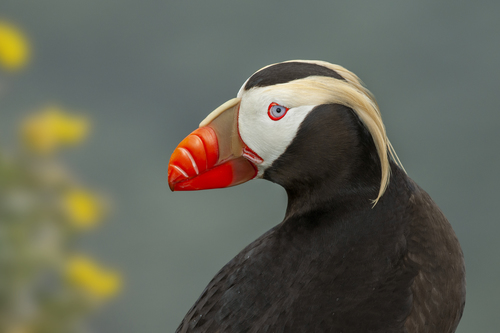
Tufted puffins, scientifically named Fratercula cirrhata, are the largest puffin species. Adults are around 35 centimeters (14 inches) long, with a similar wingspan, and weigh roughly three-quarters of a kilogram (1.6 pounds). Individuals from the western Pacific population are somewhat larger than those from the eastern Pacific, and males tend to be slightly larger than females. Their plumage is mostly black, with a white facial patch. Like other puffin species, they have a very thick bill, which is primarily red with some yellow and occasional green markings. Their most distinctive feature, which gives them their name, is the yellow tufts, called cirri in Latin, that grow annually on both sexes as the summer reproductive season approaches. In the summer, their feet turn bright red and their face becomes bright white. During the feeding season, the tufts molt off, and their plumage, beak, and legs lose much of their bright color. Like other alcids, tufted puffins have relatively short wings adapted for diving, underwater swimming, and catching prey, and they cannot glide. This adaptation gives them thick, dark, myoglobin-rich breast muscles that support a fast, aerobically strenuous wing-beat rhythm, which they can maintain for long periods of time. Juvenile tufted puffins look similar to winter adults, but have a grey-brown breast that shades to white on the belly, and a shallow, yellowish-brown bill. Overall, they resemble a horn-less, unmarked rhinoceros auklet (Cerorhinca monocerata). During the summer reproductive season, tufted puffins form dense breeding colonies across a range stretching from Washington state and British Columbia, through southeastern Alaska and the Aleutian Islands, to Kamchatka, the Kuril Islands, and the entire Sea of Okhotsk. While they share some habitat with horned puffins (F. corniculata), the tufted puffin's range is generally more eastern. Small numbers have been recorded nesting as far south as the northern Channel Islands, off the coast of southern California, but the last confirmed sighting at the Channel Islands was in 1997. Tufted puffins usually choose to breed on islands or cliffs that are relatively inaccessible to predators, close to productive waters, and tall enough that they can take off successfully. Ideal breeding habitat is steep, with relatively soft soil and grass for digging burrows. During the winter feeding season, they spend almost all of their time at sea, and their range extends across the entire North Pacific, reaching as far south as Japan and California.