About Fratercula arctica (Linnaeus, 1758)
The Atlantic puffin (Fratercula arctica) is sturdily built, with a thick-set neck, short wings and a short tail. It measures 28 to 30 cm (11 to 12 in) from the tip of its stout bill to its blunt-ended tail, has a wingspan of 47 to 63 cm (19 to 25 in), and stands about 20 cm (8 in) high on land. Males are generally slightly larger than females, but the two sexes have identical coloration.
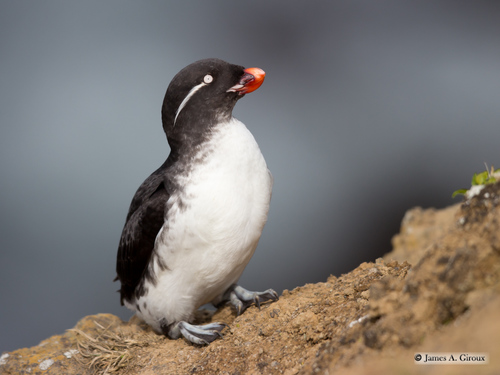
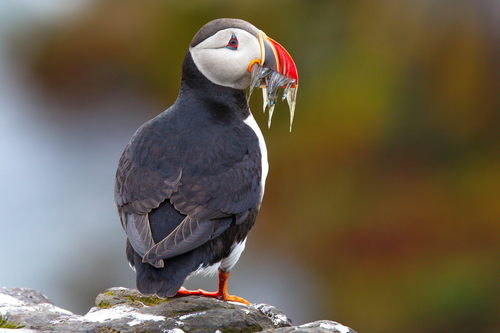
The bird's forehead, crown, nape, back, wings and tail are glossy black, with a broad black collar wrapping around the neck and throat. Each side of the head has a large, lozenge-shaped area of very pale grey; these face patches taper to a point and nearly meet at the back of the neck. The shape of the head creates a crease stretching from the eye to the hindmost point of each patch, which looks like a grey streak. The eyes appear almost triangular, because there is a small, peaked area of horny blue-grey skin above each eye, and a rectangular patch below. The irises are brown or very dark blue, and each eye has a red orbital ring. The bird's underparts including the breast, belly and under tail coverts are white. By the end of the breeding season, the black plumage may lose its shine or even develop a slight brown tinge.
The legs are short and set well back on the body, which gives the bird an upright stance when on land. Both the legs and large webbed feet are bright orange, contrasting with the sharp, black claws. The beak is very distinctive: from the side it is broad and triangular, but it is narrow when viewed from above. The half closest to the tip is orange-red, and the half closest to the head is slate grey. A yellow, chevron-shaped ridge separates the two sections, with a yellow, fleshy strip at the base of the bill. There is a yellow, wrinkled rosette at the joint of the two mandibles.
The exact proportions of the beak change with the bird's age. For immature individuals, the beak has reached its full length but is not as broad as that of an adult. As the bird ages, the bill deepens, the upper edge curves, and a kink develops at its base; one or more grooves may also form on the red portion. The bird has a powerful bite.
The characteristic bright orange bill plates and other distinct facial features develop in spring. At the end of the breeding season, these special coatings and appendages are shed in a partial moult. This makes the beak look less broad, the tip less bright, and the base darker grey. The eye ornaments are shed, and the eyes appear round. At the same time, the feathers of the head and neck are replaced, and the face becomes darker. This winter plumage is rarely seen by humans, because after puffins leave their chicks, they go out to sea and do not return to land until the next breeding season.
Juvenile birds have similar plumage to adults, but all their coloration is duller; they have a much darker grey face, yellowish-brown beak tip and yellowish-brown legs. After fledging, juveniles go to the water, head out to sea, and do not return to land for several years. During this time, each year the bill becomes broader, the face patches become paler, and the legs and beak become brighter.
The Atlantic puffin has a direct flight, typically flying 10 m (35 ft) above the sea surface, and flies higher over the water than most other auks. It mostly moves by paddling efficiently with its webbed feet, and seldom takes to the air. It is usually silent at sea, except for the soft purring sounds it sometimes makes while flying. At breeding colonies, it is quiet above ground, but makes a growling sound somewhat similar to a revving chainsaw inside its burrow.
The Atlantic puffin inhabits the colder waters of the North Atlantic Ocean. It breeds on the coasts of northwest Europe, the Arctic fringes, and eastern North America. More than 90% of the global population lives in Europe, corresponding to 4,770,000–5,780,000 breeding pairs, or 9,550,000–11,600,000 adult individuals; colonies in Iceland alone host 60% of the world's Atlantic puffins. The largest colony in the western Atlantic, estimated to hold more than 260,000 breeding pairs, is located at the Witless Bay Ecological Reserve, south of St. John's, Newfoundland and Labrador. Other major breeding locations include the north and west coasts of Norway, the Faroe Islands, Shetland and Orkney, the west coast of Greenland, and the coasts of Newfoundland. Smaller colonies are also found across other parts of the British Isles, the Murmansk area of Russia, Novaya Zemlya, Spitzbergen, Labrador, Nova Scotia, and Maine. Islands are particularly attractive to breeding puffins compared to mainland sites, likely because they help the birds avoid predators.
When at sea, the species ranges widely across the North Atlantic Ocean including the North Sea, and may enter the Arctic Circle. In summer, its southern range extends from northern France to Maine; in winter, it may range as far south as the Mediterranean Sea and North Carolina. The total extent of its oceanic range is 15×10^6–30×10^6 km2 (6×10^6–12×10^6 sq mi), meaning each bird has more than 1 km2 of area it can use, so the species is seldom seen out at sea. Researchers have attached light-level geolocators to the legs of puffins in Maine to track their whereabouts; accessing the stored information requires recapturing the birds, which is difficult. One tracked bird was found to have traveled 7,700 km (4,800 mi) across the ocean in 8 months, traveling north to the northern Labrador Sea then southeast to the mid-Atlantic before returning to land.
As a long-living species with a small clutch size, adult survival rate is an important factor influencing the overall success of the Atlantic puffin. Only 5% of ringed puffins that failed to return to the colony were lost during the breeding season; all other losses happened between the birds departed land in summer and reappeared the following spring. The birds spend winter widely spread across the open ocean, though individuals from different colonies tend to overwinter in different areas. Little is known about their behaviour and diet at sea, and no correlation was found between environmental factors such as temperature variations and their mortality rate. A combination of food availability in both winter and summer likely influences puffin survival, because individuals that start winter in poor condition are less likely to survive than those in good condition.
After spending the winter alone on the ocean, it is unclear whether Atlantic puffins meet their previous partner offshore, or only encounter each other when they return to the previous year's nest. Once on land, they quickly begin clearing and improving their burrow. Often, one bird stands outside the entrance while the other excavates, kicking out soil and grit that falls onto the waiting partner outside. Some birds collect stems and fragments of dry grasses as nesting material, while others do not. Sometimes a beakful of material is taken underground, only to be brought back out and discarded. Apart from nest-building, the pair restores their bond through billing: the two approach each other, each wagging their head from side to side, then rattle their beaks together. This appears to be an important part of courtship behaviour, as it happens repeatedly, and pairs continue to bill to a lesser extent throughout the breeding season.
Atlantic puffins reach sexual maturity at 4–5 years old. They are colonial nesters that excavate burrows on grassy clifftops or reuse existing holes, and may occasionally nest in crevices among rocks and scree, competing with other birds and animals for burrow space. They can excavate their own hole or move into a pre-existing burrow dug by a rabbit, and have been observed pecking and driving off the original occupant. Manx shearwaters also nest underground and often live in their own burrows alongside puffins; their burrowing activities may break through into the puffin's living space, resulting in the loss of the puffin's egg. Atlantic puffins are monogamous, mating for life, and both parents provide care for their young. Males spend more time guarding and maintaining the nest, while females are more involved in incubating the egg and feeding the chick.
Egg-laying begins in April in more southerly colonies, but seldom starts before June in Greenland. Females lay a single white egg each year; if the egg is lost early in the breeding season, the female may lay a replacement. Atlantic puffins in adjacent burrows lay eggs synchronously. The egg is large relative to the bird's size, averaging 61 mm (2+3⁄8 in) long by 42 mm (1+5⁄8 in) wide, and weighing about 62 g (2+3⁄16 oz). The white shell is usually unmarked, but soon becomes covered in mud. Both parents share incubation responsibilities. Each parent has two feather-free brood patches on their underside, where increased blood flow provides heat for the egg. The parent on incubation duty in the dark nest chamber spends most of its time asleep with its head tucked under its wing, and occasionally emerges from the tunnel to flap dust out of its feathers or take a short flight down to the sea. Total incubation time is around 39–45 days.
From above ground, the first sign of hatching is an adult arriving with a beak full of fish. For the first few days, the chick may be fed beak-to-beak, but later adults simply drop the fish on the nest floor next to the chick, which swallows them whole. The chick is covered in fluffy black down, its eyes are open, and it can stand immediately after hatching. It weighs about 42 g (1+1⁄2 oz) when it hatches, and grows at a rate of 10 g (3⁄8 oz) per day. One parent broods the chick at first, but as the chick's appetite increases, it is left alone for longer periods. Researchers have observed nest chambers from underground hides with peepholes: the chick sleeps most of the time between parent visits, and also has periods of activity and exercise. It rearranges its nesting material, picks up and drops small stones, flaps its immature wings, pulls at protruding root ends, and pushes against the unyielding burrow wall. It moves toward the entrance or along a side tunnel to defecate. Growing chicks seem to anticipate the arrival of an adult, moving along the burrow just before the adult arrives, but do not emerge into open air. They retreat back to the nest chamber when the adult brings fish.
Puffin hunting areas are often 100 km (62 mi) or further offshore from the nest sites, though adults only travel half that distance when feeding their young. Adults bringing fish to chicks tend to arrive in groups. This is thought to reduce kleptoparasitism by Arctic skuas, which harass puffins until they drop their fish, and also reduces predation by great skuas when multiple birds arrive at the same time.
In the Shetland Islands, sand eels normally make up at least 90% of the food fed to chicks. In years when sand eel availability is low, breeding success falls and many chicks starve to death. In Norway, herring is the main part of the puffin diet; when herring numbers decrease, puffin numbers also decrease. In Labrador, puffins are more flexible: when the staple forage fish capelin becomes less available, they can adapt and feed chicks other prey.
Chicks take 34 to 50 days to fledge, with the length of the period depending on food abundance. In years of fish shortage, the entire colony may have a longer fledging period, but the normal range is 38 to 44 days, by which time chicks have reached about 75% of their mature body weight. Chicks may come to the burrow entrance to defecate, but do not usually emerge into the open and appear to avoid light until they are nearly fully fledged. Although adult fish supply reduces over the last few days the chick spends in the nest, the chick is not abandoned, unlike what happens with Manx shearwaters. Occasionally, adults have been observed bringing food to a nest even after the chick has left. During the last few days underground, the chick sheds its down and reveals juvenile plumage. Juveniles have a relatively small beak, and dark legs and feet, and lack the white facial patches of adults. The chick finally leaves its nest at night, when predation risk is lowest. When it leaves, it emerges from the burrow, usually for the first time, and walks, runs, and flaps its way to the sea. It cannot fly properly yet, so descending a cliff is dangerous. When it reaches the water, it paddles out to sea, and may be 3 km (1.9 mi) from shore by daybreak. Juveniles do not gather with other puffins and do not return to land for 2–3 years.
The Atlantic puffin's diet consists almost entirely of fish, though stomach content analysis shows it occasionally eats shrimp, other crustaceans, molluscs, and polychaete worms, especially in more coastal waters. When fishing, it swims underwater, using its semi-extended wings as paddles to 'fly' through the water and its feet as a rudder. It swims fast, can reach considerable depths, and can stay submerged for up to one minute. It can eat shallow-bodied fish as long as 18 cm (7 in), but its prey is commonly smaller fish around 7 cm (3 in) long. An adult puffin needs to eat an estimated 40 of these small fish per day; sand eels, herring, capelin, and sprats are the most commonly consumed. Puffins fish by sight, and can swallow small fish while submerged, but bring larger fish to the surface to eat. They can catch several small fish in one dive, holding the first caught fish in place in their beak with their muscular, grooved tongue while catching more. The two mandibles are hinged so they can be held parallel to hold a row of fish in place, and inward-facing serrations on the edges of the beak also help retain the catch. Puffins get rid of excess salt they swallow partly through their kidneys and partly through excretion from specialised salt glands in their nostrils.