About Frasera speciosa Douglas ex Hook.
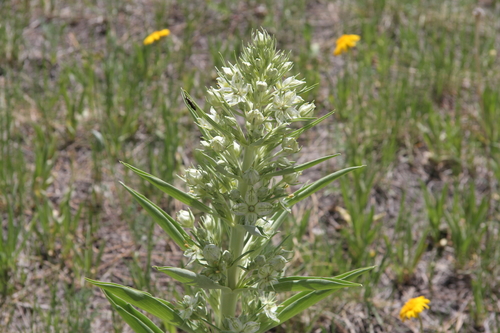
Frasera speciosa Douglas ex Hook. is a very large monocarpic plant, meaning it flowers just once before dying, but it can live for many years before it produces flowers. Non-flowering plants form a low basal cluster of strap-shaped leaves on short stalks. While less noticeable than the tall flowering stalk, this growth stage has a unique appearance and size within the species’ native range. The basal leaves are green with a glaucous waxy coating, and measure 7 to 50 centimeters long by 1 to 15 centimeters wide. They range in shape from spatulate (spoon-shaped with a narrower base) to oblanceolate (much longer than wide, with the widest portion near the tip), and can have either a pointed or rounded tip. This species has large, dark, fleshy roots that store starch to support blooming. The top of the root is a fleshy structure that may branch, allowing a single plant to produce multiple rosettes. Flowering typically occurs when a plant developed between 25 and 36 leaves in the previous growing season, but flowering may happen in plants with 12 or more leaves. Mature plants produce one large, thick, unbranched flowering stem. The flowering stem bears cauline (stem) leaves that are largest at the base and decrease in size toward the top of the stem. Stem leaves and flowers are arranged in 3 to 6 separate whorls, with sections of bare stem between each whorl. At maturity, the flowering stem grows between 0.5 meters and 2 meters tall. Flowering is synchronized among all local plants in an area, leading to widespread, picturesque periodic blooming events. Frasera speciosa grows across the western United States and extends into northern Mexico. In the Pacific Coast states, it grows in the mountains of California and Oregon, and also occurs in Yakima County, Washington. In interior western states, it is found across most of Arizona, Nevada, and Utah. In the Rocky Mountains, it grows across most of Idaho, western Montana, almost all of Wyoming, all of Colorado, and mostly the northern parts of New Mexico; in southern New Mexico, it is only found in Grant County. It also grows in three counties of South Dakota’s Black Hills. In Texas, the only recorded location for this species is Culberson County, in the far west of the state. In Mexico, it grows in four states: Coahuila, Nuevo León, Sonora, and Tamaulipas. Frasera speciosa was previously thought to be a biennial plant, but it actually lives for many years before flowering. Although seedling mortality is very high, the average overall lifespan of established plants is 6.8 years. One population of this species in Colorado has been observed over 35 years, and some individuals in this population had still not flowered by the end of the observation period. From this observation, the average age of flowering individuals is estimated at 40 years, and some individual plants are thought to live more than 80 years. Plants use an unknown mechanism to synchronize their blooming; this adaptation helps attract more pollinators and reduces the species’ impact as a food resource for herbivores. Plants usually produce a fixed number of basal leaves, with recorded counts of 2, 4, 6, 9, 12, 16, 20, 25, 30, 36, 42, 49, 56, 64, 72, 80, or 90 leaves. Leaf counts above 56 are only found at lower altitudes. Older plants do not always grow more leaves, and occasionally have fewer leaves than they did in a previous growing season. New leaves begin developing underground two to three years before they emerge above ground. Seeds are usually deposited no farther than two meters from the parent plant. Decomposing debris from previous generations of plants creates a favorable environment for seed germination. Field observations show that twice as many seeds survive their first year of growth growing in debris from previous generations than in areas of bare soil. The leaves of young plants are eaten by elk and cattle. Bumblebee species including Bombus centralis, Bombus rufocinctus, Bombus bifarius, and Bombus sylvicola visit F. speciosa flowers to collect nectar. The shape of the flowers guides these bees to make contact with the plant’s reproductive parts, so bumblebees are the primary pollinators of this species. Bees of the genus Megachile and the species Anthophora terminalis also visit the flowers, but these bees were observed collecting pollen rather than nectar. Other frequent flower visitors include moths, the fly Dilophus caurinus, the plasterer bee Colletes kincaidii, the mining bee Andrena thaspii, the orange-legged furrow bee Halictus rubicundus, and Lasioglossum hemimelas.