About Frasera caroliniensis Walter
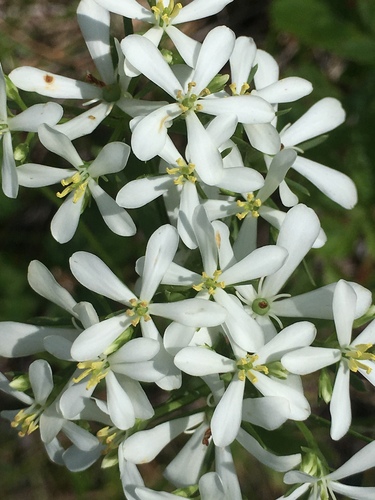
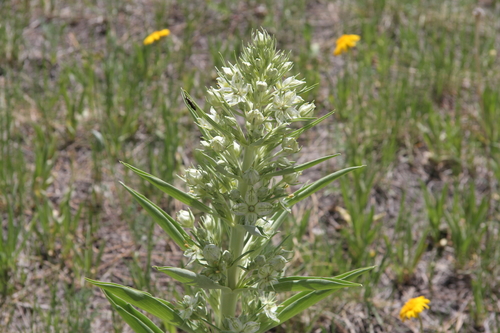
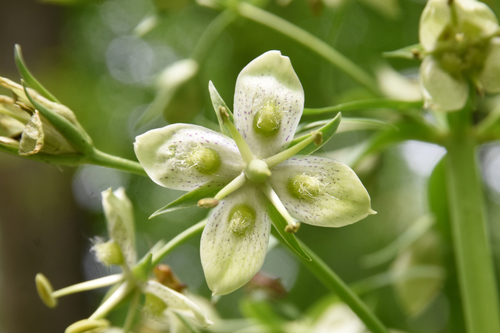
American columbo, Frasera caroliniensis Walter, is a monocarpic perennial plant: it flowers once after multiple growing seasons, then dies. It can live up to 30 years before flowering, and reach total heights over 2 metres (7 ft). When it reaches the flowering stage, it produces an elongated round stem that bears 3–6 inch lanceolate leaves, usually arranged in whorls of four. These leaves are petiolate (carried on stalks) and have a thick, waxy texture. The plant forms a panicle holding approximately 50 to 100 flowers, after which fruits mature quickly. Each flower is about 1 inch in diameter, grows in a tall, spike-like folious arrangement, and is green to yellow with purple speckles. Flowers are perfect and complete, with four stamens and two carpels, and flowering plants have large nectaries that support pollination. The oblong brown seed capsule is roughly 1/2 inch long. This species has a thick, fleshy taproot root system; in some related Frasera species, this taproot may be modified into a branched rhizome. American columbo grows in dry upland areas, rocky woods, and calcareous soils, though it is not limited by soil texture or other soil characteristics. Its natural range extends from deciduous forest regions in southern Ontario, through southern Michigan, northern Indiana, southern Illinois, southern Missouri, southeast Oklahoma, southwestern Arkansas, to northern Louisiana. A number of plant species are associated with F. caroliniensis: associated trees include sweet-gum (Liquidambar styraciflua), tulip tree (Liriodendron tulipifera), and pignut hickory (Carya glabra). Associated vines and understory trees include eastern redbud (Cercis canadensis), strawberry bush (Euonymus americanus), Japanese honeysuckle (Lonicera japonica), Virginia creeper (Parthenocissus quinquefolia), and poison ivy (Toxicodendron radicans). Associated herbs include prostrate ticktrefoil (Desmodium rotundifolium), Christmas fern (Polystichum acrostichoides), and ebony spleenwort (Asplenium platyneuron). The tree canopy from associated species is important for the plant's survival, but overly dense canopy reduces its flowering performance.