About Franklinia alatamaha W.Bartram ex Marshall
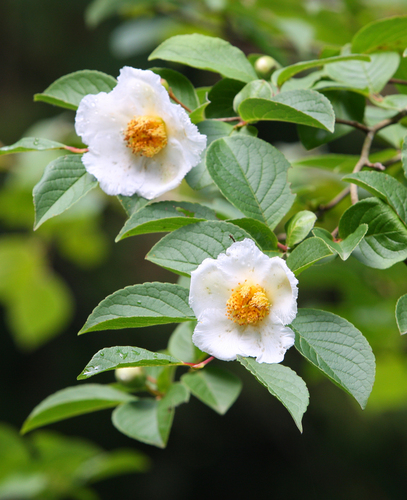
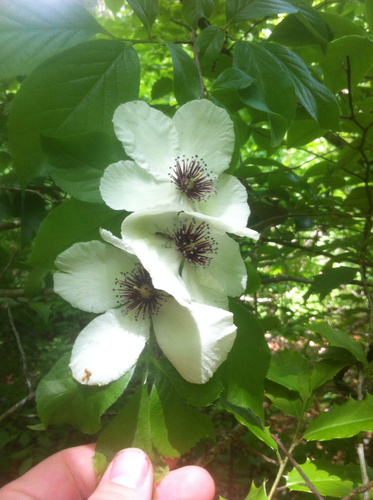
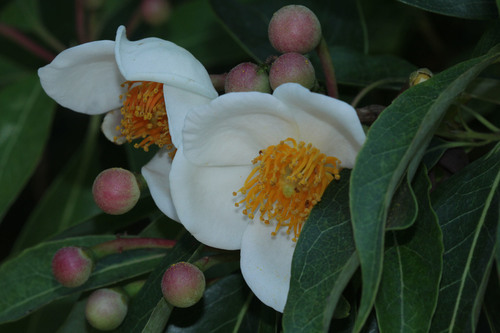
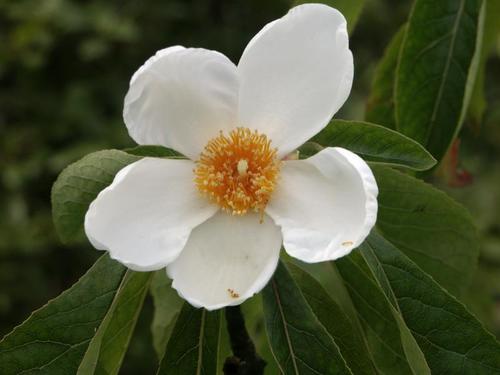
Franklinia alatamaha is a small deciduous tree or large shrub that grows 3 to 10 meters (10 to 33 ft) tall, most commonly between 5 and 7 m (16–23 ft). It has a symmetrical, somewhat rounded growth habit, frequently produces suckers, and can develop between one and five trunks. Its bark is gray with vertical white striations and a ridged texture. Due to its fibrous root system, Franklinia alatamaha is difficult to transplant, but once established, it can live for a century or longer. Leaves are arranged alternately along twigs and clustered toward the ends of the twigs. They are typically 12–18 centimeters (5–7 in) long, and may occasionally reach up to 25 cm (10 in) in length. Leaf width ranges from 5–9.5 cm (2–4 in), and is usually less than 7 cm. Leaves are attached via leaf stems that normally blend into the leaf blade, because they have 1 cm wide wings. Leaf shape varies from obovate to obtrullate: obovate is shaped like a teardrop with the narrowest part at the base, while obtrullate is shaped like a classic mason's trowel reversed, also with the narrowest part at the base. Leaf texture is chartaceous, meaning it resembles paper or parchment, with an elevated midrib and prominent veins. Foliage is bright green in summer, and turns orange or red in fall. The flowers are fairly large and striking, measuring 7–10 cm (3–4 in) across with a somewhat cup shape. They grow singly, and each flower has five creamy-white petals surrounding golden-yellow stamens. The plant's seed capsules take 12 to 14 months to mature. Unlike almost all angiosperms, Franklinia alatamaha exhibits zygotic dormancy. It pollinates in late summer or early autumn, becomes dormant over winter, and only sets fruit during the following summer. Female gametophytes are mature before pollination, and double fertilization occurs soon after pollination. The zygote becomes dormant immediately after fertilization, and development is delayed until the next summer. Initial endosperm development occurs for up to three months after fertilization, but stops at the start of winter. When the next summer begins, embryogenesis begins and endosperm development restarts. This overwinter zygotic dormancy is extremely rare among temperate angiosperms. In cultivation, Franklinia is valued as a desirable understory plant for its large, Camellia-like flowers and bright fall color. To produce a good display of fall color and flowers, it requires a planting site in full sun. The Franklin tree has a reputation among gardeners for being difficult to cultivate, especially in urban environments. It prefers sandy, high-acid soil, and does not tolerate compacted clay soil, excessive moisture, or any disturbance to its roots. Franklin alatamaha has no known pests, but it is susceptible to root-rot and crown-rot caused by Phytophthora cinnamomi, and does not tolerate drought well. It is commercially available for garden cultivation. It is one of two species of tree in the tea family that only exists in cultivation; the other is Camellia amplexicaulis.