About Frankenia pauciflora DC.
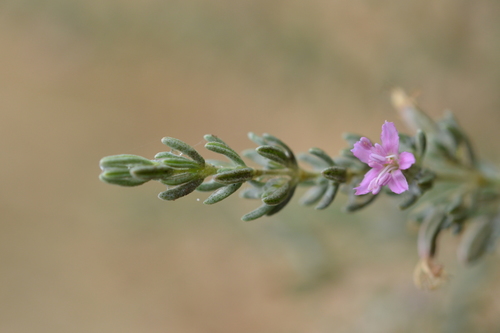
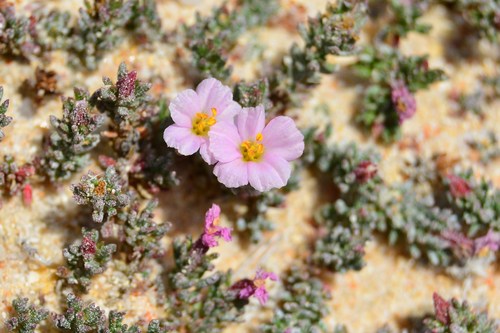
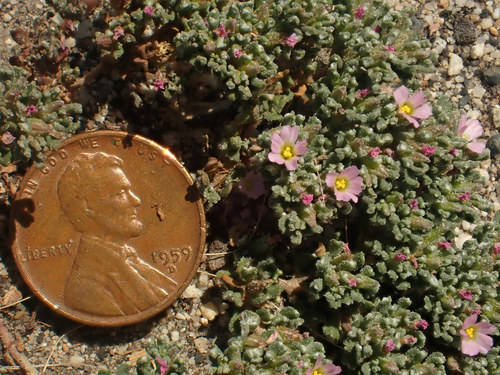
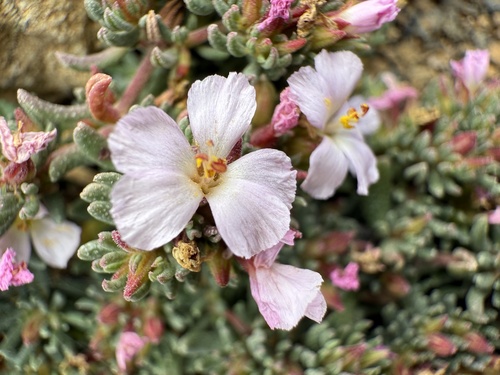
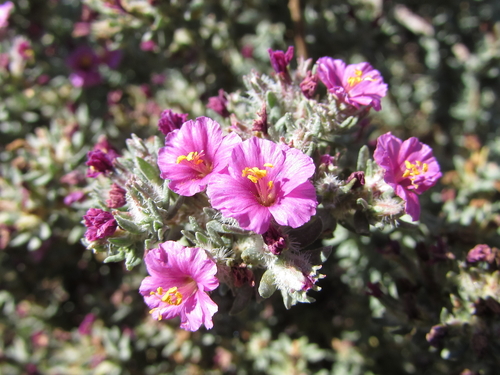
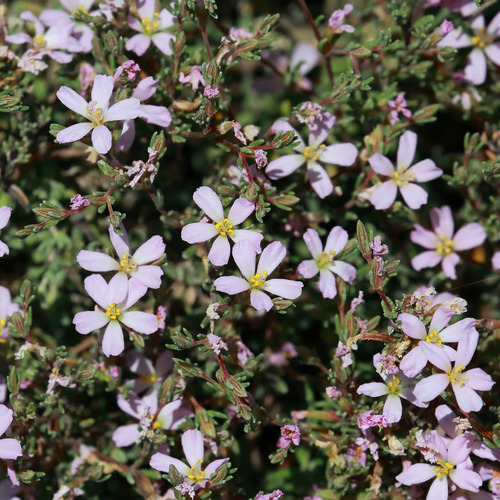
Frankenia pauciflora DC. is a prostrate perennial shrub that reaches up to 0.5 meters in height. Individuals of this species produce many branches that form a thick, mat-like structure. Its leaves are fleshy, linear, grey-green, grow up to 2 centimeters long, and are somewhat similar in appearance to thyme. Leaves of this species can range from hairless to densely hairy.
This species is a halophyte, meaning it is salt-tolerant, and it grows in sandy soils, salt flats, salt marshes, and coastal limestones. It grows in moderately to highly saline soils of classes S2 and S3. It is also a xerophyte, or drought-tolerant plant, and can survive in environments with long, predictable dry periods followed by moist soil conditions. It tolerates a wide range of soil pH, from acidic to alkaline. It grows well in conditions ranging from hot overhead sun to warm low sun, and it is shade tolerant.
Frankenia pauciflora is distributed across Western Australia, South Australia, Victoria, and Tasmania. In Tasmania, the species is represented by the variety F. pauciflora var. gunnii, which only grows on Flinders Island, Short Island, and Harcus Island. The species as a whole is generally not considered threatened, but F. p. var. gunnii is considered rare, as it has only a small population in Tasmania that may face greater risk. Var. fruticulosa occurs primarily in South Australia; var. longifolia occurs in Western Australia and South Australia; and var. pauciflora occurs only in Western Australia.
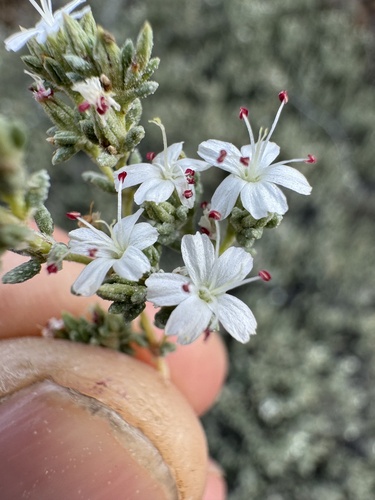
This species does not have a fixed flowering time. It flowers throughout the year, with peak flowering occurring between June and February, and it can produce seeds at any time of year. Its flowers are insect-pollinated, and produce dicotyledon seeds. Specifically, the flowers of F. p. var. gunnii are pollinated by insects belonging to the orders Diptera, Hymenoptera, and Lepidoptera. Both observational and controlled studies have found that xenogamy (outcrossing) produces more fruits per flower and more seeds per fruit than autogamy (self-pollination) in this species.
This plant is relatively easy to grow and can adapt to a wide range of soils, making it a popular choice for home gardening. It has flame-retardant properties, so when planted around homes in fire-prone areas of Australia, it reduces the risk of bushfire spread. It provides shelter for many types of wildlife, and acts as a food source for a number of insects. Its thick network of fine roots also helps stabilize sediments and floodplains.