About Francolinus francolinus (Linnaeus, 1766)
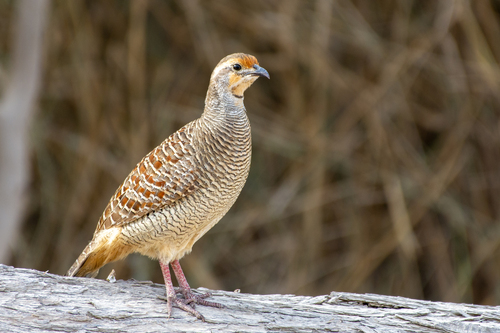
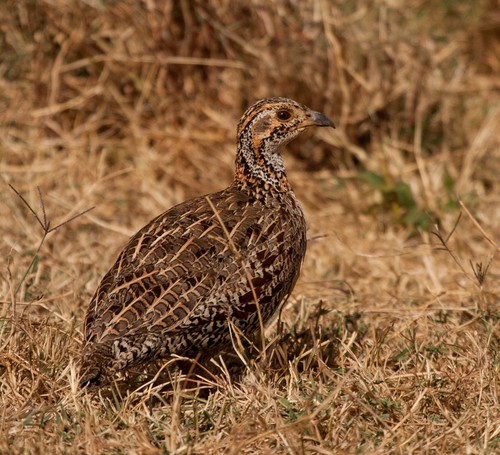
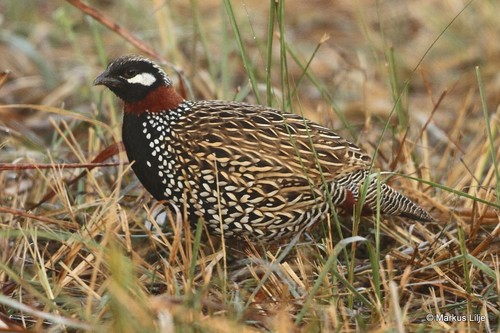
The black francolin, Francolinus francolinus, measures 33 to 36 cm (13 to 14 in) long and weighs roughly 453 g (16.0 oz). Males are primarily black, with a white cheek patch, a chestnut collar, and white spotting on the flanks. Their back and wings have a scalloped pattern of golden brown shades, paired with sub-terminal tawny-buff bands and pale edges. Their rounded black tail bears narrow white or greyish bars, and their neck and legs range from reddish-brown to red. The extent of white flank spotting varies significantly across the species’ range, and female color depth also varies by location. Females are mainly brown, with a chestnut hind neck. They have a curved head shape, brown irises, a brown crown, and a black throat. Their upper plumage, wings, and tail follow the same general pattern as males, but black is replaced by mottled brown, and the brown bars on the lower back and tail are wider. Females have duller overall plumage, lack the male’s cheek patch, and have a nuchal patch in place of the male’s chestnut collar. Where males have black on the head and underparts, females have buff coloring, and their rump and upper tail coverts are light brown. Compared to the similar grey francolin, the black francolin differs in that the grey francolin has a grey-brown and buff body, a buff throat instead of black, and lacks the black francolin’s rufous collar. Black francolins are resident breeders, ranging from southeastern Turkey eastward through Iran to southwest Turkmenistan, northeast India, and Kazipara, Panchagarh in Bangladesh. The species historically had a much larger range, but over-hunting has reduced both its distribution and population size, and fragmented populations are now found across the western portion of its native range. This species was introduced to Calcasieu and Cameron parishes in southwestern Louisiana in 1961, with additional introductions to south Florida. It has also been introduced to Guam and the Hawaiian Islands elsewhere. Black francolins occupy scrubby habitats that support plenty of tall cultivated crops to provide shelter, with open space under the vegetation for escape routes and easy movement. They prefer areas with thick vegetation, and are typically found close to water. They are not forest-dwelling birds, but do regularly use scrubland and forest edges connected to grassland. They are more closely associated with water than chukars, even when occupying drier areas.